
Crawl Space Encapsulation Cost Calculator
Use this free crawl space encapsulation cost calculator to estimate your total project cost based on vapor barrier grade, dehumidifier, and insulation. Whether you’re planning basic moisture sealing or a full system with dehumidification and insulation, simply select your options to get an instant cost range.
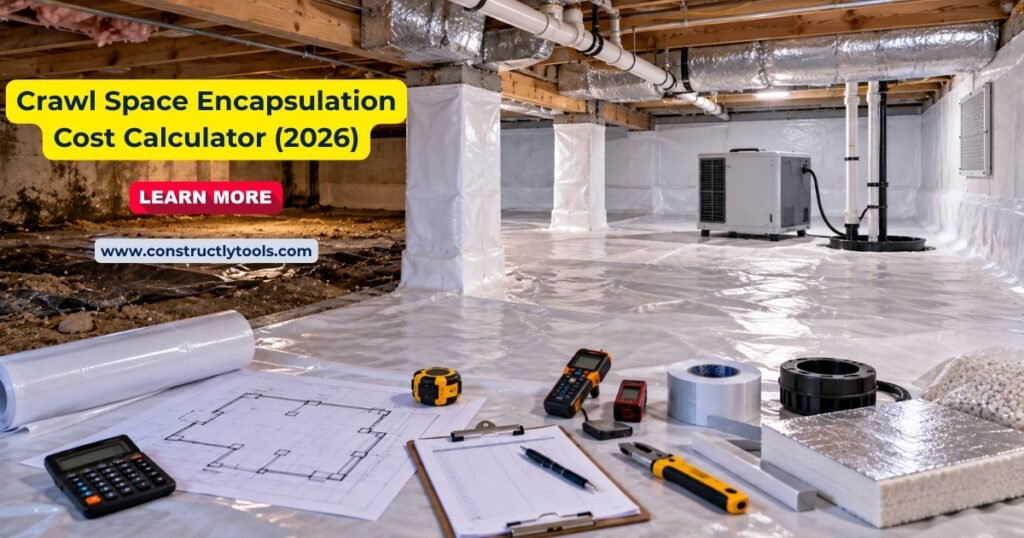
Never encapsulate over active mold — it must be remediated first · A dehumidifier is genuinely necessary in humid climates, not an optional upsell · Labor is 50–70% of total cost, materials the remaining 30–50%
Estimates based on 2026 US average pricing from Angi, HomeGuide, and Palm Build. Actual costs vary by region, crawl space condition, and access. Always get 3 quotes.
Understanding the Calculator Inputs
Crawl space encapsulation cost is driven mainly by three additive decisions: vapor barrier grade, whether to add a dehumidifier, and whether to add insulation — each one a real, separate cost rather than a single bundled "encapsulation" price.
Vapor Barrier Grade
A proper encapsulation system uses a heavy-duty polyethylene barrier, typically 12 to 20 mil thick, sealing the crawl space floor and walls. Thinner 6-mil barriers exist but are considered basic sealing rather than true encapsulation — 12-mil is the standard recommendation for most residential projects, with 20-mil offering more durability for harsher conditions.
Dehumidifier
In humid climates, a vapor barrier alone doesn't fully solve the moisture problem — condensation and minor leaks can still raise humidity inside a sealed space. A dedicated crawl space dehumidifier is the most effective ongoing moisture management tool and is genuinely necessary, not an optional upsell, in most humid US regions.
Insulation
Adding wall and floor insulation improves energy efficiency and comfort in the space above, at a meaningful cost premium over barrier-and-sealing alone. This is worth considering alongside your broader home insulation plans — see our Insulation Cost Calculator if you're evaluating insulation upgrades more broadly.
Active mold must be remediated before any vapor barrier is installed. Encapsulating over existing mold traps the problem inside a sealed environment and accelerates structural damage rather than solving anything. If mold is present, treat remediation as a separate, prerequisite project — see our Mold Remediation Cost Calculator to budget that first. Any contractor willing to encapsulate over visible mold without addressing it first is a red flag worth walking away from.
3 Real-World Crawl Space Encapsulation Examples
Example 1 — Basic Vapor Barrier Only, No Dehumidifier (800 sq ft)
A small, relatively dry crawl space in a mild climate needing basic moisture protection, 12-mil barrier and sealing only, no dehumidifier or insulation.
800 × $3 to 800 × $4.50 = $2,400 – $3,600
Total:$2,400 – $3,600
Real-world note: This is the entry point for crawl space encapsulation and works for genuinely dry, mild-climate crawl spaces. In humid regions, skipping the dehumidifier here often means the barrier alone doesn't fully solve the moisture problem — condensation can still build up inside the sealed space.
Example 2 — Standard Encapsulation with Dehumidifier (1,200 sq ft)
A typical residential crawl space in a moderately humid region, 12-mil barrier with a commercial dehumidifier added, standard condition, no insulation.
1,200 × $3 to 1,200 × $4.50 = $3,600 – $5,400
Step 2 — Dehumidifier:$800 – $1,800
Total:$4,400 – $7,200
Real-world note: This is the most common, well-rounded encapsulation project and matches national averages closely. The dehumidifier's cost looks large as a standalone line item, but it's the single most effective ongoing moisture control tool in the whole system — worth the added cost for most climates.
Example 3 — Large Space, Heavy-Duty Barrier, Full System, Poor Condition (1,500 sq ft)
A larger crawl space needing significant cleanup and prep work first, 20-mil heavy-duty barrier, dehumidifier, and full wall/floor insulation, no active mold (already remediated separately).
1,500 × $4 × 1.25 to 1,500 × $6 × 1.25 = $7,500 – $11,250
Step 2 — Dehumidifier:$800 – $1,800
Step 3 — Insulation ($3–$5/sq ft):$4,500 – $7,500
Total:$12,800 – $20,550
Real-world note: This sits near the top of what a residential crawl space project should cost — poor condition, heavy-duty materials, and the full add-on package all compounding together. If prior mold was involved, remediation cost is separate and additional to this figure entirely.
Vapor Barrier Grade Guide
| Grade | Material $/Sq Ft | Installed $/Sq Ft | Best For |
|---|---|---|---|
| 6-mil (basic) | $0.05–$0.20 | $2–$4 | Basic sealing, not full encapsulation |
| 12-mil (standard) | $0.30–$0.70 | $3–$4.50 | Most residential encapsulation projects |
| 20-mil (heavy-duty) | $0.40–$0.60 | $4–$6 | High-traffic crawl spaces, severe conditions |
A complete encapsulation includes sealing all penetrations — pipes, wires, support columns — with tape and mastic, not just laying a barrier flat on the floor. Ask any contractor for the manufacturer's spec sheet on the barrier product and confirm penetration sealing is included, since this detail work is easy to skip and hard to verify after the fact.
Crawl Space Encapsulation Cost Data Tables (2026)
Total Cost by Size — 12-Mil Barrier, Standard Condition
| Crawl Space Size | Barrier Only | With Dehumidifier | With Dehumidifier + Insulation |
|---|---|---|---|
| 800 sq ft | $2,400–$3,600 | $3,200–$5,400 | $5,600–$9,400 |
| 1,200 sq ft (typical) | $3,600–$5,400 | $4,400–$7,200 | $8,000–$13,200 |
| 1,500 sq ft | $4,500–$6,750 | $5,300–$8,550 | $9,800–$16,050 |
Additional Cost Factors
| Factor | Cost |
|---|---|
| Dehumidifier | $800–$1,800 |
| Wall & floor insulation | +$3–$5/sq ft |
| Poor condition (cleanup/repairs) | +25% of base |
| Vent sealing | Typically included in full encapsulation |
| Drainage system (if needed) | $500–$1,500+ |
| Mold remediation (if present, separate project) | See Mold Remediation Cost Calculator |
Hidden Costs Most Estimates Miss
1. Mold Remediation Before Encapsulating
As covered above, this isn't optional if mold is present, and it's a completely separate cost from the encapsulation itself. Budget both projects if you suspect or have confirmed mold — see our Mold Remediation Cost Calculator.
2. Cleanup and Debris Removal
Crawl spaces frequently accumulate old insulation, debris, or even rodent nesting material that needs to be removed before a barrier can be properly installed. This prep work is what drives the "poor condition" cost premium and is sometimes underestimated in a bare per-square-foot quote.
3. Foundation or Structural Repairs
If chronic moisture has caused wood rot or other structural issues, those repairs are priced separately from encapsulation and can add significantly to the total project cost, especially on older homes discovered mid-project. Termites are drawn to the same damp conditions, so it's worth having the crawl space checked for activity before it's sealed, since the barrier will cover the soil and walls where signs are easiest to spot. See our Termite Treatment Cost Calculator for what treatment costs if you find any.
4. Sump Pump or Drainage System
Crawl spaces with active water intrusion, not just humidity, may need a drainage system or sump pump alongside encapsulation — $500–$1,500 or more depending on scope. See our Basement Waterproofing Cost Calculator if active water intrusion, not just humidity, is the underlying issue.
5. Rebates and Incentives
Some regional utility or energy-efficiency programs offer rebates for crawl space encapsulation, particularly when insulation is included, since it improves overall home energy efficiency. Check state and utility programs before finalizing your budget, since availability varies significantly by location.
Common Estimation Mistakes
Encapsulating Over Existing Mold
This is the single most consequential mistake possible in this project. Any contractor recommending encapsulation over visible mold without remediation first should be treated as a red flag, not accepted as a shortcut.
Skipping the Dehumidifier in a Humid Climate
A vapor barrier alone doesn't fully control humidity from condensation or minor leaks. In genuinely humid regions, skipping the dehumidifier to save money often means the encapsulation doesn't fully solve the problem it was meant to fix.
Using Barrier Thinner Than 12-Mil for a "Full" Encapsulation
6-mil barriers are basic sealing, not true encapsulation, despite sometimes being marketed that way. Confirm the actual mil-thickness being quoted before assuming "encapsulation" and "vapor barrier" quotes are equivalent.
Not Confirming Penetration Sealing Is Included
A barrier laid flat on the floor without properly sealed pipe, wire, and column penetrations isn't a complete system. Ask specifically whether tape-and-mastic sealing of all penetrations is part of the quote.
Comparing Quotes Without Confirming Scope
A "$2/sq ft" quote and a "$10/sq ft" quote for "encapsulation" can be describing very different scopes — basic sealing versus a full system with dehumidifier and insulation. Confirm exactly what each quote includes before comparing on price alone.
How the Calculator Works
Total Cost = Area × Vapor Barrier Price/sq ft × Condition Multiplier + Dehumidifier (if selected) + Insulation (if selected)
The base vapor barrier rate reflects standard installation including sealing for the selected grade. The condition multiplier adds 25% for crawl spaces needing cleanup or repairs before installation can begin. The dehumidifier is priced as a flat unit cost rather than per-square-foot, since it's a discrete piece of equipment. Insulation is priced per square foot as an add-on to the base barrier rate.
Factors That Affect Your Actual Cost
Regional Labor Rates and Humidity
State labor multipliers can shift total cost by up to 35% in either direction from national averages. Humid regions like the Southeast also see a higher share of projects opting for the full dehumidifier package, since it's more consistently necessary there.
Crawl Space Height and Access
Very low-clearance crawl spaces slow installation labor significantly compared to standard-height spaces, adding cost beyond what square footage alone predicts.
Radon Considerations
If your home also has elevated radon and uses a crawlspace sub-membrane depressurization system, that's a related but distinct project from general encapsulation — see our Radon Mitigation Cost Calculator if radon is part of what you're addressing.
Bundling with Broader Moisture Control
If your crawl space issues are part of a larger foundation moisture problem, addressing encapsulation alongside waterproofing in one project avoids redundant site visits. See our Basement Waterproofing Cost Calculator for that broader picture.
Frequently Asked Questions
Plan your full moisture control and crawl space project with these free tools.
Basement & Moisture
Related Cost Estimators
Measurement Tools
- Angi 2026 Crawl Space Encapsulation Cost Guide — National average pricing by scope, size-based cost scaling. Referenced for cost tables. Angi, 2026.
- HomeGuide 2026 Crawl Space Encapsulation Cost Guide — Vapor barrier and dehumidifier cost breakdown, humidity-related dehumidifier guidance. Referenced for the barrier guide and hidden costs. HomeGuide, 2026.
- Palm Build 2026 Crawl Space Encapsulation Pricing Guide — Regional cost variance, labor vs. material cost split, Southeast humidity context. Referenced for the factors section. Palm Build, 2026.
- Crawl Space Cost Calculator 2026 Data — Size-specific worked examples, state labor multiplier data, per-component pricing breakdown. Referenced for worked examples and the formula. CrawlSpaceCostCalculator.com, 2026.
- myhomecostcalc.com 2026 Crawl Space Guide — Mold-before-encapsulation sequencing guidance, penetration sealing standards, contractor red flags. Referenced for the safety callout and mistakes section. myhomecostcalc.com, 2026.
Pricing reflects 2026 US national average contractor pricing. Costs vary significantly by region, crawl space condition, and access — always get 3 local, itemized quotes before committing to a crawl space encapsulation project. ConstructlyTools does not have a paid relationship with any contractor, material manufacturer, or supplier referenced on this page.

Prakash
Prakash is the founder and editor of ConstructlyTools. He researches, develops, and maintains construction calculators, material estimators, cost guides, and DIY planning resources designed to help homeowners, contractors, and builders make informed project decisions.
Every calculator and guide is researched using trusted industry references, published building standards, manufacturer specifications, and reliable construction pricing sources. Each page is reviewed for formula accuracy, pricing methodology, readability, and practical usefulness before publication and is updated regularly as standards or market prices change.
Every calculator and article published on ConstructlyTools is independently reviewed for formula accuracy, pricing methodology, readability, and practical usefulness before publication. Content is updated whenever construction pricing, industry standards, or building code references significantly change.
This page was researched, written, and reviewed in accordance with our Editorial Policy.