
Electrical Panel Upgrade Cost Calculator
Use this free electrical panel upgrade cost calculator to estimate your total project cost based on upgrade type, meter/mast needs, and wiring condition. Whether you’re adding a simple subpanel, replacing an aging or hazardous panel, or upgrading service capacity for an EV charger or heat pump, simply select your options to get an instant cost range.
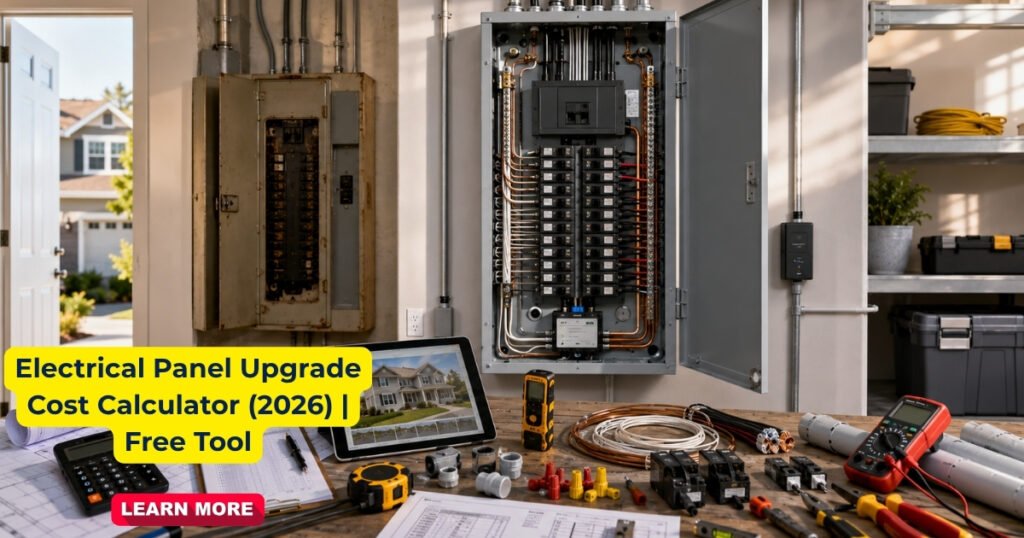
A 100A-to-200A upgrade is the most common job, driven by EVs, heat pumps, and induction ranges · This is licensed-electrician work end to end, never DIY · A subpanel solves a circuit-slot problem, not a capacity problem
Estimates based on 2026 US average pricing from HomeGuide, ProjectCostPro, and Ecostify. Actual costs vary significantly by region, utility requirements, and home age. Always get 3 quotes from licensed electricians.
Understanding the Calculator Inputs
Electrical panel pricing has one of the widest ranges of any project on this site — from $500 for a simple subpanel up to $12,000+ for a full service upgrade with new utility coordination. Upgrade type is what explains most of that spread, not panel brand or home size.
Upgrade Type — The Core Decision
A subpanel adds circuit slots without changing your home's total electrical capacity — useful when your main panel has enough amperage but not enough open breaker spaces, like when finishing a basement. A like-for-like replacement swaps an aging or hazardous panel for a new one at the same amperage, with no utility involvement. A service upgrade (100A to 200A, or 200A to 400A) increases your home's total electrical capacity and almost always involves the utility company, since it changes the service entrance itself.
New Meter Base & Service Mast
Many service upgrades need a new meter base and mast to handle the higher amperage safely, which requires utility coordination to disconnect and reconnect service. Whether this is needed depends on the condition and rating of your existing meter equipment — an electrician can typically tell you this after an inspection, but if you don't know yet, budget for the possibility.
Panel work involves the main electrical service to your home and carries real fire and electrocution risk if done incorrectly. It's licensed-electrician work end to end, and in most jurisdictions it's illegal to do yourself without a license regardless of skill level. If a quote seems unusually cheap, confirm the electrician is licensed and that the work will be permitted and inspected — both are non-negotiable for panel work.
3 Real-World Electrical Panel Upgrade Examples
Example 1 — Adding a Subpanel for a Basement Finishing Project
A homeowner finishing a basement needs more circuit slots for lighting, outlets, and a future bathroom fan, but the main panel has adequate amperage already.
$500 – $1,200
Total:$500 – $1,200
Real-world note: This is the cheapest and fastest electrical panel project on this page precisely because it doesn't touch the utility connection at all — it's purely adding capacity to distribute power that's already available. If your main panel is genuinely undersized, though, a subpanel won't fix that; you'd need a full service upgrade instead.
Example 2 — Standard 100A to 200A Upgrade for a Heat Pump and EV Charger
A home with an aging 100A panel that's nearly full, adding a heat pump and planning for an EV charger, requiring a new meter base and service mast.
$1,800 – $4,500
Step 2 — New meter base & mast:$500 – $1,500
Total:$2,300 – $6,000
Real-world note: This is the most common project on this calculator and the exact scenario named on our HVAC and water heater cost pages — heat pumps, electric tankless water heaters, and EV chargers are the three most common reasons homeowners discover their panel needs an upgrade.
Example 3 — Historic Home, 200A Upgrade with Knob-and-Tube Wiring (Difficult Access)
An older home with some remaining knob-and-tube wiring, upgrading to 200A service, panel located in a tight, hard-to-access basement corner requiring a longer conduit run.
$1,800 – $4,500
Step 2 — Meter/mast work:$500 – $1,500
Step 3 — Old wiring removal:$1,470 – $2,500
Step 4 — Difficult access surcharge:$200 – $500
Total:$3,970 – $9,000
Real-world note: Knob-and-tube removal can turn a one-day panel job into a multi-day project, since it often means opening walls to trace and replace old wiring runs. This example covers panel-adjacent wiring work only — a full whole-house rewire is a much larger, separate project beyond the scope of this calculator.
Upgrade Type Guide
| Type | Installed Cost | Utility Involved? | Best For |
|---|---|---|---|
| Subpanel | $500–$1,200 | No | More circuit slots, existing capacity is enough |
| Like-for-Like Replacement | $1,200–$3,000 | No | Aging or hazardous panel (Federal Pacific, Zinsco), same amperage |
| 100A to 200A Service Upgrade | $1,800–$4,500 | Usually | Modern loads — EV, heat pump, electric tankless |
| 200A to 400A Service Upgrade | $4,000–$9,000 | Yes | Large homes, all-electric, multiple EVs, workshops |
These older panel brands have documented failure modes where breakers may not trip reliably during a fault, and many insurers now require replacement or refuse coverage outright. If your home has one of these panels, replacement is the standard recommendation even if you haven't had any problems — treat it as a safety issue, not a discretionary upgrade.
Electrical Panel Cost Data Tables (2026)
Cost by Target Amperage
| Amperage | Best For | Typical Cost |
|---|---|---|
| 100A | Small/older homes, gas heat and cooking | $1,200–$2,500 (replacement) |
| 200A | Standard modern home, EV + heat pump | $1,800–$4,500 (upgrade) |
| 400A | Large/all-electric homes, multiple EVs, workshop | $4,000–$9,000 (upgrade) |
Additional Cost Factors
| Factor | Cost |
|---|---|
| New meter base & service mast | $500–$1,500 |
| Utility disconnect/reconnect coordination | $470–$800 |
| Knob-and-tube or old wiring removal | $1,470–$2,500 |
| Grounding/bonding upgrade to current code | $235–$400 |
| Permit & inspection | $150–$400 |
| Difficult access surcharge | $200–$500 |
Hidden Costs Most Estimates Miss
1. Utility Coordination Delays
Service upgrades require the utility company to disconnect and reconnect your service, which sometimes involves scheduling delays beyond your electrician's control — not a direct cost, but worth planning around if you're on a tight timeline for a dependent project like an EV charger install or HVAC replacement.
2. Grounding and Bonding Updates
Older homes frequently don't meet current grounding and bonding code, and a panel upgrade is a natural trigger point for an inspector to require this be brought up to standard — $235–$400 that's easy to miss in a bare panel-only quote.
3. AFCI/GFCI Breaker Requirements
Current code requires arc-fault and ground-fault circuit interrupter breakers on many circuits that older panels may not have had. A full panel replacement often needs to include these upgraded breakers to pass inspection, adding modest per-breaker cost that a bare-panel price sometimes excludes.
4. Load Calculation Requirements
Before approving a service upgrade, code requires a load calculation (per NEC 220) confirming the new panel size is appropriate for your home's actual electrical demand. This is typically included in a qualified electrician's process but is worth confirming is being done rather than skipped. Try our Electrical Load Calculator for a rough estimate of your own before that conversation — it won't replace the official calculation, but it gives you a real number to start from.
5. Downstream Circuit Work
A bigger panel doesn't automatically mean every existing circuit is ready for higher loads — some downstream wiring may need upgrading to safely carry new capacity to specific rooms or appliances, particularly in older homes. This is sometimes discovered only once work begins.
Common Estimation Mistakes
Choosing a Subpanel When You Actually Need a Service Upgrade
A subpanel only helps if your main panel already has adequate amperage but is out of circuit slots. If your main panel is genuinely undersized for your household's electrical load, a subpanel doesn't solve that — you need a full service upgrade instead.
Assuming All 100A-to-200A Quotes Include the Same Scope
Some quotes include new meter base and mast work; others assume your existing equipment is adequate and don't. This is exactly why published averages for this project can look wildly different across sources — always confirm what your specific quote includes.
Ignoring a Known-Hazard Panel Brand
Federal Pacific and Zinsco panels have documented reliability problems and should be treated as a replacement priority regardless of whether they're currently "working fine." Insurance implications alone often make this a financial decision, not just a safety one.
Not Getting a Load Calculation Before Adding a Major New Appliance
Before assuming you need a panel upgrade for a new EV charger, heat pump, or induction range, get an actual load calculation — some homes have more headroom than owners assume, and load management devices can sometimes avoid a full upgrade entirely. Our Electrical Load Calculator is a good first step to see roughly where you stand before bringing in an electrician for the official number.
Hiring an Unlicensed or Unpermitted Electrician
Panel work is one of the least appropriate places to cut corners on price by skipping licensing or permits. Unpermitted panel work can create serious problems at home sale and, more importantly, real safety risk if not done to code.
How the Calculator Works
Total Cost = Base Price (by upgrade type) + Meter/Mast Surcharge (if needed) + Old Wiring Surcharge (if present) + Access Surcharge
The base price reflects a standard installation for the selected upgrade type. The meter/mast surcharge applies when your existing meter equipment needs replacement to handle the new service size — this is common but not universal for service upgrades. The old wiring surcharge applies only when knob-and-tube or other outdated wiring needs removal alongside the panel work. The access surcharge is a flat addition for difficult installation locations.
Factors That Affect Your Actual Cost
Regional Labor Rates and Utility Requirements
Electrician labor rates range roughly from $65/hour in lower-cost rural markets to $150+/hour in cities like New York, San Francisco, and Honolulu. Utility company requirements for disconnect/reconnect scheduling and equipment standards also vary significantly by region and provider.
Home Age and Existing Wiring Condition
Homes built before 1960 with 60-amp service face the highest costs due to safety-mandated rewiring requirements that often accompany a panel upgrade in very old homes.
What's Driving the Upgrade
Panel upgrades are increasingly triggered by a specific new load — an EV charger, heat pump, or electric water heater — rather than a standalone decision. See our EV Charger Installation Cost Calculator, HVAC Cost Calculator, and Water Heater Replacement Cost Calculator if any of those is what's prompting this project, since bundling the load calculation and panel decision with that project makes practical sense.
Load Management as an Alternative
Smart load management devices can sometimes let a home avoid a full panel upgrade by intelligently sharing capacity between circuits (for example, an EV charger that automatically reduces its draw when other high-demand appliances are running). This is worth discussing with an electrician before committing to the larger project.
Adding a Standby Generator Transfer Switch
A whole-house standby generator's automatic transfer switch has to be sized and wired to match your panel's service amperage, and installing one is a natural time to also address any panel deficiencies at the same time rather than in two separate projects. See our Whole House Generator Cost Calculator if a generator install, not an appliance upgrade, is what's driving your panel questions.
Frequently Asked Questions
Plan your full home electrical and systems project with these free tools.
Home Systems
Related Cost Estimators
Measurement Tools
- HomeGuide Electrical Panel Replacement Cost Guide 2026 — Per-amperage pricing, labor rate breakdown, subpanel comparison data. Referenced for cost tables and worked examples. HomeGuide, 2026.
- ProjectCostPro Electrical Panel Upgrade Cost Guide 2026 — Full-scope service upgrade pricing including meter base, service-entrance cable, and grounding/bonding costs. Referenced for hidden costs and the meter/mast surcharge. ProjectCostPro, 2026.
- Ecostify Electrical Panel Upgrade Cost Guide 2026 — Amperage tier comparison (100A/200A/400A), EV and heat pump load context. Referenced for the upgrade type guide and FAQ. Ecostify, 2026.
- National Electrical Code (NEC) Article 220 — Load Calculations — Referenced for load calculation guidance in the mistakes and factors sections. National Fire Protection Association, current edition.
Pricing reflects 2026 US national average contractor pricing. Costs vary significantly by region, utility requirements, and home age — always get 3 local quotes from licensed electricians before committing to a panel upgrade project. ConstructlyTools does not have a paid relationship with any contractor, manufacturer, or utility referenced on this page.

Prakash
Prakash is the founder and editor of ConstructlyTools. He researches, develops, and maintains construction calculators, material estimators, cost guides, and DIY planning resources designed to help homeowners, contractors, and builders make informed project decisions.
Every calculator and guide is researched using trusted industry references, published building standards, manufacturer specifications, and reliable construction pricing sources. Each page is reviewed for formula accuracy, pricing methodology, readability, and practical usefulness before publication and is updated regularly as standards or market prices change.
Every calculator and article published on ConstructlyTools is independently reviewed for formula accuracy, pricing methodology, readability, and practical usefulness before publication. Content is updated whenever construction pricing, industry standards, or building code references significantly change.
This page was researched, written, and reviewed in accordance with our Editorial Policy.