
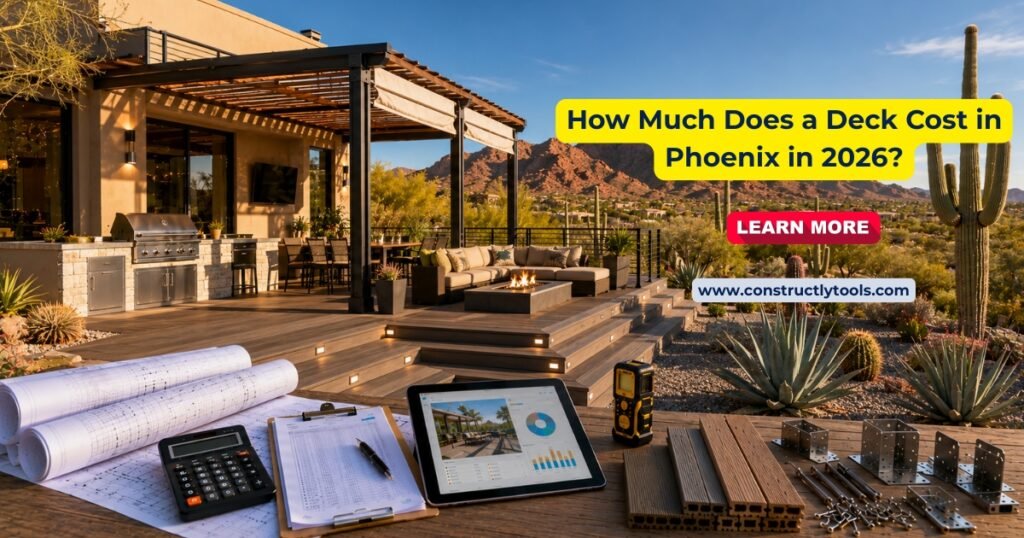
How Much Does a Deck Cost in Phoenix in 2026?
📋 On This Page
- Phoenix Deck Cost Calculator
- Best Deck Materials for Phoenix Heat
- Shade Structures — A Phoenix Essential
- Pricing by Deck Size
- Phoenix-Specific Cost Factors
- Best Time to Build in Phoenix
- How We Calculate These Estimates
- Typical Cost Breakdown
- Phoenix vs. Houston vs. Chicago
- 7 Money-Saving Tips
- Frequently Asked Questions
- References
Deck costs in Phoenix range from $17 to $45 per square foot installed in 2026 — near the national average, but for reasons completely different from any other market in our guide. Phoenix's advantages (no frost line, year-round building season, competitive contractor market) keep structural costs in check. But Phoenix's extreme desert climate — 110°F+ summers, intense UV radiation that fades and cracks wood within one season, and composite surfaces that reach 150–160°F in direct sun — means material selection is more critical here than anywhere else in our 10-city series. Getting the material choice right, and pairing it with a shade structure, is what separates a deck that's usable nine months a year from one you abandon from May through September.
🧮 Phoenix Deck Cost Calculator
💰 Cost Breakdown
Estimates reflect Phoenix metro (Maricopa County) contractor rates for 2026. Prices vary by city (Scottsdale typically 10–15% above Phoenix average), complexity, and season. Always get 3 quotes. Shade structure costs are approximate — final pricing depends on design, material, and foundation requirements. Arizona ROC license verification is required before signing any contract over $1,000.
Best Deck Materials for Phoenix's Extreme Climate
Material selection is more consequential in Phoenix than any other city in our guide. UV radiation, extreme heat, and very low humidity create a desert environment that degrades wood faster than almost anywhere in the US. Here's how each material performs specifically in the Phoenix market:
- Lowest upfront cost
- Requires sealing before first summer
- Annual re-sealing mandatory in AZ desert
- Lifespan: 8–12 years in Phoenix climate
- Better dimensional stability in dry heat vs PT
- Natural appearance when sealed
- UV-protective sealant required annually
- Lifespan: 12–18 years with maintenance
- UV-stabilized capping resists desert fading
- No annual sealing or staining required
- 25-year warranty on most products
- Lifespan: 25–30+ years
- Significantly cooler than composite in AZ sun
- Zero maintenance — won't rot, fade, or splinter
- 50+ year lifespan
- Best long-term value in Phoenix market
Composite decking in direct Phoenix sun can reach 150–160°F surface temperature — too hot to walk on barefoot and uncomfortable for pets. This is the most common Phoenix-specific deck complaint. Solutions: choose lighter-colored composite boards (they absorb less heat), install aluminum decking instead, or — most effectively — add a shade structure (ramada or pergola) over the deck. A shaded composite deck stays 30–50°F cooler than an unshaded one.
Shade Structures — Nearly Essential in Phoenix
In most US cities, a pergola or patio cover is an optional upgrade. In Phoenix, a shade structure is effectively a functional requirement for summer deck usability. Without shade, composite and wood decks are unusable from roughly 9am–6pm from May through September. Here's what Phoenix homeowners typically add:
In Phoenix, most deck contractors also build shade structures — they're designed and permitted together more often than in any other US market. Bundling a deck + ramada in one contract typically saves 12–18% versus separate mobilizations, and the permit can often cover both structures. This is the single most effective money-saving strategy for Phoenix deck projects.
Phoenix Deck Costs by Size (2026)
Deck-only pricing (shade structure not included). See the shade section above for ramada and pergola add-on costs:
| Deck Size | Sq Ft | PT Wood | Composite (UV) | Aluminum | Notes |
|---|---|---|---|---|---|
| 10×10 | 100 sq ft | $1,700–$2,200 | $3,300–$4,500 | $3,800–$5,500 | Small patio deck. ROC license required for contractor. |
| 12×16 | 192 sq ft | $3,264–$4,224 | $6,336–$8,640 | $7,296–$10,560 | Most common size in Phoenix market. |
| 16×20 | 320 sq ft | $5,440–$7,040 | $10,560–$14,400 | $12,160–$17,600 | Mid-size entertaining deck — shade structure strongly recommended. |
| 20×24 | 480 sq ft | $8,160–$10,560 | $15,840–$21,600 | $18,240–$26,400 | Large deck. Shade structure adds $8K–$25K — budget accordingly. |
| Elevated / 2nd story | 200–400 sq ft | $6,000–$13,000 | $12,000–$22,000 | $14,000–$26,000 | Add 25–40% for elevation. Structural engineering may be required. |
Phoenix-Specific Cost Factors
1. Extreme UV and Heat — The #1 Material Enemy
Phoenix receives some of the highest annual UV radiation of any major US city. Wood decks exposed to direct desert sun without UV-protective sealant can develop visible cracking, splintering, and graying within a single summer season. This creates specific requirements:
- Pressure-treated wood must be sealed with UV-protective penetrating oil before the first summer — no exceptions in Arizona's climate
- Annual re-sealing is non-negotiable in Phoenix, not optional as in more moderate climates
- UV-stabilized composite (specifically capped composite, not uncapped) resists fading far better than basic composite lines — always specify capped composite in Phoenix
- Light-colored materials absorb less heat than dark boards — a practical consideration for underfoot temperature
2. Arizona ROC Contractor Licensing
Arizona requires all contractors performing residential work over $1,000 to be licensed by the Arizona Registrar of Contractors (ROC). This is a stricter threshold than Texas (no state threshold) and means essentially every Phoenix deck contractor must have an active ROC license. Verify any contractor's license at roc.az.gov before signing. Unlicensed contractors are present in the Phoenix market and commonly underbid by 20–30%, but carry no state-backed recourse for defective work.
3. Maricopa County Permit Requirements
The City of Phoenix and surrounding Maricopa County jurisdictions (Scottsdale, Tempe, Mesa, Chandler, Gilbert) all require permits for decks attached to structures and most elevated decks. Permit fees run $150–$500 for typical residential decks. Arizona also imposes a Transaction Privilege Tax (TPT) on contractors for materials used in construction projects — this is typically passed on to homeowners and is worth understanding when comparing bids, as it may be itemized or bundled differently by different contractors.
4. Caliche Soil — The Hidden Excavation Risk
Much of the Phoenix metro sits on caliche — a hardened calcium carbonate layer that can appear anywhere from 6 inches to several feet below grade. When deck footings encounter caliche, it must be broken up with a jackhammer before footings can be poured. This adds $200–$800 per footing encounter, and a contractor who doesn't probe the site before bidding may present this as a change order after starting. Ask every contractor how they handle caliche encounters before signing, and request a written contingency rate in the contract.
Caliche is Phoenix's version of Nashville's karst rock — an unpredictable subsurface condition that can significantly affect footing costs. The same neighborhood can have radically different caliche depth from one lot to the next. Always request a written per-footing caliche contingency rate from every contractor, and ask them to probe the site before finalizing their bid.
5. Scottsdale Premium — 10–15% Above Phoenix Average
The City of Scottsdale consistently runs 10–15% above Phoenix average deck pricing due to higher labor demand, stricter aesthetic standards in many HOA communities, more complex design requirements common in Scottsdale's luxury market, and permit processing that tends to be more detailed for high-value properties. If you're in Scottsdale, Paradise Valley, or North Scottsdale, adjust all estimates upward accordingly.
Best Time to Build a Deck in Phoenix
Phoenix's build season is essentially the inverse of Chicago's — build in the cooler months, not the warmer ones:
Signing a contract in August when contractor demand is lowest (nobody wants to build in Phoenix summer heat) and scheduling the build for October–November gets you the best pricing and first pick of the fall's construction window. Many Phoenix contractors offer modest discounts for fall forward-bookings signed during the summer slow period.
How We Calculate These Estimates
Our Phoenix deck pricing is compiled from three sources, reviewed quarterly:
- Local contractor quotes — We aggregate bids from Phoenix-area deck contractors on Angi, HomeAdvisor, and Thumbtack, filtered to the Phoenix-Mesa-Chandler MSA across Maricopa County including Phoenix, Scottsdale, Mesa, Tempe, Chandler, Gilbert, and Peoria.
- Material pricing — We track decking material costs from major suppliers (Home Depot, Lowe's, local lumber yards) in the Phoenix metro, including UV-stabilized composite lines specifically marketed for desert climates and aluminum decking suppliers active in the Arizona market.
- BLS labor rate data — Bureau of Labor Statistics data for the Phoenix-Mesa-Chandler MSA shows carpenters and deck contractors earning $20–$35/hour — comparable to Houston, below Chicago. Labor comprises 40–48% of total Phoenix deck project cost.
Shade structure costs (pergola, ramada) are estimated separately and shown as a breakdown item when selected in the calculator. Caliche excavation contingencies are not included in base estimates — request a written rate from your contractor before signing.
Typical Cost Breakdown — Phoenix Deck
For a representative 12×16 ft (192 sq ft) UV-stabilized composite deck with aluminum railing and basic stairs, no shade structure:
| Cost Component | Cost Range | % of Total | Notes |
|---|---|---|---|
| Decking material | $2,500–$4,000 | 28–32% | UV-stabilized capped composite at $13–$21/sq ft material only. |
| Framing lumber | $700–$1,100 | 8–12% | Pressure-treated framing. ACQ-rated for AZ soil contact. |
| Footings | $400–$900 | 5–9% | |
| Labor (framing + decking) | $2,000–$3,500 | 30–40% | Fall/spring rates. Summer heat work may add 10–15% surcharge. |
| Aluminum railing | $700–$1,800 | 9–14% | |
| Stairs | $400–$900 | 5–8% | Single stair set, 3–5 steps. |
| Arizona TPT (tax) | $200–$500 | 2–4% | Transaction Privilege Tax passed from contractor to homeowner on materials. |
| Permit (Phoenix/Maricopa) | $150–$500 | 2–5% | Required for attached decks and elevated structures. |
Phoenix vs. Houston vs. Chicago — Desert vs. Gulf vs. Midwest
| Factor | Phoenix | Houston | Chicago |
|---|---|---|---|
| Cost / sq ft (composite) | $33–$45 | $30–$45 | $35–$52 |
| 192 sq ft deck total | $6,336–$8,640 | $5,760–$8,640 | $6,720–$9,984 |
| Primary climate challenge | Extreme UV + 110°F heat | Heat + humidity | Freeze-thaw + frost line |
| Frost line / footing depth | None (12–18") | None (12–18") | 42" mandatory |
| Best material | UV composite / Aluminum | Composite / Ipe | Composite / PVC |
| Shade structure needed? | Strongly yes — for usability | Helpful | Not needed |
| Build season | Oct–Apr (coolest) | Year-round (Oct–Apr best) | May–Sep only |
| Contractor license | Arizona ROC (verify at roc.az.gov) | No state threshold | City license required |
| Deck ROI | ~90% | ~80% | ~70% |
7 Ways to Save Money on a Phoenix Deck
1. Sign in Summer, Build in Fall
August and September are Phoenix's slowest months for deck contractors — nobody wants to build in 110°F heat. Signing your contract during this slow period and scheduling the build for October or November often gets you 5–10% off from contractors eager to fill their fall books. You get the benefit of off-peak pricing without actually having to build in the summer.
2. Choose Composite Over PT Wood — The Math Is Clear in Phoenix
Pressure-treated wood in Phoenix's climate requires sealing before the first summer, annual re-sealing ($200–$400/year), and typically fails significantly faster than in humid climates (8–12 years vs 15–20 years elsewhere). Composite's higher upfront cost pays for itself in far fewer years in Phoenix than in any other market in our guide. If you're planning to stay in your home more than 5 years, composite almost always wins the 10-year total cost comparison in Phoenix.
3. Bundle Deck + Shade Structure in One Contract
In Phoenix, a deck without a shade structure is often a $10,000+ investment you can't use in summer. Bundling both in one contract saves 12–18% on the combined project, requires only one permit application (in most jurisdictions), and ensures structural coordination between the deck and the shade structure support posts. Never contract these separately unless you have a specific reason.
4. Choose Lighter-Colored Boards to Save on Cooling
Light grey or tan composite boards in Phoenix can be 20–30°F cooler underfoot than dark brown or charcoal boards — in a city where composite reaches 150°F+, this is a functional decision, not just aesthetic. Lighter boards also show less fading from UV exposure over time. Specify board color with underfoot temperature in mind, not just curb appeal.
5. Verify Arizona ROC License Before Any Conversation
The 2-minute verification at roc.az.gov should happen before you invest time in any contractor conversation. Phoenix's active construction market has a significant share of unlicensed operators. A contractor without an active ROC license cannot legally pull a Maricopa County permit — meaning your deck would be built without required county approval, creating liability at resale.
6. Ask About Caliche in Writing Before Signing
Caliche is Phoenix's most common source of unexpected change orders. Ask every contractor: "What is your per-footing rate if we hit caliche during excavation?" Get the answer in writing as a contract clause. A contractor who refuses to provide this clause is either expecting caliche and hiding it, or hasn't thought about it — neither inspires confidence.
7. Get Maricopa County Permit Yourself to Avoid Contractor Markup
Some Phoenix contractors mark up permit fees 20–40%. The Maricopa County permit portal allows homeowners to apply for permits directly — though you'll need your contractor's ROC license number and project details. Pulling the permit yourself saves the markup on a $150–$500 fee, but make sure your contractor is comfortable with this arrangement before signing.
Select UV-stabilized composite or aluminum, choose your shade structure option, and enter your dimensions above before calling any contractor. Phoenix's unique combination of heat, UV, and caliche risk makes knowing the realistic range — including shade structure add-on cost — essential to evaluating any bid you receive.
Frequently Asked Questions
Related Construction Tools
Free calculators to plan your Phoenix deck project.
National pricing for any deck size and material.
Compare concrete patio vs deck for your outdoor space.
Add privacy fencing to your outdoor living area.
Add a concrete patio adjacent to your new deck.
Compare Phoenix vs. Houston warm-market deck pricing.
Local pricing guides for 10 major US cities.
References
- Angi — How Much Does It Cost to Build a Deck in Phoenix, AZ? (2026)
- HomeBlue — Cost to Build a Deck in Phoenix, Arizona
- Homeyou — Composite Decking in Phoenix, AZ — Costs 2026
- YardCost — Deck Cost Calculator — Wood, Composite & Ipe (2026)
- BhumiCalculator — Decking Cost Per Square Foot: Complete 2026 Pricing Guide
- U.S. Bureau of Labor Statistics — Occupational Employment, Phoenix-Mesa-Chandler MSA, Construction Trades (2025)
- Arizona Registrar of Contractors — ROC License Verification
- City of Phoenix Planning & Development — Building Permits & Inspections

Prakash
Prakash is the founder and editor of ConstructlyTools. He researches, develops, and maintains construction calculators, material estimators, cost guides, and DIY planning resources designed to help homeowners, contractors, and builders make informed project decisions.
Every calculator and guide is researched using trusted industry references, published building standards, manufacturer specifications, and reliable construction pricing sources. Each page is reviewed for formula accuracy, pricing methodology, readability, and practical usefulness before publication and is updated regularly as standards or market prices change.
Every calculator and article published on ConstructlyTools is independently reviewed for formula accuracy, pricing methodology, readability, and practical usefulness before publication. Content is updated whenever construction pricing, industry standards, or building code references significantly change.
This page was researched, written, and reviewed in accordance with our Editorial Policy.