
Concrete Slab Cost Calculator
Use this concrete slab cost calculator to estimate material volume and total project cost based on slab dimensions and thickness. Designed for driveways, patios, garage floors, and foundations using standard US measurements to help homeowners and contractors plan accurate budgets before pouring concrete.
Concrete Volume = Area × (Thickness ÷ 12) ÷ 27 cubic yards
Standard broom $5–$10/sq ft · Exposed aggregate $7–$12/sq ft · Stamped $10–$20/sq ft · Colored $6–$12/sq ft (installed, 6") · Rebar, site prep, and permits are additional
Estimates based on 2026 US average pricing. Actual costs vary by region. Always get 3 itemized contractor quotes before committing.
Understanding the Calculator Inputs
This calculator estimates the total installed cost of a concrete slab — concrete material and labor combined — based on your dimensions, thickness, finish type, and whether you hire a contractor or pour it yourself. It also calculates the cubic yards of concrete needed to pair with your ready-mix order.
Thickness — The Biggest Cost Driver After Area
Going from 4 inches to 6 inches adds 50% more concrete volume and roughly 15–20% more total project cost (concrete is one of several cost components). Use the correct thickness for the application — overbuild on vehicle slabs (use 6"), use 4" for foot traffic only. The calculator applies a thickness multiplier: 4" = 0.85×, 6" = 1.0× (baseline), 8" = 1.25×.
Finish Type
The finish is the most variable cost factor in concrete work. Standard broom finish is functional and low-cost. Stamped concrete can cost 2–3× more than broom finish for the same slab — the premium pays for decorative molds, release agents, color hardeners, and a significantly more skilled labor crew. Choose the finish based on function and budget, not just appearance. See the finish guide below for a full comparison.
What This Calculator Does NOT Include
- Rebar — use our rebar calculator to estimate separately ($0.35–$1.00/sq ft for #4 at 12" OC)
- Gravel base — 4–6" compacted gravel required under all slabs (use our gravel calculator)
- Excavation and site prep — $1–$3/sq ft additional
- Existing concrete removal — $2–$6/sq ft additional
- Permits — $100–$300 depending on jurisdiction
- Sealing — $0.25–$0.75/sq ft, required every 2–5 years for stamped/exposed finishes
The calculator covers concrete + labor. Add rebar ($0.35–$1.00/sq ft), gravel base ($0.50–$1.00/sq ft), site prep ($1–$3/sq ft), and permits ($100–$300) for the realistic all-in project budget. On a 400 sq ft slab, the true all-in budget is typically 35–50% higher than the concrete + labor estimate alone.
3 Real-World Concrete Slab Examples
Example 1 — Backyard Patio (20×20 ft, 4 inches, Standard Broom, Contractor)
Standard 400 sq ft backyard patio — broom finish, compacted gravel base, #4 rebar at 18" OC, 1 saw-cut control joint grid.
| Item | Qty | Unit Cost | Total |
|---|---|---|---|
| Ready-mix concrete (3,000 PSI, 5.4 cu yd w/ 10% waste) | 5.4 cu yd | $130–$175/cu yd | $702–$945 |
| Compacted gravel base (4", 400 sq ft) | ~5 tons | $35–$55/ton | $175–$275 |
| #4 rebar (18" OC, ~420 lin ft) | ~21 bars | $7–$12/bar | $147–$252 |
| Form lumber (80 LF perimeter) | 80 LF | $0.65–$1.00/LF | $52–$80 |
| Labor — pour, screed, broom finish | 400 sq ft | $3–$6/sq ft | $1,200–$2,400 |
| Saw-cut control joints | 40 LF | $1–$2/LF | $40–$80 |
| Concrete sealer (initial application) | 400 sq ft | $0.25–$0.50/sq ft | $100–$200 |
| Total contractor installed all-in | $2,416–$4,232 | ||
| DIY materials only (concrete + rebar + base) | $1,076–$1,552 | ||
Real-world note: The 20×20 patio is one of the most common residential concrete projects — and one of the most DIY-accessible. Key decision point: pouring 5+ cubic yards requires 4–5 helpers and a clear timeline (concrete can't wait). Rent a bull float and 10-foot screed. Broom finish must be applied while the surface is still wet but has lost its sheen — typically 2–4 hours after the pour depending on temperature. Too early = washes out; too late = surface is too hard to mark.
Example 2 — Two-Car Garage Floor (24×24 ft, 6 inches, Broom Finish, Contractor)
576 sq ft garage slab, 6-inch thick, 4,000 PSI air-entrained concrete for freeze-thaw climate, #4 rebar at 12" OC, vapor barrier, 4 saw-cut control joints.
| Item | Qty | Unit Cost | Total |
|---|---|---|---|
| Ready-mix (4,000 PSI, air-entrained, 12 cu yd) | 12 cu yd | $145–$195/cu yd | $1,740–$2,340 |
| Compacted gravel base (4") | ~8 tons | $35–$55/ton | $280–$440 |
| Vapor barrier (6 mil poly) | 576 sq ft | $0.10–$0.20/sq ft | $58–$115 |
| #4 rebar (12" OC, ~1,300 lin ft) | ~72 bars | $7–$12/bar | $504–$864 |
| Labor — pour, screed, broom finish | 576 sq ft | $2–$4/sq ft | $1,152–$2,304 |
| Saw-cut control joints (4 cuts × 24 ft) | 96 LF | $1–$2/LF | $96–$192 |
| Total contractor installed all-in | $3,830–$6,255 | ||
Real-world note: Garage slabs in freeze-thaw climates must use air-entrained concrete — specify this explicitly when ordering from the ready-mix supplier. Standard non-air-entrained concrete will scale and spall within 3–5 winters in climates where road salt is tracked in. Control joints must be spaced at a maximum of 10–12 ft in each direction — a 24×24 garage needs 2 cuts each way creating a 4-panel grid. Cut within 6–18 hours of the pour (before the concrete gets too hard to saw but after it's firm enough to walk on).
Example 3 — Stamped Concrete Patio (16×20 ft, 4 inches, Stamped, Contractor)
320 sq ft decorative backyard patio with slate texture stamped pattern and integral brown color. Premium finish requiring specialized contractor crew.
| Item | Qty | Unit Cost | Total |
|---|---|---|---|
| Ready-mix with integral color (3,500 PSI) | 4.3 cu yd | $160–$220/cu yd | $688–$946 |
| Color hardener (surface broadcast) | 320 sq ft | $0.50–$1.00/sq ft | $160–$320 |
| Release agent (prevents stamp sticking) | 320 sq ft | $0.20–$0.40/sq ft | $64–$128 |
| Stamp mats (contractor-supplied) | Included in labor | — | — |
| Compacted gravel base + rebar | 320 sq ft | $1.50–$2.50/sq ft | $480–$800 |
| Labor — stamped finish crew (specialist) | 320 sq ft | $5–$10/sq ft | $1,600–$3,200 |
| Acrylic sealer (2 coats, required) | 320 sq ft | $0.50–$1.00/sq ft | $160–$320 |
| Total stamped patio installed | $3,152–$5,714 | ||
| Cost per sq ft | $9.85–$17.86/sq ft | ||
Real-world note: Stamped concrete is a specialty trade — the stamping window is only 2–3 hours after the pour (when the concrete is firm enough to hold the pattern but not yet too hard to stamp). A crew that's late, understaffed, or inexperienced will produce a poor result that can't be corrected after curing. Always ask for photos of completed stamped concrete projects from your specific contractor — not stock photos. Budget $0.50–$1.00/sq ft to reseal every 2–3 years. Skipping resealing causes color fading and surface deterioration within 5–7 years.
Concrete Slab Cost by Finish Type (2026)
Installed cost per square foot for each finish at both 4-inch and 6-inch thickness. Includes concrete material and labor. Rebar, gravel base, site prep, and permits are additional.
| Finish Type | 4" — $/sq ft | 6" — $/sq ft | Maintenance | Best For |
|---|---|---|---|---|
| Standard Broom | $4–$8 | $5–$10 | None required | Driveways, garage floors, utility slabs |
| Colored / Integral Color | $5–$10 | $6–$12 | Seal every 3–5 yrs | Patios, pool decks, decorative slabs |
| Exposed Aggregate | $6–$10 | $7–$12 | Seal every 3–5 yrs | Pool decks, patios — slip-resistant texture |
| Stamped Concrete | $8–$18 | $10–$20 | Reseal every 2–3 yrs | Decorative patios, entries, driveways |
National average installed pricing 2026. Add 25–40% for Northeast and Pacific Coast markets. Subtract 10–20% for South Central and Midwest markets.
Concrete Slab Cost by Size (2026)
Contractor-installed cost at 6-inch thickness, standard broom finish. Does not include rebar, gravel base, site prep, or permits — add $2–$5/sq ft for these items.
| Slab Size | Sq Ft | Concrete (cu yd) | Broom Finish | Colored | Stamped |
|---|---|---|---|---|---|
| 10×10 ft | 100 | 1.9 cu yd | $500–$1,000 | $600–$1,200 | $1,000–$2,000 |
| 12×12 ft | 144 | 2.7 cu yd | $720–$1,440 | $864–$1,728 | $1,440–$2,880 |
| 16×20 ft | 320 | 5.9 cu yd | $1,600–$3,200 | $1,920–$3,840 | $3,200–$6,400 |
| 20×20 ft | 400 | 7.4 cu yd | $2,000–$4,000 | $2,400–$4,800 | $4,000–$8,000 |
| 24×24 ft | 576 | 10.7 cu yd | $2,880–$5,760 | $3,456–$6,912 | $5,760–$11,520 |
| 30×30 ft | 900 | 16.7 cu yd | $4,500–$9,000 | $5,400–$10,800 | $9,000–$18,000 |
Concrete + labor only. Add $2.50–$5.00/sq ft for rebar (#4 at 12–18" OC), compacted gravel base, and control joint saw-cutting.
Concrete Finish Guide
Standard Broom Finish
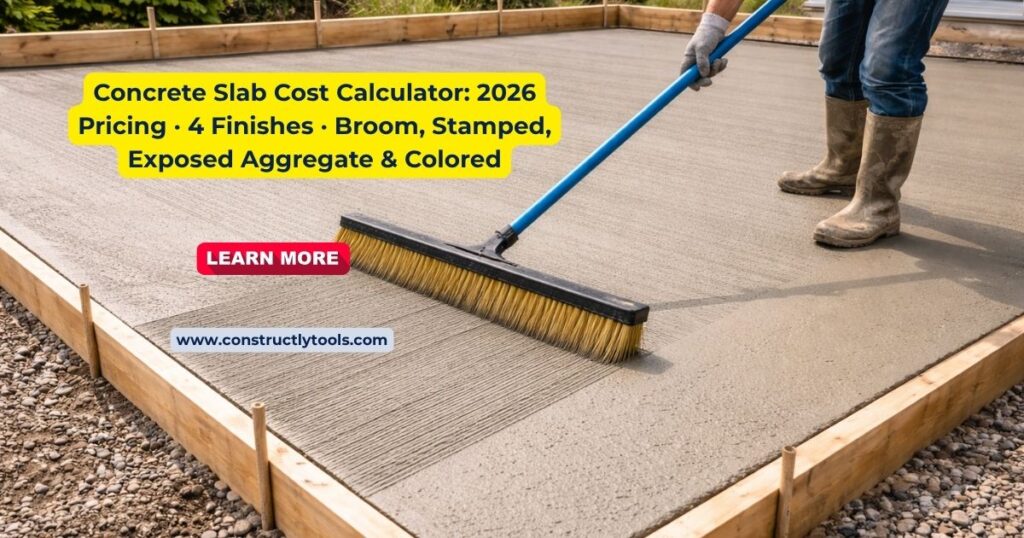
A broom is dragged across the surface while the concrete is still wet, creating a textured slip-resistant finish. It's the most common concrete finish in North America — used for virtually all driveways, garage floors, sidewalks, and utility slabs. Zero maintenance required. Not decorative, but highly durable and functional.
Exposed Aggregate
The surface layer of cement paste is washed away while the concrete is still green, exposing the natural stone aggregate underneath. Creates a textured, stone-like appearance with excellent slip resistance — popular for pool decks, patios, and commercial walkways. Requires sealing every 3–5 years to protect the aggregate from weathering and staining. Cost is 20–30% more than broom finish.
Stamped Concrete
Rubber stamp mats are pressed into freshly poured concrete to create patterns mimicking brick, slate, cobblestone, wood, or flagstone. Color hardener is broadcast on the surface before stamping for color; release agent prevents the stamps from sticking. The result is a decorative surface that costs 50–100% more than broom finish but significantly less than real stone or brick pavers. Requires resealing every 2–3 years. The biggest risk: a poorly executed stamped pour cannot be corrected — always hire a contractor with documented stamped concrete experience.
Colored / Integral Color
Color pigment is added directly to the concrete mix before pouring, producing consistent color throughout the full slab depth. Color doesn't fade with surface wear because it goes all the way through. Less decorative than stamped but more durable than surface-applied color. Often combined with a broom or exposed aggregate finish. Costs 15–25% more than standard broom and requires sealing every 3–5 years to maintain vibrancy.
Driveway or garage floor → Standard broom (functional, durable, lowest maintenance). Backyard patio with decorative goal → Exposed aggregate or colored (good appearance, reasonable cost). Feature entry or premium patio → Stamped concrete (best appearance, highest cost, requires maintenance). Budget patio → Standard broom at 4" (lowest all-in cost, still durable for foot traffic).
Hidden Costs Most Estimates Miss
1. Gravel Base and Excavation
Every slab requires excavating the topsoil and installing 4–6 inches of compacted gravel base before any concrete is poured. This is almost never included in per-sq-ft concrete quotes. Excavation runs $1–$2/sq ft; gravel base material and compaction adds $0.75–$1.50/sq ft. On a 400 sq ft patio, that's $700–$1,400 in site prep that appears as a separate line item or change order if not specified upfront. Use our gravel calculator to estimate base material.
2. Rebar or Wire Mesh
Reinforcement is quoted separately by most contractors. #4 rebar at 12" OC adds $0.60–$1.00/sq ft to material cost. Wire mesh adds $0.20–$0.40/sq ft. On a 576 sq ft garage slab, rebar alone adds $345–$576 — a significant addition not visible in a bare concrete quote. Always ask: "Is rebar included in this price?" Use our rebar calculator to verify quantities.
3. Existing Concrete Removal
Breaking out and hauling away existing concrete adds $2–$6 per sq ft — $800–$2,400 for a 400 sq ft slab. This cost is almost never in a replacement concrete quote without being explicitly discussed. Always confirm whether existing concrete demolition is in scope before signing a contract. Concrete debris hauling also requires a dumpster or truck with tipping rights — not all contractors include disposal.
4. Stamped Concrete Resealing
Stamped and exposed aggregate concrete must be resealed every 2–3 years to maintain color, pattern definition, and surface protection. Professional resealing costs $0.75–$1.50/sq ft — $240–$480 every 2–3 years for a 320 sq ft patio. Over 20 years, that's $1,600–$4,800 in maintenance for stamped vs $0 for broom finish. Factor this into the true lifetime cost comparison before choosing a decorative finish.
5. Permits and Inspections
Concrete slabs over 200 sq ft, slabs attached to a structure, or driveways connecting to a public road typically require permits ($100–$300). Some jurisdictions require a pre-pour inspection to verify rebar placement before concrete is poured. Skipping a required permit creates issues at home sale and may require demolition and re-poring the slab. Always ask your contractor whether a permit is required for your specific project.
Concrete + labor: $2,000–$4,000 · Gravel base: $300–$600 · Rebar: $200–$400 · Forms: $52–$80 · Control joints: $40–$80 · Sealer: $100–$200 · Permit: $150–$300 · True all-in: $2,842–$5,660. The concrete-only estimate ($2,000–$4,000) understates the true project cost by 30–40%.
DIY vs Contractor — What Makes Sense
| Factor | DIY Concrete | Contractor Poured |
|---|---|---|
| Labor savings | $3–$10/sq ft saved | — |
| Helpers needed | 4–5 per 5 cu yd pour | Crew provided |
| Equipment | Screed, float, edger, broom — rent $80–$150 | Included |
| Risk of cold joint | Higher — inexperienced crew may fall behind | Lower — professional pace |
| Finish quality | Good with practice | Consistent professional result |
| Stamped/decorative | Not recommended DIY | Specialist required |
| Best slab size for DIY | Under 5 cu yd (200 sq ft at 6") | Any size |
DIY concrete is viable for standard broom finish slabs under 5 cubic yards with an experienced helper crew. The labor savings are real — $3–$10/sq ft on a 400 sq ft slab = $1,200–$4,000 saved. The risk is the compressed working window: once the truck starts pouring, you have 60–90 minutes to screed, float, and get the surface ready for finishing. An understaffed DIY crew that falls behind ends up with a cold joint or a surface that's too hard to finish properly.
1 cubic yard per helper is a reasonable pace for DIY. A 5-yard pour needs 5 helpers. A 10-yard pour needs a contractor. Stamped, exposed aggregate, and colored concrete are not DIY-appropriate for most homeowners — the finishing window is too compressed and the techniques require practiced skill. Always hire a specialist for decorative finishes.
Common Concrete Slab Cost Mistakes
Comparing Quotes That Don't Include the Same Scope
A $2,500 quote and a $4,000 quote for the same slab may differ because one includes gravel base, rebar, and permits while the other is concrete-only. Always ask every contractor to provide an itemized breakdown: site prep, formwork, gravel base, concrete material, reinforcement, labor, finishing, joints, sealing, and permit. Compare line by line — not total to total.
Choosing the Lowest-PSI Concrete to Save Money
Upgrading from 3,000 PSI to 4,000 PSI concrete typically costs only $8–$15 more per cubic yard — $80–$150 extra on a 10-yard pour. The structural benefit (better freeze-thaw resistance, lower permeability, higher load capacity) is significant. Specifying the cheapest concrete to save a trivial amount is a false economy that shortens the slab's service life in demanding applications.
Not Getting Stamped Concrete References
Stamped concrete is a specialty — the finishing window is 2–3 hours and quality depends entirely on crew skill and coordination. A poor stamped pour produces uneven patterns, color blotches, and alignment errors that can't be corrected after the fact. Always require portfolio photos and references from local stamped concrete projects from your specific contractor, not franchise stock images.
Skipping Control Joints
Concrete shrinks as it cures. Without control joints (saw cuts or tooled grooves), shrinkage cracks appear randomly across the surface — often diagonally, always visibly. Control joints cost $1–$2/LF and direct the inevitable cracking below the surface in straight, predetermined lines. Always ask your contractor: "Where are the control joints going?" A good contractor plans the joint layout before the pour.
How We Estimate Costs
The Formula
Total Cost = Slab Area × (Material $/sq ft + Labor $/sq ft) × Thickness Multiplier
Base rates are set at 6-inch thickness. Thickness multipliers: 4" = 0.85×, 6" = 1.0×, 8" = 1.25×. Material cost covers concrete material only; labor covers forming, pouring, finishing, and curing. Concrete cubic yards are calculated as: Area × (Thickness ÷ 12) ÷ 27, which is the industry-standard formula.
Pricing Sources
Material rates are based on ready-mix concrete pricing and finishing material costs across 8 US markets in 2026. Labor rates are derived from contractor bid data on HomeAdvisor and Angi for completed concrete slab projects, cross-referenced with RSMeans residential labor unit cost data. Ranges represent the 20th to 80th percentile of real market bids — excluding outlier low bids and premium market outliers.
Frequently Asked Questions
Plan your full concrete project with these free tools.
Concrete Tools
Related Cost Estimators
Material Calculators

Prakash
Prakash is the founder and editor of ConstructlyTools. He researches, develops, and maintains construction calculators, material estimators, cost guides, and DIY planning resources designed to help homeowners, contractors, and builders make informed project decisions.
Every calculator and guide is researched using trusted industry references, published building standards, manufacturer specifications, and reliable construction pricing sources. Each page is reviewed for formula accuracy, pricing methodology, readability, and practical usefulness before publication and is updated regularly as standards or market prices change.
Every calculator and article published on ConstructlyTools is independently reviewed for formula accuracy, pricing methodology, readability, and practical usefulness before publication. Content is updated whenever construction pricing, industry standards, or building code references significantly change.
This page was researched, written, and reviewed in accordance with our Editorial Policy.