
Sump Pump Cost Calculator
Use this free sump pump installation and replacement cost calculator to estimate your total cost based on project scope, pump type, and battery backup. Whether you’re swapping an aging pump in an existing pit or installing a brand new system, simply select your options to get an instant cost range.
A primary pump without battery backup is useless during a power outage — and storms are exactly when outages and heavy water both happen · A full perimeter drain system is a separate, larger waterproofing project, not part of a sump pump install · Most pumps fail between years 7 and 12
Estimates based on 2026 US average pricing from Angi, This Old House, and The Basement Guide. Actual costs vary by region, pit condition, and pump horsepower. Always get 3 quotes from licensed plumbers.
Understanding the Calculator Inputs
Sump pump cost depends on three variables that most generic pricing guides collapse into a single number: whether a pit already exists, which pump type the application needs, and whether battery backup is included. This calculator is built around those three, since they explain nearly all the real-world price variation.
Project Scope — The Biggest Cost Swing
A pump swap in an existing, working pit is a straightforward 1–2 hour job — essentially unplugging the old unit and dropping in the new one. A new installation requires breaking concrete, excavating a pit, and installing proper drainage, taking 4–8 hours depending on concrete thickness and pit depth. This single distinction explains most of the spread between a $500 project and a $2,500 one.
Pump Type
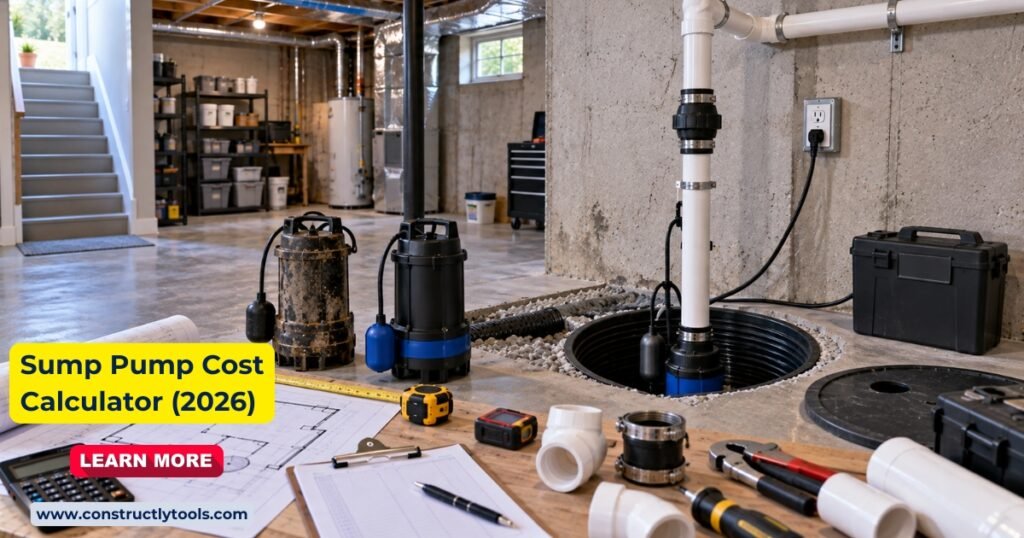
Pedestal pumps have the motor mounted above the pit — cheapest, easiest to service, but louder and lower capacity, fine for occasional light water. Submersible pumps sit inside the pit, sealed and underwater — quieter, more powerful, and the default choice for a finished basement. Premium submersible pumps use cast-iron construction and higher horsepower, suited to high water tables or basements with a history of significant flooding.
Standard homeowners insurance typically excludes water damage from sump pump failure unless you've added a specific water-backup endorsement. If your basement floods because your sump pump failed and you don't have this endorsement, that claim will likely be denied. The endorsement costs a small fraction of what water damage restoration runs — check your policy and add it now, before you need it, not after.
3 Real-World Sump Pump Examples
Example 1 — Simple Pump Swap, Standard Submersible, No Backup
An aging submersible pump in a working, existing pit needs replacement after 9 years of service, standard swap, no battery backup added.
$400 – $1,200
Total:$400 – $1,200
Real-world note: This is the most common sump pump project and matches national averages closely. Most pumps fail between years 7 and 12, so if yours is in that range, proactively replacing it before failure is far cheaper than an emergency call after a flood.
Example 2 — New Installation with Battery Backup
A basement with no existing sump system needs a full new installation with pit excavation, standard submersible pump, adding battery backup for storm protection.
$1,000 – $2,200
Step 2 — Battery backup:$600 – $1,200
Total:$1,600 – $3,400
Real-world note: Battery backup is the single highest-value upgrade for any sump system — the most common time a sump pump is critically needed is during a severe storm, which is exactly when the power tends to go out. A primary pump alone offers no protection during that scenario.
Example 3 — Premium High-Capacity Pump, High Water Table, with Backup
A new installation in a home with a high water table and history of significant water intrusion, premium cast-iron submersible pump for higher capacity, battery backup included.
$1,500 – $2,800
Step 2 — Battery backup:$600 – $1,200
Total:$2,100 – $4,000
Real-world note: This sits near the top of a typical residential sump pump budget. If your home's water intrusion is severe enough to need a premium pump, it's also worth having your broader moisture situation assessed — see our Basement Waterproofing Cost Calculator if a sump pump alone isn't addressing the full problem.
Pedestal vs. Submersible Guide
| Type | Unit Cost | Lifespan | Best For |
|---|---|---|---|
| Pedestal | $75–$300 | 25–30 years | Occasional light water, budget, easy DIY service |
| Submersible | $150–$500 | 10–15 years | Most finished basements, the US default choice |
| Premium Submersible | $470–$800 | 10–15 years | High water tables, history of significant flooding |
Replacing an existing submersible pump in an existing pit is a reasonable DIY project for a mechanically-inclined homeowner — unplug the old unit, disconnect the discharge pipe, drop in the new pump, reconnect, and test. New pit excavation requires breaking concrete and proper drainage engineering — that part is a hire-a-professional job, not a DIY one.
Sump Pump Cost Data Tables (2026)
Total Cost by Scope and Pump Type
| Scenario | Pedestal | Submersible | Premium Submersible |
|---|---|---|---|
| Pump swap (existing pit) | $300–$600 | $400–$1,200 | N/A — new install only |
| New installation (pit excavation) | $800–$1,800 | $1,000–$2,200 | $1,500–$2,800 |
Additional Cost Factors
| Factor | Cost |
|---|---|
| Battery backup (installed) | $600–$1,200 |
| Water-powered backup (installed) | $1,200–$2,500 |
| Electrical upgrade (dedicated circuit) | $150–$600 |
| WiFi-connected monitoring pump | +$100–$300 |
| Permit (some jurisdictions) | $50–$200 |
| Replacement cycle (every 7–12 years) | $300–$700 per cycle |
Hidden Costs Most Estimates Miss
1. Water-Backup Insurance Endorsement
As covered above, this isn't a cost of the sump pump installation itself, but it's a genuinely important budget line to add — without it, a claim from sump pump failure water damage will likely be denied. This costs far less than a single water damage restoration job.
2. Electrical Upgrades
Older homes sometimes need a dedicated circuit for the sump pump, particularly when adding battery backup, which draws additional power. This $150–$600 cost is easy to miss in a bare pump-and-labor quote.
3. Discharge Line Routing
The discharge pipe needs to route water safely away from the foundation, sometimes requiring a longer run or routing around landscaping than a basic quote assumes. Confirm where the discharge line will actually exit and where the water will go.
4. Check Valve Replacement
The check valve prevents water from flowing back into the pit after the pump shuts off. A worn or missing check valve reduces system efficiency and is sometimes overlooked when only the pump itself is being replaced.
5. Confusing a Sump Pump with a Full Waterproofing System
A sump pump manages water that's already reached the pit — it doesn't stop water from entering in the first place. A full perimeter drainage system (French drain) is a separate, larger waterproofing project. See our Basement Waterproofing Cost Calculator if ongoing water intrusion, not just pump replacement, is the underlying issue.
Common Estimation Mistakes
Skipping Battery Backup to Save Money
A primary pump without backup is useless during a power outage — and power outages disproportionately happen during the same severe storms that produce the most water. This is one of the highest-value additions available for the cost.
Not Checking Insurance Coverage
As covered above, assuming standard homeowners insurance covers sump pump failure water damage is a costly mistake. Confirm your specific policy's water-backup endorsement status before you need it, not during a claim.
Waiting Until the Pump Fails to Replace It
Most pumps fail between years 7 and 12. If yours is approaching that range, proactive replacement during a routine service visit is far cheaper and less stressful than an emergency call after a flood has already started.
Assuming a Sump Pump Solves All Water Problems
A sump pump is one component of a complete water management system, not a substitute for addressing why water is reaching the pit in the first place. Chronic, heavy water intrusion may need broader waterproofing beyond pump capacity alone.
Choosing Pedestal for a Finished Basement
Pedestal pumps are noisier and lower capacity — fine for an unfinished basement with occasional water, but submersible is the better default for a finished living space where noise and reliability matter more.
How the Calculator Works
Total Cost = Base Install (by scope & pump type) + Battery Backup (if selected)
The base install price reflects the selected combination of project scope (swap vs. new installation) and pump type, covering the pump unit and standard labor for that scope. Battery backup is priced as a flat additive cost when selected, since it's a discrete component installed alongside the primary pump rather than something that scales with pump type or scope.
Factors That Affect Your Actual Cost
Pit Condition and Concrete Thickness
New pit excavation cost depends significantly on concrete thickness and how deep the pit needs to go, both of which vary by home and region beyond what a flat estimate can fully capture.
Regional Labor Rates
Labor rates vary by region similarly to other plumbing and basement projects. See the regional patterns discussed on our Patio Cost Calculator for a sense of typical regional variance.
Whether Broader Moisture Issues Exist
If chronic water intrusion is the reason you need a sump pump in the first place, addressing the broader moisture picture alongside the pump often makes more sense than treating them as separate problems. See our Basement Waterproofing Cost Calculator and Foundation Crack Repair Cost Calculator if either is also part of your situation.
Home Resale Considerations
A basement with a history of flooding and no sump pump is a significant home inspection finding that can reduce sale price or derail a deal entirely. A working sump system doesn't typically add a direct sale premium, but its absence in a flood-prone area is a real liability.
Frequently Asked Questions
Plan your full basement water management project with these free tools.
Basement & Moisture
Related Cost Estimators
Measurement Tools
- Angi 2026 Sump Pump Installation Cost Guide — National average pricing, battery backup cost breakdown, insurance endorsement guidance. Referenced for cost tables and the insurance callout. Angi, 2026.
- This Old House 2026 Sump Pump Cost Guide — Pedestal vs. submersible comparison, installation location cost factors. Referenced for the pump type guide. This Old House, 2026.
- The Basement Guide 2026 Sump Pump Cost Guide — Scope-based pricing methodology (swap vs. new install), three-variable cost framework. Referenced for the formula and worked examples. The Basement Guide, 2026.
- RateYourPlumber 2026 Sump Pump Installation Cost Guide — Lifespan and failure-window data, DIY feasibility guidance, resale impact context. Referenced for the mistakes section and FAQ. RateYourPlumber, 2026.
- ProjectCostPro 2026 Sump Pump Cost Calculator Data — Unit-level pricing by pump tier, storm/power-outage timing context for battery backup. Referenced for the types guide. ProjectCostPro, 2026.
Pricing reflects 2026 US national average contractor pricing. Costs vary significantly by region, pit condition, and pump horsepower — always get 3 local quotes from licensed plumbers before committing to a sump pump project. Insurance coverage details vary by policy and provider; confirm your specific water-backup endorsement status directly with your insurer. ConstructlyTools does not have a paid relationship with any contractor, manufacturer, or insurer referenced on this page.

Prakash
Prakash is the founder and editor of ConstructlyTools. He researches, develops, and maintains construction calculators, material estimators, cost guides, and DIY planning resources designed to help homeowners, contractors, and builders make informed project decisions.
Every calculator and guide is researched using trusted industry references, published building standards, manufacturer specifications, and reliable construction pricing sources. Each page is reviewed for formula accuracy, pricing methodology, readability, and practical usefulness before publication and is updated regularly as standards or market prices change.
Every calculator and article published on ConstructlyTools is independently reviewed for formula accuracy, pricing methodology, readability, and practical usefulness before publication. Content is updated whenever construction pricing, industry standards, or building code references significantly change.
This page was researched, written, and reviewed in accordance with our Editorial Policy.