
Insulation Calculator
Use this free insulation calculator to estimate the total cost of insulating your attic, walls, floor, or basement. Select your insulation type — fiberglass batt, blown-in cellulose, spray foam, mineral wool, or rigid foam board — enter your area dimensions, and get an instant cost range based on 2026 US average pricing.
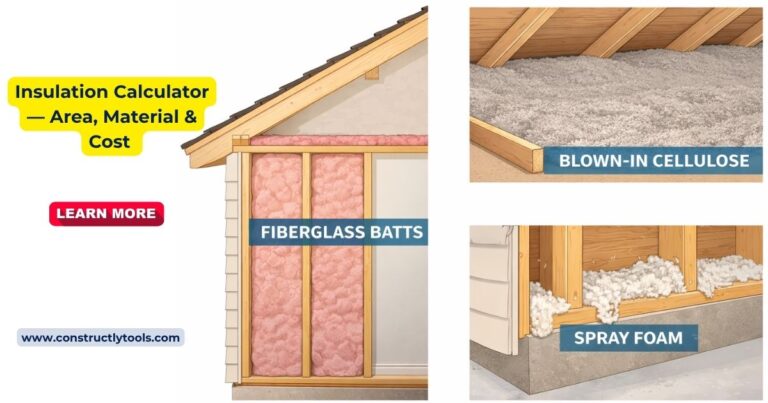
- Insulation Calculator
- Understanding the Inputs
- 3 Real-World Examples
- R-Value Chart by Climate Zone
- Cost by Insulation Type (2026)
- Which Insulation Type Is Right for You?
- Hidden Costs Most Estimates Miss
- Tax Credits & Rebates (2026)
- Common Insulation Mistakes
- How We Estimate Costs
- FAQs
- Related Tools
- References
Fiberglass Batt $0.30–$0.65/sq ft · Mineral Wool $0.60–$1.20/sq ft · Blown Fiberglass $0.50–$1.00/sq ft · Cellulose $0.40–$0.80/sq ft · Open Cell Spray $0.50–$1.00/sq ft · Closed Cell $1.00–$2.50/sq ft · Rigid Foam $0.50–$1.50/sq ft (material only)
Estimates based on 2026 US average pricing from DOE, ENERGY STAR, and RSMeans data. Costs vary by R-value, thickness, and region. Check energystar.gov/rebates for the 30% federal 25C tax credit before starting.
Understanding the Calculator Inputs
This calculator estimates insulation material and labor cost based on area dimensions, insulation type, installation location, and labor choice. Here’s what each means and how to measure correctly for each location type.
How to Measure Each Location
- Attic: Measure the floor area of the attic — length × width of the space below the roof. For irregular shapes, break into rectangles and add. Measure the floor footprint, not along the roofline.
- Walls: Measure total wall area — perimeter × wall height. Deduct large openings (windows, doors) at approximately 20 sq ft each. For a 1,500 sq ft home with 8 ft ceilings, total wall area is roughly 1,200–1,400 sq ft.
- Floor / Crawl Space: Measure the floor area above the crawl space — same dimensions as the room(s) above. For a whole-house crawl space, use the home’s footprint.
- Basement: For basement walls, measure total wall perimeter × wall height. For a basement ceiling (insulating floor above), measure the basement floor area.
DIY Feasibility by Type
Fiberglass and mineral wool batt insulation are the most DIY-friendly — cut to fit between studs or joists, no special equipment. Blown-in insulation requires a blower machine (rentable at Home Depot/Lowe’s for $100–$150/day) — very DIY-able for attics. Spray foam requires professional equipment and respiratory protection — always hire a certified contractor.
Before calculating your budget, visit energystar.gov/rebates — the federal 25C tax credit offers 30% back (up to $1,200/year) on qualifying insulation materials. On a $3,000 attic insulation project, that’s $900 back on your tax return. This changes the effective cost significantly and should factor into your material and contractor selection.
3 Real-World Insulation Examples
Example 1 — Attic Blown-In Cellulose (40×30 ft, Contractor)
The most common insulation project — adding blown-in cellulose to a 1,200 sq ft attic to reach R-49 in a Zone 5 climate. Existing insulation is R-11, topping up to R-49 requires approximately 5 additional inches of cellulose.
| Item | Qty | Unit Cost | Total |
|---|---|---|---|
| Air sealing (bypasses, penetrations) | 1,200 sq ft | $0.25–$0.50/sq ft | $300–$600 |
| Blown-in cellulose (R-38 additional) | 1,320 sq ft (+10%) | $0.40–$0.80/sq ft | $528–$1,056 |
| Labor (blowing + air seal) | 1,200 sq ft | $0.40–$0.70/sq ft | $480–$840 |
| Attic hatch insulation + weatherstrip | 1 unit | $50–$120 | $50–$120 |
| Total contractor installed | $1,358–$2,616 | ||
| Federal 30% tax credit (est.) | −$407–$785 | ||
| Effective after-tax cost | $951–$1,831 | ||
Real-world note: Air sealing before insulating is the most overlooked step in attic projects. The DOE estimates that air sealing + insulation together reduces heating/cooling costs 15–25% more than insulation alone. Always ask if air sealing is included in the quote — a professional who skips it is leaving your biggest energy savings on the table.
Example 2 — Wall Insulation Retrofit (1,500 sq ft home, Blown-In Cellulose)
Adding insulation to existing uninsulated 2×4 walls from the exterior — drill-and-fill method on a 1,500 sq ft ranch home. Approximately 1,200 sq ft of wall area after deducting windows and doors.
| Item | Qty | Unit Cost | Total |
|---|---|---|---|
| Blown-in cellulose (fills 2×4 cavity, R-13) | 1,320 sq ft (+10%) | $0.40–$0.80/sq ft material | $528–$1,056 |
| Labor (drill exterior siding, fill, patch) | 1,200 sq ft | $1.50–$3.00/sq ft | $1,800–$3,600 |
| Siding patch + repaint drill holes | ~120 holes | $8–$15/hole | $960–$1,800 |
| Total contractor installed | $3,288–$6,456 | ||
Real-world note: Retrofitting wall insulation is significantly more expensive than attic insulation because of the access challenge. The drill-and-fill method is standard but the patching and repainting cost is often 30–40% of the total project cost. If the home is due for new siding, combining siding replacement with wall insulation (adding rigid foam behind the new siding) is the most cost-effective approach.
Example 3 — Crawl Space Spray Foam (30×40 ft, Closed Cell, Contractor)
Encapsulating a 1,200 sq ft crawl space with 2" closed cell spray foam on walls and rim joists — the most effective moisture and energy solution for vented crawl spaces in cold climates.
| Item | Qty | Unit Cost | Total |
|---|---|---|---|
| Closed cell spray foam — rim joists (2") | ~160 sq ft | $3–$6.50/sq ft installed | $480–$1,040 |
| Closed cell spray foam — crawl walls (2") | ~320 sq ft | $3–$6.50/sq ft installed | $960–$2,080 |
| Vapor barrier — crawl floor | 1,200 sq ft | $0.15–$0.50/sq ft | $180–$600 |
| Dehumidifier (if needed) | 1 unit | $200–$600 | $200–$600 |
| Total contractor installed | $1,820–$4,320 | ||
| Federal 30% tax credit (est.) | −$546–$1,296 | ||
| Effective after-tax cost | $1,274–$3,024 | ||
Real-world note: Closed cell spray foam is the only insulation that functions as both a thermal barrier and a vapor/air barrier in one application. Rim joists are the #1 source of air infiltration in most homes — even 1" of closed cell foam on rim joists produces dramatic improvements in draft reduction and winter comfort in rooms above the crawl space.
R-Value Chart by Climate Zone
R-value measures resistance to heat flow — the higher the R-value, the better the insulation. The US Department of Energy recommends different R-values by climate zone and location. Most older homes are significantly under-insulated by current DOE standards.
| Climate Zone | States (Examples) | Attic | Walls | Floor / Crawl |
|---|---|---|---|---|
| Zone 1–2 (Hot) | FL, HI, TX south | R-30–R-49 | R-13 | R-13 |
| Zone 3 (Warm) | GA, AL, CA south | R-30–R-60 | R-13–R-15 | R-19–R-25 |
| Zone 4 (Mixed) | TN, VA, OR, WA | R-38–R-60 | R-13–R-21 | R-25–R-30 |
| Zone 5 (Cool) | IL, OH, PA, CO | R-49–R-60 | R-15–R-21 | R-25–R-30 |
| Zone 6–7 (Cold) | MN, WI, MT, ND | R-49–R-60 | R-19–R-21 | R-25–R-30 |
Source: US Department of Energy / ENERGY STAR. Visit energystar.gov for R-value recommendations for your specific zip code.
R-Value Per Inch by Insulation Type
| Insulation Type | R-Value per Inch | To Reach R-38 | To Reach R-49 | To Reach R-60 |
|---|---|---|---|---|
| Fiberglass Batt | R-3.2/in | ~12 in | ~15 in | ~19 in |
| Mineral Wool Batt | R-3.7/in | ~10 in | ~13 in | ~16 in |
| Blown-In Cellulose | R-3.5/in | ~11 in | ~14 in | ~17 in |
| Blown-In Fiberglass | R-2.5/in | ~15 in | ~20 in | ~24 in |
| Open Cell Spray Foam | R-3.7/in | ~10 in | ~13 in | ~16 in |
| Closed Cell Spray Foam | R-6.5/in | ~6 in | ~8 in | ~9 in |
| Rigid Foam (XPS) | R-5.0/in | ~8 in | ~10 in | ~12 in |
Closed cell spray foam delivers the highest R-value per inch — critical where space is limited (rim joists, thin walls). Blown-in cellulose is the most cost-effective choice per R-value dollar for open attic applications.
Insulation Cost by Type (2026)
Complete pricing for all 7 insulation types including total project cost at three common project sizes and DIY feasibility. Pricing sourced from RSMeans 2026 and HomeAdvisor contractor bid data.
| Type | Material $/sq ft | Installed $/sq ft | 500 sq ft | 1,000 sq ft | DIY? |
|---|---|---|---|---|---|
| Fiberglass Batt | $0.30–$0.65 | $0.64–$1.20 | $320–$600 | $640–$1,200 | Yes |
| Blown-In Cellulose | $0.40–$0.80 | $0.80–$1.50 | $400–$750 | $800–$1,500 | Yes (rent blower) |
| Blown-In Fiberglass | $0.50–$1.00 | $1.00–$1.80 | $500–$900 | $1,000–$1,800 | Yes (rent blower) |
| Mineral Wool Batt | $0.60–$1.20 | $1.20–$2.00 | $600–$1,000 | $1,200–$2,000 | Yes |
| Rigid Foam Board | $0.50–$1.50 | $1.50–$3.00 | $750–$1,500 | $1,500–$3,000 | Moderate |
| Open Cell Spray Foam | $0.50–$1.00 | $1.50–$3.00 | $750–$1,500 | $1,500–$3,000 | No — contractor only |
| Closed Cell Spray Foam | $1.00–$2.50 | $3.00–$6.50 | $1,500–$3,250 | $3,000–$6,500 | No — contractor only |
Installed cost includes labor. Prices reflect standard R-values for each location. Before applying tax credits.
Which Insulation Type Is Right for You?
The right insulation depends on location, budget, moisture conditions, and whether you’re doing new construction or a retrofit.
Best by Location
| Location | Best Choice | Why | Budget Alternative |
|---|---|---|---|
| Attic (open, accessible) | Blown-in cellulose | Cheapest per R-value, fast install, settles into gaps | Fiberglass batt (DIY) |
| Attic (sloped/tight) | Closed cell spray foam | High R-value/inch, seals gaps, fits tight spaces | Rigid foam board |
| Walls (new construction) | Fiberglass or mineral wool batt | Easy to install between studs before drywall | Blown-in cellulose (dense pack) |
| Walls (existing/retrofit) | Blown-in cellulose (drill-fill) | Fills existing cavity without opening walls | Open cell spray foam |
| Crawl space walls | Closed cell spray foam | Vapor barrier + insulation in one, handles moisture | Rigid foam board + vapor barrier |
| Rim joists | Closed cell spray foam (2") | Seals air gaps completely, highest impact per sq ft | Rigid foam + caulk |
| Basement walls | Rigid foam board | Handles moisture, easy to install, no vapor issues | Closed cell spray foam |
Attic air sealing + blown-in insulation is the single highest-return insulation investment for most existing homes. A typical 1,200 sq ft attic project costs $1,200–$2,500 installed, qualifies for a 30% federal tax credit, and reduces heating/cooling costs 15–25% per year. Payback period: 3–6 years in most US climates per DOE energy savings estimates.
Hidden Costs Most Insulation Estimates Miss
1. Air Sealing
Air sealing (foam and caulk around penetrations, bypasses, and gaps) should always precede insulation but is often quoted separately and omitted from budget estimates. Cost: $0.25–$0.75/sq ft on top of insulation cost. Without air sealing, insulation works against moving air rather than still air, dramatically reducing real-world performance. The DOE recommends always air sealing before insulating.
2. Old Insulation Removal
If existing attic insulation is damaged by moisture, rodents, or mold, it must be removed before new insulation is installed. Removal and disposal costs $1–$2/sq ft — $1,200–$2,400 for a 1,200 sq ft attic. This can double the project cost and is rarely visible until an inspection. Always ask contractors to assess existing insulation condition before quoting.
3. Pest or Moisture Remediation
Attics with rodent activity or moisture damage require remediation before re-insulating. Rodent dropping sanitization costs $500–$2,000. Mold treatment costs $500–$3,000+. Moisture source repair must be fixed before insulating or the problem recurs. These costs are almost never in an initial insulation quote.
4. Attic Ventilation
Proper attic insulation requires maintaining clear soffit vents and ridge vents. Rafter baffles ($1–$3 each, required along every eave) are a code requirement in most jurisdictions and must be installed before blown-in to maintain airflow. This adds $0.10–$0.30/sq ft to attic projects.
5. Insulation Around Recessed Lighting
Old recessed light fixtures in the ceiling below an attic are major air leakage points and must be sealed with an airtight cover before blown-in insulation is added. Fixture covers cost $10–$30 each; a home with 20 recessed lights adds $200–$600 in materials before insulation begins.
Calculator estimate (blown-in cellulose): $1,008–$1,896 · Air sealing: $300–$600 · Rafter baffles: $120–$360 · Attic hatch cover: $50–$120 · Recessed light covers (15 fixtures): $150–$450 · True all-in: $1,628–$3,426. The federal 30% credit brings the effective cost to $1,140–$2,398.
Tax Credits & Rebates (2026)
Federal Energy Efficient Home Improvement Credit (25C)
- Credit amount: 30% of qualifying insulation material costs (not labor)
- Annual cap: $1,200 per year
- Eligible materials: Insulation and air sealing materials that meet IECC standards for your climate zone
- Labor is NOT eligible — only material cost qualifies for the 30% credit
- Primary residence only — rental properties do not qualify
- How to claim: File IRS Form 5695 with your tax return
How Much Can You Save?
| Project | Material Cost | 30% Tax Credit | Effective Material Cost |
|---|---|---|---|
| 1,200 sq ft attic (cellulose) | $528–$1,056 | $158–$317 | $370–$739 |
| 1,500 sq ft wall retrofit | $660–$1,320 | $198–$396 | $462–$924 |
| Crawl space spray foam | $1,440–$3,120 | $432–$936 | $1,008–$2,184 |
State & Utility Rebates
In addition to the federal credit, most states and utility companies offer rebates for qualifying insulation improvements — some offer $0.10–$0.30/sq ft cash rebates, others offer low-interest financing or free energy audits. Visit energystar.gov/rebates or your utility company’s website before getting contractor quotes.
A professional home energy audit ($200–$400, sometimes free through utility programs) uses a blower door test to identify exactly where your home loses energy and ranks improvements by ROI. Many utilities offer free audits — check before paying.
Common Insulation Mistakes
Insulating Without Air Sealing First
Insulation slows heat transfer through still air — it does almost nothing against moving air. A gap the size of a quarter allows as much heat loss as a square foot of missing insulation. Air sealing gaps, bypasses, and penetrations before insulating is what makes the insulation work as designed. Always air seal first, insulate second.
Blocking Attic Ventilation
Burying soffit vents under blown-in insulation cuts off the ventilation path from eaves to ridge, trapping moisture in the roof deck. This causes mold, rot, and sheathing failure within 3–5 years — a $5,000–$15,000 roof repair. Always install rafter baffles before adding blown-in to any attic with soffit vents.
Choosing Insulation Type Based Only on R-Value Per Dollar
In a crawl space or rim joist application where moisture is present, fiberglass batt holds moisture, loses R-value when wet, and provides no vapor barrier — making closed cell spray foam’s higher cost justified. Match the insulation type to the specific conditions of the location, not just the cheapest price per R-value.
Not Claiming the Tax Credit
Fewer than 40% of homeowners who complete qualifying energy efficiency improvements claim the available federal tax credits. The 25C credit requires filing IRS Form 5695 — it’s not automatic. Ask your contractor for the manufacturer’s certification statement for the insulation product (required for the credit claim) and keep all receipts. On a $2,000 material cost, this is a $600 tax credit that most people leave unclaimed.
How We Estimate Costs
Material Cost = (Area × 1.10) × Material $/sq ft · Labor Cost = Area × Labor $/sq ft · Total = Material + Labor
The 10% waste factor applies to materials only. Labor is calculated on actual area. Costs reflect standard R-values for each location — attic costs reflect R-38 to R-49 depths per DOE Climate Zone 5 recommendations, wall costs reflect 2×4 or 2×6 cavity fill, crawl space and basement costs reflect 2" application. R-value targets are based on DOE/ENERGY STAR recommendations by climate zone.
Material cost ranges from retail pricing at Home Depot, Lowe’s, and insulation distributors. Labor rates from contractor bid data on HomeAdvisor and Angi, cross-referenced with RSMeans 2026 residential labor data. Ranges represent the 20th to 80th percentile of national market pricing.
Ask every insulation contractor: (1) Does the quote include air sealing? (2) What R-value will the finished installation achieve? (3) Do you provide the manufacturer’s certification for the tax credit? (4) Is old insulation removal included if needed? Contractors who answer these clearly are doing the job right.
Frequently Asked Questions
Plan your full home energy efficiency and renovation project.
Energy & Interior
Renovation Cost Estimators
Measurement Tools
- US Department of Energy — Insulation R-Value Recommendations by Climate Zone — Climate zone map and recommended R-values for attic, wall, floor, and basement insulation by US DOE zone (1–7). Referenced for the R-value chart and R-value per inch comparison table. US DOE Office of Energy Efficiency & Renewable Energy, current edition. energystar.gov.
- ENERGY STAR — Home Improvement Tax Credit (25C) Program Guidelines — Federal Energy Efficient Home Improvement Credit specifications: 30% credit rate, $1,200 annual cap, qualifying material categories (insulation meeting IECC standards), primary residence requirement, and IRS Form 5695 filing instructions. Referenced for the tax credits section and all credit dollar amounts. ENERGY STAR / US EPA, 2026 program year.
- International Energy Conservation Code (IECC) — Residential Energy Efficiency Requirements — Minimum insulation R-values by climate zone and building assembly (attic, wall, floor, basement) required for code compliance. Referenced for the R-value recommendation table and insulation material qualification for the 25C tax credit. ICC, current edition.
- RSMeans Building Construction Cost Data 2026 — Unit labor cost data for residential insulation installation by type and location (attic blown-in, wall batt, crawl space spray foam). Referenced for all installed cost ranges per square foot and regional labor adjustment factors. RSMeans / Gordian, 2026.
- HomeAdvisor True Cost Guide 2026 — Contractor bid data for insulation projects by type, location, and US region. Used to cross-validate RSMeans labor cost ranges. Referenced for installed cost ranges per project type in the examples and cost tables. HomeAdvisor / Angi, 2026.
Material pricing reflects 2026 US national average retail pricing from Home Depot, Lowe’s, and insulation distributors. Tax credit information reflects the federal 25C program as of 2026 — program terms are subject to change; verify current program details at energystar.gov/rebates before filing. ConstructlyTools does not have a paid relationship with any insulation manufacturer, distributor, or contractor mentioned on this page.

Prakash
Prakash is the founder and editor of ConstructlyTools. He researches, develops, and maintains construction calculators, material estimators, cost guides, and DIY planning resources designed to help homeowners, contractors, and builders make informed project decisions.
Every calculator and guide is researched using trusted industry references, published building standards, manufacturer specifications, and reliable construction pricing sources. Each page is reviewed for formula accuracy, pricing methodology, readability, and practical usefulness before publication and is updated regularly as standards or market prices change.
Every calculator and article published on ConstructlyTools is independently reviewed for formula accuracy, pricing methodology, readability, and practical usefulness before publication. Content is updated whenever construction pricing, industry standards, or building code references significantly change.
This page was researched, written, and reviewed in accordance with our Editorial Policy.