
Framing Calculator
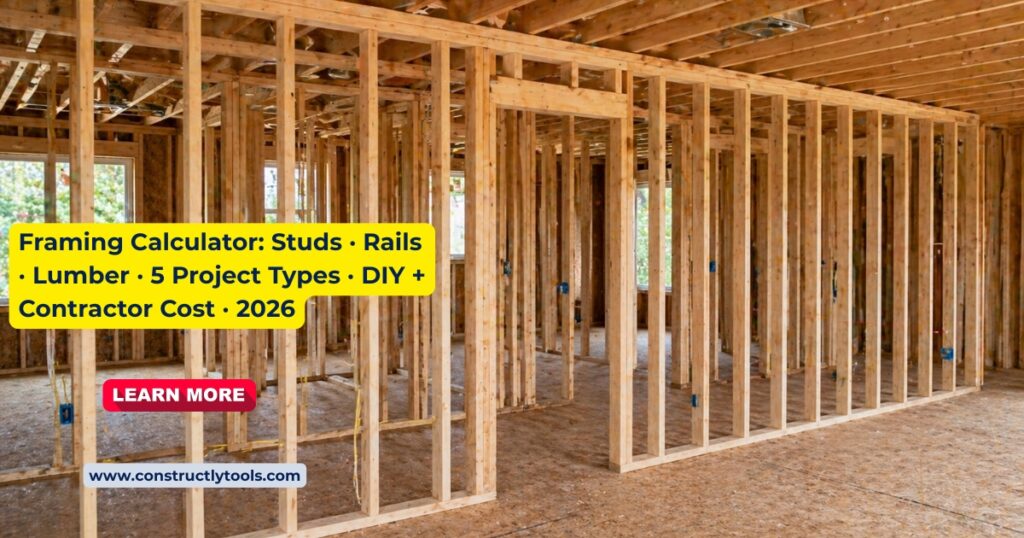
Use this free framing calculator to estimate how many studs, total linear feet of lumber, and number of boards you need for any wall, shed, deck, or roof framing project. Enter your wall dimensions and stud spacing — 12, 16, or 24 inches on center — and the calculator instantly tells you the stud count, total lumber needed including top and bottom plates, and a material and installation cost estimate based on 2026 pricing.
- Framing Calculator
- Understanding the Inputs
- 3 Real-World Examples
- Lumber Size Reference Chart
- Stud Count Quick Reference
- Framing Cost by Project Type (2026)
- What the Calculator Doesn’t Count
- Common Framing Estimation Mistakes
- Factors That Affect Cost
- How We Estimate Costs
- FAQs
- Related Tools
- References
Includes top plate, bottom plate & all studs · 2×4 lumber ~$4–$8 per 8 ft board · Add 10–15% for waste, headers & blocking · Load-bearing walls need a double top plate · Use PT lumber for bottom plates on concrete
Estimates based on 2026 US average pricing from AWC, IRC, and RSMeans data. Lumber prices fluctuate — always confirm current pricing at your local lumber yard.
Understanding the Calculator Inputs
This calculator estimates stud count, total lumber in linear feet, number of 8 ft boards to buy, and material and labor cost for five common framing project types.
Wall Length
Enter the full exterior length of the wall being framed — not the net interior measurement. For a room with multiple walls, run the calculator once per wall and add the results. The stud count formula adds one stud for the starting corner, so running separate walls gives a more accurate total than treating the perimeter as one continuous run.
Wall Height
Standard residential wall height is 8 ft. Many newer homes use 9 ft (pre-set as default here) or 10 ft ceilings. Taller walls use proportionally more lumber per stud but don’t change the stud count formula. For vaulted or cathedral ceilings where height varies, use the average height across the wall.
Stud Spacing
16" on center is the US building code standard (IRC R602) for load-bearing walls and most exterior walls. 24" on center is permitted for non-load-bearing interior partition walls and saves ~25% on lumber. 12" on center is used for heavy loads, tall walls over 10 ft, or high-wind/seismic zones. Never use 24" OC on a load-bearing wall without engineering approval.
Project Type
The project type adjusts material cost per linear foot (lumber grade appropriate for that use) and labor cost per square foot. Deck framing uses pressure-treated lumber at higher cost. Roof framing uses more complex cuts at higher labor rates. Interior walls use standard SPF dimensional lumber at the lowest cost per linear foot.
The calculator gives you the theoretical minimum. Real framing jobs always need more — waste from cuts, damaged boards, extra studs for door and window trimmers, blocking for future shelf brackets, and the occasional miscalculation. Order 10% extra for simple rectangular walls, 15% for walls with multiple openings or complex layouts.
3 Real-World Framing Examples
Example 1 — Basement Partition Wall (16 ft × 8 ft, 16" OC)
A non-load-bearing interior wall dividing a basement. Standard 2×4 SPF framing, no windows, one door opening.
| Item | Qty | Unit Cost | Total |
|---|---|---|---|
| 2×4×8 ft studs (16" OC) | 13 studs + 15% = 15 boards | $4–$7 each | $60–$105 |
| 2×4×16 ft top plate (doubled) | 2 pieces | $12–$18 each | $24–$36 |
| 2×4×16 ft bottom plate (PT) | 1 piece | $12–$18 | $12–$18 |
| Door header (doubled 2×6, 36" opening) | 2 pieces × 4 ft | $6–$10 each | $12–$20 |
| King studs + trimmers (door) | 4 pieces cut to height | $4–$7 each | $16–$28 |
| Concrete screws (bottom plate to slab) | 1 box | $10–$15 | $10–$15 |
| Total materials (DIY) | $134–$222 | ||
| Contractor installed | $900–$2,000 | ||
Real-world note: Concrete slab floors require powder-actuated nailers or concrete screws for the bottom plate — a standard nail gun won’t work. Rent a powder-actuated tool ($20–$40/day) or use Tapcon concrete screws with a hammer drill. Use pressure-treated lumber for the bottom plate only — it costs ~$5 more but resists rot if water ever contacts it.
Example 2 — Exterior Wall Addition (20 ft × 9 ft, 16" OC)
Framing a new 20 ft exterior wall for a home addition. Load-bearing, 2×6 framing for insulation depth, two window openings.
| Item | Qty | Unit Cost | Total |
|---|---|---|---|
| 2×6×10 ft studs (16" OC) | 16 studs + 15% = 19 boards | $9–$14 each | $171–$266 |
| 2×6×20 ft double top plate | 4 pieces (2 plates, spliced) | $18–$26 each | $72–$104 |
| 2×6×20 ft bottom plate (PT) | 2 pieces | $22–$32 each | $44–$64 |
| Window headers (2 openings, doubled 2×8) | 4 pieces × 4 ft each | $10–$16 each | $40–$64 |
| King studs + trimmers (2 windows) | 8 pieces | $9–$14 each | $72–$112 |
| Sill plates + cripple studs (2 windows) | ~10 pieces | $9–$14 each | $90–$140 |
| Structural hardware (joist hangers, anchors) | 1 lot | $60–$100 | $60–$100 |
| Total materials (DIY) | $549–$850 | ||
| Contractor installed | $2,000–$4,000 | ||
Real-world note: Exterior load-bearing walls require 2×6 framing in most cold-climate codes (IRC requires R-20 wall insulation in Climate Zones 5–8) to accommodate R-19 batt insulation. Every window opening in a load-bearing wall requires an engineered header sized for the span. Undersized headers are a code violation and structural risk.
Example 3 — Shed Framing (12×16 ft, All 4 Walls + Roof)
Complete framing material list for a 12×16 ft gable-roof shed. 7 ft eave height, 16" OC, standard 2×4 SPF walls, 2×6 rafters.
| Item | Qty | Unit Cost | Total |
|---|---|---|---|
| 2×4×8 ft wall studs (all 4 walls) | ~60 studs + 15% = 70 boards | $4–$7 each | $280–$490 |
| 2×4 plates (top + bottom, all walls) | ~12 pieces (various lengths) | $6–$14 each | $72–$168 |
| 2×6×12 ft rafters | 10 pairs = 20 pieces + 15% | $12–$18 each | $240–$414 |
| Ridge board (2×8×16 ft) | 1 piece | $28–$40 | $28–$40 |
| 2×4×12 ft collar ties | 10 pieces | $8–$12 each | $80–$120 |
| Door header + framing | 1 opening kit | $30–$60 | $30–$60 |
| Structural hardware (hurricane ties, joist hangers) | 1 lot | $80–$140 | $80–$140 |
| Total framing materials | $810–$1,432 | ||
| + Sheathing (walls + roof) | $400–$700 | ||
| Total framing + sheathing | $1,210–$2,132 | ||
Real-world note: This is framing and sheathing only. A complete 12×16 shed build typically runs $4,000–$9,000 contracted or $1,800–$3,500 in DIY materials for everything. Use our plywood calculator to calculate sheathing quantities and our shed cost calculator for the full project budget.
Lumber Size Reference Chart
Lumber is sold by nominal size but the actual dimensions are smaller due to drying and planing. This matters when calculating fits, clearances, and load capacities.
| Nominal Size | Actual Size | Common Use | Avg Price (8 ft) | Pressure Treated |
|---|---|---|---|---|
| 2×3 | 1.5" × 2.5" | Non-load-bearing blocking, nailers | $3–$5 | N/A |
| 2×4 | 1.5" × 3.5" | Interior & exterior wall studs | $4–$8 | $6–$11 |
| 2×6 | 1.5" × 5.5" | Exterior walls (cold climate), floor joists | $7–$12 | $10–$16 |
| 2×8 | 1.5" × 7.25" | Floor joists, window/door headers | $10–$16 | $14–$22 |
| 2×10 | 1.5" × 9.25" | Long-span floor joists, ridge boards | $14–$22 | $18–$28 |
| 2×12 | 1.5" × 11.25" | Beams, stair stringers, long spans | $18–$28 | $24–$36 |
| 4×4 | 3.5" × 3.5" | Posts, corners, deck framing | $8–$14 | $12–$20 |
| 4×6 | 3.5" × 5.5" | Beams, heavy-load deck posts | $14–$22 | $20–$30 |
| 6×6 | 5.5" × 5.5" | Heavy posts, pergola columns | $22–$35 | $28–$45 |
Prices for standard SPF (Spruce-Pine-Fir) #2 grade at 2026 national average. PT adds 40–60%. Douglas Fir runs 10–20% above SPF. Always confirm current pricing at your lumber yard.
When to Use Pressure Treated Lumber
PT lumber is required by IRC code anywhere lumber contacts or comes close to concrete, soil, or persistent moisture:
- Bottom plates on concrete slabs — any wall plate sitting directly on a concrete floor
- Ground-contact applications — posts, beams, or framing within 6 inches of grade
- Deck framing — all structural members of an outdoor deck exposed to weather
- Exterior sill plates — the bottom plate of any exterior wall sitting on a foundation
Stud Count Quick Reference
Quick lookup for common wall lengths at standard spacing. All counts include end studs. Add 15% for waste and add extra for door/window king studs and trimmers.
| Wall Length | 16" OC Studs | 24" OC Studs | 8 ft Boards (16" OC) | Linear Ft (16" OC, 9 ft wall) |
|---|---|---|---|---|
| 8 ft | 7 studs | 5 studs | ~10 boards | ~79 linear ft |
| 10 ft | 9 studs | 6 studs | ~12 boards | ~101 linear ft |
| 12 ft | 10 studs | 7 studs | ~14 boards | ~114 linear ft |
| 16 ft | 13 studs | 9 studs | ~18 boards | ~149 linear ft |
| 20 ft | 16 studs | 11 studs | ~23 boards | ~184 linear ft |
| 24 ft | 19 studs | 13 studs | ~27 boards | ~219 linear ft |
| 30 ft | 24 studs | 16 studs | ~33 boards | ~276 linear ft |
| 40 ft | 31 studs | 21 studs | ~44 boards | ~359 linear ft |
Board count includes 15% waste. Linear footage includes studs + top plate + bottom plate at 9 ft wall height. Does not include headers, blocking, or king studs.
16" OC — all load-bearing walls, all exterior walls, any wall where you’re unsure, any wall with tile or heavy finishes. 24" OC — acceptable for non-load-bearing interior partition walls only; saves ~25% on lumber but requires ⅝" drywall to prevent sagging. Never guess — if you don’t know whether a wall is load-bearing, treat it as load-bearing and use 16" OC.
Framing Cost by Project Type (2026)
Cost Per Square Foot by Project Type
| Project Type | Material $/sq ft | Installed $/sq ft | Typical Project Cost |
|---|---|---|---|
| Interior Partition Wall | $1–$3 | $7–$16 | $700–$2,400 (100 sq ft wall) |
| Exterior Load-Bearing Wall | $2–$5 | $10–$20 | $1,000–$3,000 (100 sq ft wall) |
| Shed / Outbuilding | $3–$6 | $12–$25 | $1,500–$5,000 (12×16 shed walls) |
| Deck Framing (PT lumber) | $4–$8 | $15–$30 | $3,000–$9,000 (200 sq ft deck) |
| Roof Framing | $5–$10 | $18–$35 | $5,000–$14,000 (1,500 sq ft roof) |
| New Home (full framing) | $7–$16 | $20–$40 | $30,000–$80,000 (2,000 sq ft home) |
Contractor Labor Rate by Region (2026)
| Region | Framing Labor Rate | vs National Average |
|---|---|---|
| Southeast (GA, FL, NC, SC) | $8–$14/sq ft wall | 15–20% below average |
| Midwest (OH, IN, MI, MN) | $9–$16/sq ft wall | At or near average |
| Mid-Atlantic (VA, MD, PA) | $11–$18/sq ft wall | 10–20% above average |
| Northeast (NY, MA, CT) | $14–$24/sq ft wall | 30–45% above average |
| Pacific Coast (CA, WA, OR) | $15–$28/sq ft wall | 35–50% above average |
Lumber prices are the most volatile input in any framing estimate. They swung 300%+ between 2020 and 2022 and continue to fluctuate based on mill capacity, tariffs, and housing demand. The prices in this calculator reflect 2026 national averages but can be out of date within months. Always confirm current pricing at your local lumber yard before finalizing any framing budget.
What the Calculator Doesn’t Count
Headers Above Every Opening
Every door and window requires a structural header. A standard 32" door opening needs a doubled 2×6 header; a 48" window needs a doubled 2×8; a 6 ft garage door needs a doubled 2×12 or an engineered beam. Headers can add 5–15% to total lumber depending on the number of openings.
King Studs and Trimmers
Every door and window opening requires 2 king studs (full-height) and 2 trimmer studs (support the header ends). That’s 4 extra studs per opening plus cripple studs above the header. A wall with 3 windows and 1 door needs 16+ extra stud pieces beyond the basic wall calculation.
Blocking
Horizontal blocking is required for fire blocking (code-required at specific heights), backing for future fixtures (grab bars, TV mounts), and structural blocking between joists. For bathrooms, always install blocking at 33–36" height on every wall — retrofitting blocking means cutting open finished walls.
Corner and Intersection Framing
Every exterior corner requires 3 studs — two to form the corner and one as a nailer for interior finish. On a typical room with 4 corners and 2 intersecting walls, that’s 10–18 additional studs beyond the basic wall count.
Structural Hardware
Modern framing requires metal connectors required by code and structural engineering: hurricane ties, joist hangers, post bases, and hold-down anchors. Budget $80–$250 in structural hardware for a typical room addition or shed, and more for seismic zones.
Sheathing
Structural wall sheathing (OSB or plywood) and roof decking are separate from framing lumber. Use our plywood calculator to estimate sheathing quantities. A 20 ft × 9 ft wall needs approximately 6 sheets of OSB.
Removing or modifying a load-bearing wall without a structural engineer’s review causes structural collapse. Signs a wall may be load-bearing: it runs perpendicular to floor joists, it sits directly above a beam in the basement, it runs through the center of the house. When in doubt, hire a structural engineer ($300–$700) before touching anything.
Common Framing Estimation Mistakes
Calculating Only the Net Wall Area
A 20 ft wall with a 3 ft door and a 4 ft window still needs studs positioned every 16" across the full 20 ft run, plus extra studs for window and door framing. Calculate studs for the full wall length, then add window and door framing separately.
Forgetting the Double Top Plate
Load-bearing walls require a double top plate — two layers of horizontal lumber at the top. This adds one full wall length of lumber to your material list — easy to forget, immediately visible when you run short on framing day.
Using Indoor Lumber for Outdoor Applications
Standard KD SPF lumber will rot within 2–5 years when contacting concrete, soil, or persistent moisture. Using untreated lumber for deck framing, shed floor systems, or bottom plates on concrete slabs is both a building code violation and a structural failure waiting to happen. PT lumber costs 40–60% more but is the only appropriate choice for these applications.
Not Accounting for Lumber Length Waste
A 9 ft wall stud cut from a 10 ft board wastes 1 ft per piece — 10% waste per board. Always match lumber lengths to your wall height: 9 ft walls use 10 ft studs, 8 ft walls use 8 ft studs, 10 ft walls use 10 or 12 ft studs. Mismatched lengths generate significant waste and return trips to the lumber yard.
Ignoring Permit and Inspection Requirements
Most structural framing — adding walls, removing walls, building additions — requires a building permit and a framing inspection before walls are closed in with drywall. Skipping permits creates problems when selling: buyers’ inspectors find unpermitted work, title companies flag open permits, and insurance claims on structures with unpermitted modifications are routinely denied.
Factors That Affect Framing Cost
Lumber Species and Grade
Standard SPF #2 grade is the most common framing lumber. Douglas Fir is stronger and costs 10–20% more — preferred for long spans and high-load applications. Pressure treated lumber adds 40–60% to material cost but is required for ground-contact and exterior applications.
Wall Complexity
Simple rectangular walls are the cheapest to frame. Angled walls, curved walls, cathedral ceilings, and multi-story walls increase labor time significantly. Expect 25–50% higher labor costs for complex geometry vs standard rectangular framing.
Engineered Lumber vs Dimensional
LVL (laminated veneer lumber) beams, I-joists, and PSL cost 2–4× more than dimensional lumber but span farther and carry more load — allowing longer spans without intermediate posts. For headers over large openings (garage doors, wide windows), engineered beams are often the only code-compliant option.
Seismic and Wind Zone Requirements
In earthquake zones (California, Pacific Northwest) and hurricane zones (Gulf Coast, Atlantic Coast), framing requires additional structural connections, shear panels, and hold-down hardware. These requirements add $1,000–$5,000+ to a typical framing project in high-risk zones.
How We Estimate Costs
Stud count formula: Studs = CEILING(Wall Length in inches ÷ Stud Spacing) + 1 — ceiling function rounds up to ensure enough studs; +1 accounts for the closing stud at the far end. This matches the methodology in RSMeans framing labor unit data and the AWC prescriptive stud spacing tables.
Total linear feet: (Studs × Wall Height) + (2 × Wall Length) — second term accounts for one top plate and one bottom plate. Load-bearing walls require a double top plate — add one additional wall length. The calculator uses a single top plate by default; add 15% waste to cover the double plate on load-bearing applications.
Material cost per linear foot is derived from retail lumber pricing at Home Depot, Lowe’s, and regional lumber yards for the appropriate species for each project type, updated as of early 2026. Labor cost per square foot is sourced from contractor bid data on HomeAdvisor and Angi, cross-referenced with RSMeans labor unit data for residential framing.
A 2×4 stud costs $4.50 at one lumber yard and $7.80 at another in the same city. Framing labor runs $9/sq ft in rural Georgia and $24/sq ft in Manhattan. Showing a single number would be meaningless. The ranges reflect real market pricing — use the midpoint for planning, the high end as your ceiling, and get actual quotes from local suppliers and contractors for final budgeting.
Frequently Asked Questions
Plan your full construction project with these free calculators.
Measurement Tools
Material Calculators
- American Wood Council (AWC) — National Design Specification for Wood Construction — Stud spacing and wall framing specifications, PT lumber requirements for ground contact and concrete contact, and prescriptive stud sizing by wall height and load. Referenced for stud spacing guidance (16" vs 24" OC), PT lumber requirements, and post embedment rules. AWC, current edition.
- IRC (International Residential Code) — Section R602: Wood Wall Framing — Prescriptive framing requirements including stud spacing by load type (R602.3), double top plate requirements for load-bearing walls (R602.3.2), header sizing by span (Table R602.7), and wall sheathing requirements. Referenced for stud spacing rules, double top plate requirement, and header sizing. ICC, current edition.
- IRC Section R318 — Protection Against Decay — Requirements for pressure-treated lumber in ground contact, within 6 inches of grade, and on concrete slabs. Referenced for the PT lumber requirement guidance in the lumber chart and installation tips. ICC, current edition.
- RSMeans Building Construction Cost Data 2026 — Unit labor cost data for residential framing by project type (interior wall, exterior wall, roof), regional labor rate multipliers, and material unit costs for SPF and pressure-treated lumber. Referenced for all installed cost ranges and regional labor rate table. RSMeans / Gordian, 2026.
- HomeAdvisor True Cost Guide 2026 — Contractor bid data for framing projects by scope and US region. Used to cross-validate RSMeans labor cost ranges and regional adjustment factors. HomeAdvisor / Angi, 2026.
Lumber pricing reflects 2026 US national average retail pricing from Home Depot, Lowe’s, and regional lumber yards. Lumber prices are highly volatile — always confirm current pricing with your local supplier before finalizing any budget. ConstructlyTools does not have a paid relationship with any lumber manufacturer, retailer, or contractor mentioned on this page.

Prakash
Prakash is the founder and editor of ConstructlyTools. He researches, develops, and maintains construction calculators, material estimators, cost guides, and DIY planning resources designed to help homeowners, contractors, and builders make informed project decisions.
Every calculator and guide is researched using trusted industry references, published building standards, manufacturer specifications, and reliable construction pricing sources. Each page is reviewed for formula accuracy, pricing methodology, readability, and practical usefulness before publication and is updated regularly as standards or market prices change.
Every calculator and article published on ConstructlyTools is independently reviewed for formula accuracy, pricing methodology, readability, and practical usefulness before publication. Content is updated whenever construction pricing, industry standards, or building code references significantly change.
This page was researched, written, and reviewed in accordance with our Editorial Policy.