
Pea Gravel Calculator
Use this free pea gravel calculator to instantly find out how many tons, cubic yards, and bags of pea gravel you need for your project. Whether you’re covering a walkway, patio, driveway, dog run, or drainage area, simply enter your length, width, and desired depth to get accurate material quantities and an optional cost estimate. Perfect for homeowners, DIY landscapers, and contractors planning any pea gravel project.
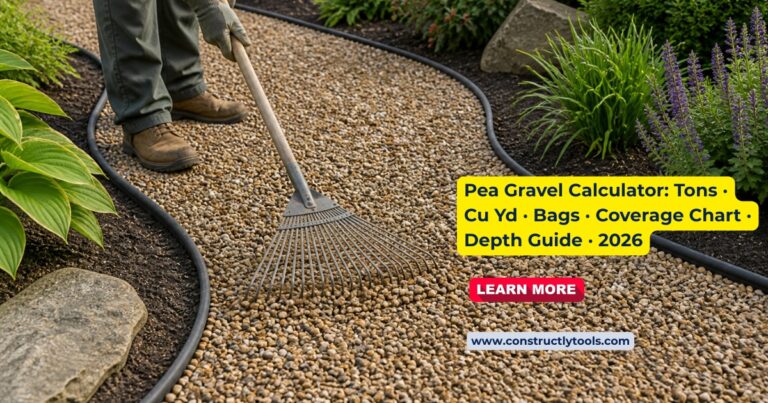
1 ton of pea gravel ≈ 0.67 cu yd · covers ~100 sq ft at 2" depth · ~50 sq ft at 4" depth · Density: 105 lbs/cu ft · Always add 10% for waste · Bulk beats bags for projects over 50 sq ft
Estimates based on standard pea gravel density of 105 lbs/cu ft per ASTM aggregate data and 2026 US average pricing from landscape suppliers and HomeAdvisor. Always confirm current pricing with your local supplier.
How Does the Pea Gravel Calculator Work?
This pea gravel calculator estimates tons, cubic yards, cubic feet, and 0.5 cu ft bags for any landscaping or construction project. Enter your area dimensions and desired depth, and the calculator instantly gives you material quantities and an optional cost estimate based on your local supplier price per ton.
- Enter the length and width of your project area in feet. For irregular shapes, use our Square Footage Calculator first.
- Enter the desired depth in inches — 2 inches for walkways/borders, 3–4 inches for driveways.
- Optionally enter your price per ton to get a cost estimate.
Always order 10–15% more than the calculator result to account for compaction, spillage, and uneven ground. It is far cheaper to have extra than to make a second delivery trip — most suppliers have a delivery minimum.
3 Worked Examples
Example 1 — Backyard Patio (20×15 ft, 2 Inches, Bulk Delivery)
A 300 sq ft backyard seating area with pea gravel at 2-inch depth. Bulk delivery at $45/ton, landscape fabric included.
20 × 15 = 300 sq ft
Step 2 — Volume:300 × (2 ÷ 12) = 300 × 0.167 = 50.0 cu ft
Step 3 — Cubic yards:50.0 ÷ 27 = 1.85 cu yd
Step 4 — Tons (105 lbs/cu ft):50.0 × 10⁵ ÷ 2,000 = 2.63 tons
Step 5 — Add 10% waste:2.63 × 1.10 = 2.89 tons to order
| Item | Qty | Unit Cost | Total |
|---|---|---|---|
| Pea gravel (bulk delivery) | 2.89 tons | $35–$55/ton | $101–$159 |
| Bulk delivery charge | 1 load | $50–$150 | $50–$150 |
| Landscape fabric (woven geotextile) | 330 sq ft (+10%) | $0.10–$0.20/sq ft | $33–$66 |
| Fabric pins | 35 pins | $0.15–$0.30 each | $5–$11 |
| Edging (70 linear ft perimeter) | 70 LF | $0.50–$2.00/LF | $35–$140 |
| Total materials | $224–$526 | ||
Real-world note: For a patio application, install edging first before spreading gravel — pea gravel migrates easily without containment. Use metal landscape edging for a clean, durable border. Rake the gravel to an even 2-inch depth and check in multiple spots with a ruler. A flat-blade garden rake works better than a bow rake for spreading gravel evenly.
Example 2 — Gravel Driveway (60×12 ft, 4 Inches, Bulk)
A 720 sq ft single-lane gravel driveway at 4-inch depth. Note: pea gravel driveways require edging and regular maintenance as gravel shifts under vehicle weight.
60 × 12 = 720 sq ft
Step 2 — Volume:720 × (4 ÷ 12) = 720 × 0.333 = 240.0 cu ft
Step 3 — Tons:240.0 × 10⁵ ÷ 2,000 = 12.6 tons
Step 4 — Add 10% waste:12.6 × 1.10 = 13.9 tons to order
| Item | Qty | Unit Cost | Total |
|---|---|---|---|
| Pea gravel (bulk) | 13.9 tons | $35–$55/ton | $487–$765 |
| Delivery (2 loads for this quantity) | 2 loads | $50–$150/load | $100–$300 |
| Edging (144 LF perimeter) | 144 LF | $1–$3/LF | $144–$432 |
| Landscape fabric | 800 sq ft | $0.10–$0.20/sq ft | $80–$160 |
| Total materials | $811–$1,657 | ||
Real-world note: Pea gravel driveways are affordable but require more maintenance than crushed stone — round gravel rolls under vehicle tires and migrates to edges over time, requiring periodic raking back to center. For a lower-maintenance driveway, consider crushed limestone or angular stone instead. If you proceed with pea gravel, install 4–6 inch edging buried at least 2 inches below grade to contain the material. Top up with an additional 1–2 tons every 2–3 years as gravel settles and migrates.
Example 3 — Dog Run / Play Area (15×20 ft, 3 Inches, Bags)
A 300 sq ft dog run surface at 3-inch depth using bagged pea gravel from a home improvement store. Small project, no delivery needed.
15 × 20 = 300 sq ft
Step 2 — Volume:300 × (3 ÷ 12) = 300 × 0.25 = 75.0 cu ft
Step 3 — Tons:75.0 × 10⁵ ÷ 2,000 = 3.94 tons
Step 4 — Bags (0.5 cu ft each) with 10% waste:CEILING(75.0 × 1.10 ÷ 0.5) = 165 bags
| Option | Qty | Unit Cost | Total | Notes |
|---|---|---|---|---|
| Bags (0.5 cu ft, home store) | 165 bags | $4–$8/bag | $660–$1,320 | No delivery needed |
| Bulk delivery (recommended) | 4.33 tons | $35–$55/ton | $152–$238 + delivery | 60–75% cheaper |
| Landscape fabric | 330 sq ft | $0.10–$0.20/sq ft | $33–$66 | — |
| Edging (70 LF) | 70 LF | $0.50–$2/LF | $35–$140 | — |
Real-world note: At 165 bags, the bagged option costs $660–$1,320 just in gravel — bulk delivery at $152–$388 all-in is 60–75% cheaper for this same project. The bag option only makes sense if you have no truck access or need less than 0.5 tons (about 20–25 bags). For this project size, always call a landscape supply yard for bulk pricing before buying bags.
Pea Gravel Coverage Chart
How much area does 1 ton of pea gravel cover? Based on standard pea gravel density of 105 lbs/cu ft (approximately 2,800 lbs/cu yd). Includes 10% waste factor.
| Depth | 1 Ton Covers | 100 sq ft needs | 200 sq ft needs | 500 sq ft needs |
|---|---|---|---|---|
| 1 inch | ~181 sq ft | 0.55 tons | 1.1 tons | 2.75 tons |
| 2 inches | ~91 sq ft | 1.10 tons | 2.2 tons | 5.50 tons |
| 3 inches | ~60 sq ft | 1.65 tons | 3.3 tons | 8.25 tons |
| 4 inches | ~45 sq ft | 2.20 tons | 4.4 tons | 11.00 tons |
| 6 inches | ~30 sq ft | 3.30 tons | 6.6 tons | 16.50 tons |
Based on pea gravel density of 105 lbs/cu ft, including 10% waste. Actual coverage varies slightly by supplier and moisture content.
Pea Gravel Cost (2026)
| Purchase Type | Quantity | Average Price | Cost/Ton Equiv. | Best For |
|---|---|---|---|---|
| Bulk by ton | 1 ton | $35–$55 | $35–$55/ton | Large projects 200+ sq ft |
| Bulk by cubic yard | 1 cu yd | $40–$65 | $60–$97/ton equiv. | Medium projects |
| Bag (0.5 cu ft) | 0.5 cu ft | $4–$8 | $240–$480/ton equiv. | Small patches under 50 sq ft |
| Delivery charge | Per load | $50–$150 | — | Bulk orders |
Bagged pea gravel from home improvement stores costs $240–$480/ton equivalent — roughly 5–10× more expensive than bulk. For any project over 50 sq ft (about 25 bags at 2" depth), bulk delivery is cheaper even after the delivery fee. Call your local landscape supply yard for bulk pricing before buying a single bag.
Recommended Depth by Application
| Application | Recommended Depth | Notes |
|---|---|---|
| Decorative garden border | 1–2 inches | Aesthetic only — not for foot traffic |
| Walkway / path | 2–3 inches | Most common use |
| Patio / seating area | 2–3 inches | Install landscape fabric below |
| Driveway | 4–6 inches | Needs edging to contain; round gravel shifts under vehicles |
| Dog run / play area | 3–4 inches | Smooth, safe surface; easy to clean |
| Drainage / French drain | 6–12 inches | Use washed pea gravel only |
| Playground safety surface | 6–9 inches | CPSC standard for 6 ft equipment height |
Hidden Costs Most Estimates Miss
1. Landscape Fabric
Landscape fabric is not included in most pea gravel estimates but is essential — without it, weeds push through within one season and the gravel sinks into soft soil over time, requiring a full top-up. Commercial-grade woven geotextile fabric costs $0.10–$0.20 per sq ft ($30–$60 for a 300 sq ft project). Do not use cheap plastic sheeting — it blocks water drainage and degrades in sunlight.
2. Edging
Pea gravel is round and migrates easily — especially on any slight grade. Without edging, gravel spreads into lawn areas within one season. Metal landscape edging costs $1–$3 per linear foot installed; plastic edging costs $0.50–$1.50. For a 300 sq ft rectangular patio (70 LF perimeter), edging adds $35–$210 to the project cost. This is consistently one of the most overlooked line items.
3. Delivery Minimums
Most bulk landscape suppliers have a 1–3 ton minimum for delivery. If you need 0.8 tons but the minimum is 2 tons, you pay for 2 tons. Always ask: What is the delivery minimum? Is there a small-load surcharge? Fuel surcharges of $10–$30 per delivery are standard in 2026. Factor all of these into your per-ton cost comparison before choosing a supplier.
4. Ongoing Top-Up Costs
Pea gravel compacts and settles over time — especially in high-traffic areas like driveways. Expect to top up 10–20% of the original volume every 2–3 years. A 720 sq ft driveway that took 14 tons at installation may need 1.5–3 tons every few years to maintain the original depth. Budget for this ongoing cost when comparing pea gravel to lower-maintenance options like decomposed granite with stabilizer.
5. Base Layer (for Driveways)
For driveways and high-traffic pathways, pea gravel performs best over a compacted base layer of crushed stone (2–4 inches of ¾" crushed limestone or road base). Without a base layer, the gravel sinks into soft soil under vehicle weight and requires replacement sooner. This base layer adds $25–$55/ton for a separate crushed stone order — typically 5–8 tons for a single-lane driveway.
Common Calculation Mistakes
Not Adding the Waste Factor
The calculator gives exact theoretical volume. Real projects always need 10–15% more — gravel compacts when spread, settles over time, and spills at edges during installation. Running short means a second delivery at full price. Always order at least 10% more than the calculator result.
Using the Wrong Depth for Driveways
Many homeowners install pea gravel driveways at 2–3 inches depth because that’s what they use for walkways. For vehicle traffic, 4–6 inches is required — thinner applications compress to almost nothing under vehicle weight within months and require immediate top-up. Using the wrong depth means ordering half as much gravel as you actually need.
Forgetting the Landscape Fabric and Edging in the Budget
Many estimates include only gravel cost. A complete project also needs landscape fabric ($0.10–$0.20/sq ft), fabric pins ($5–$15), and edging ($0.50–$3.00/LF). For a 300 sq ft project, these add $70–$365 — potentially more than the gravel itself for smaller projects. Always budget the complete material list.
Buying Bags When Bulk Is Dramatically Cheaper
Bagged pea gravel from home improvement stores costs $240–$480/ton equivalent. Bulk delivery costs $35–$55/ton plus $50–$150 delivery. For a 300 sq ft patio at 2 inches deep (2.63 tons needed), bags cost $630–$1,260 vs bulk at $142–$295 all-in. Bags are only cost-effective for projects under 0.5 tons (roughly 50 sq ft at 2 inches deep).
Choosing Pea Gravel for Steep Slopes
Pea gravel is round and smooth — it rolls on any slope greater than about 5% grade. Using pea gravel on a sloped area produces a surface that shifts underfoot, migrates downhill with rain, and requires constant maintenance. For slopes, use angular crushed stone or decomposed granite with stabilizer — the angular edges lock together and stay in place.
Buying & Installation Tips
Before You Buy
- Always install landscape fabric first — woven geotextile prevents weeds and stops gravel from sinking into soil.
- Install edging before spreading — metal, plastic, or brick edging keeps pea gravel contained and prevents migration into lawn areas.
- Order 10–15% extra — for compaction, waste, and future top-ups.
- Ask for washed pea gravel — unwashed gravel contains dust and debris that affects appearance and drainage.
- Get 3 local quotes — bulk pea gravel pricing varies significantly by region. Call local quarries and landscape supply yards to compare.
- Order a sample bag first — color and size can look very different in person vs photos online.
Pea gravel is not suitable for slopes greater than ~5% grade — it rolls and shifts with foot traffic and rain. Use angular crushed stone or decomposed granite with polymer stabilizer for any sloped application.
How We Calculate
Volume (cu ft) = Length × Width × (Depth ÷ 12) · Tons = Volume × 105 ÷ 2,000 · Cubic Yards = Volume ÷ 27 · Bags = CEILING(Volume ÷ 0.5)
The density constant of 105 lbs per cubic foot is the standard bulk density for pea gravel consistent with ASTM C125 (Standard Terminology Relating to Concrete and Concrete Aggregates) and widely used by landscape supply industry sources. This translates to approximately 2,835 lbs per cubic yard, or roughly 0.71 short tons per cubic yard.
Note: the original calculator used a factor of 0.0975 tons/cu ft, which corresponds to a density of 195 lbs/cu ft — significantly higher than the standard 105 lbs/cu ft for pea gravel. This updated formula uses the correct 0.0525 tons/cu ft (105 lbs/cu ft ÷ 2,000 lbs/ton). The 10% waste factor should always be applied before ordering. Bag count uses 0.5 cu ft as the standard bag size at US home improvement stores.
Frequently Asked Questions
Use these calculators to measure areas, estimate materials, and plan your project.
Measurement Tools
Material Calculators
- ASTM C125 — Standard Terminology Relating to Concrete and Concrete Aggregates — Standard definitions and bulk density specifications for fine aggregates including pea gravel. Standard bulk density of pea gravel: approximately 105 lbs per cubic foot (2,835 lbs per cubic yard), used as the density constant in the calculator formula. ASTM International, current edition.
- CPSC (US Consumer Product Safety Commission) — Public Playground Safety Handbook — Required depth of loose-fill protective surfacing materials including pea gravel for playground applications: minimum 9 inches of uncompressed material for equipment with a maximum use zone height of 6 feet (Publication #325). Referenced for playground depth recommendations. US CPSC, current edition.
- HomeAdvisor True Cost Guide 2026 — Bulk pea gravel pricing by US region ($35–$55/ton), bag pricing at home improvement stores ($4–$8 per 0.5 cu ft bag), and delivery fee ranges. Referenced for all cost estimates in the cost table, worked examples, and hidden costs section. HomeAdvisor / Angi, 2026.
- IECA (International Erosion Control Association) — Geotextile Fabric Specifications — Performance specifications for woven geotextile landscape fabric including water flow rate, UV stability, and overlap/pinning requirements. Referenced for landscape fabric guidance in the hidden costs and buying tips sections. IECA, current edition.
Pea gravel pricing reflects 2026 US national average pricing from landscape supply yards. Pricing varies significantly by region — areas near local aggregate sources pay substantially less per ton. Always get 3 local quotes before ordering any bulk delivery. ConstructlyTools does not have a paid relationship with any aggregate supplier or contractor mentioned on this page.

Prakash
Prakash is the founder and editor of ConstructlyTools. He researches, develops, and maintains construction calculators, material estimators, cost guides, and DIY planning resources designed to help homeowners, contractors, and builders make informed project decisions.
Every calculator and guide is researched using trusted industry references, published building standards, manufacturer specifications, and reliable construction pricing sources. Each page is reviewed for formula accuracy, pricing methodology, readability, and practical usefulness before publication and is updated regularly as standards or market prices change.
Every calculator and article published on ConstructlyTools is independently reviewed for formula accuracy, pricing methodology, readability, and practical usefulness before publication. Content is updated whenever construction pricing, industry standards, or building code references significantly change.
This page was researched, written, and reviewed in accordance with our Editorial Policy.