
Retaining Wall Cost Calculator
Use this retaining wall cost calculator to estimate the total price of your project based on wall length, height, and material choice. Perfect for homeowners, DIY builders, and contractors looking to plan retaining wall projects and calculate accurate budgets.
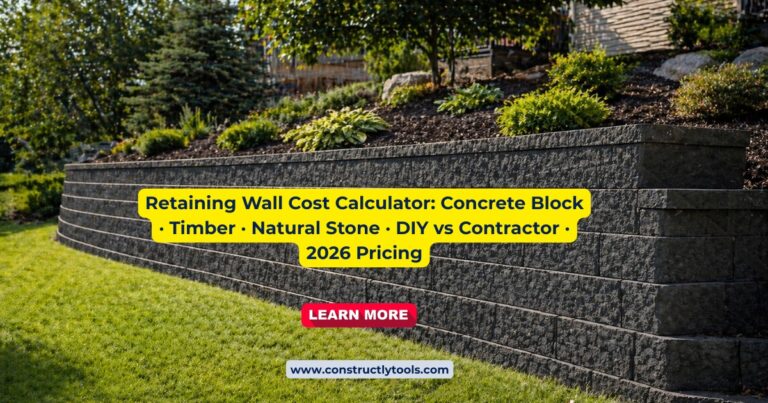
- Retaining Wall Cost Calculator
- Understanding the Inputs
- 3 Real-World Examples
- Cost by Material Type (2026)
- Wall Height & Engineering Guide
- Drainage — The Non-Negotiable
- Hidden Costs Most Estimates Miss
- Common Estimation Mistakes
- DIY vs Contractor Guide
- How We Estimate Costs
- FAQs
- Related Tools
- References
⚠️ Drainage NOT included — add $300–$2,500 · Concrete Block $6–$9 · Timber $5–$8 · Natural Stone $10–$20 · Poured Concrete $8–$12 · Brick $9–$14 (materials per sq ft) · Walls over 4 ft require permit + engineering
Estimates based on 2026 US national average pricing from HomeAdvisor, RSMeans, and NAHB. Costs vary by site conditions, soil type, and region. Always get 3 quotes from licensed contractors.
Understanding the Calculator Inputs
Retaining wall cost varies more than almost any other landscape project — a 2-foot timber garden border costs $800; a 6-foot engineered concrete block wall costs $30,000+. The four inputs in the calculator drive 90% of the estimate. Here's what each means and what to watch out for.
Wall Length
Measure along the base of the wall, following any curves or corners. For an L-shaped or stepped wall, add the two leg lengths together. Wall length is straightforward — it's the height and material that create the most estimation surprises.
Wall Height
Measure the exposed face height — from finished grade at the base of the wall to the top of the wall, measured vertically. This is not the same as the total depth of the wall structure, which includes the buried footing course (typically 1 buried course for every 8 courses exposed). The exposed face height drives material quantity, cost, and — most critically — whether your project requires a permit and engineering drawings.
Material Selection
Material choice affects cost per square foot, aesthetic, lifespan, and DIY feasibility. Concrete block/segmental (Allan Block, Versa-Lok, Belgard) is the most common residential choice — DIY-friendly up to 3–4 ft, excellent variety, 50+ year lifespan. Timber is cheapest but has the shortest lifespan (10–20 years) and is not code-compliant for walls over 4 ft in most areas. Natural stone is beautiful and lasts 100+ years but requires skilled labor. Poured concrete is strongest and most permanent but requires formwork — not a DIY project. Brick is attractive but labor-intensive and expensive.
DIY vs Contractor
DIY mode removes the labor cost entirely — realistic only for walls under 3 feet using segmental concrete block or timber. Any wall over 4 feet, any wall with structural requirements, and any poured concrete or mortared stone wall should always be contractor-installed. For the DIY estimate to be complete, budget drainage materials separately — drainage is never included in any wall-only estimate, including this calculator.
Most US municipalities require a building permit for retaining walls over 3–4 feet in exposed height. Many also require stamped engineering drawings from a licensed structural engineer for walls over 4 feet. This isn't bureaucratic red tape — walls over 4 feet generate enormous lateral soil pressure and failure of an unengineered tall wall can be catastrophic. Check your local building department before designing anything taller than 3 feet.
3 Real-World Retaining Wall Examples
These are realistic project scenarios showing full cost breakdowns — wall structure plus drainage, which is always required but almost never in the advertised estimate.
Example 1 — Garden Border Wall (30 ft × 2 ft, Concrete Block, DIY)
A low garden terrace wall along a sloped backyard, DIY-installed using interlocking concrete block. Under permit threshold in most jurisdictions.
| Item | Qty | Unit Cost | Total |
|---|---|---|---|
| Segmental concrete block (6"×12"×8") | ~95 blocks | $3–$6 each | $285–$570 |
| Cap blocks | 30 caps | $4–$8 each | $120–$240 |
| Compacted gravel base (6") | ~1.5 tons | $30–$50/ton | $45–$75 |
| Drainage gravel (behind wall) | ~1 ton | $35–$55/ton | $35–$55 |
| Filter fabric (geotextile) | ~70 sq ft | $0.20–$0.35/sq ft | $14–$25 |
| 4" perforated drain pipe | 35 LF + outlet | $0.60–$1.00/ft | $21–$35 |
| Total DIY materials (60 sq ft wall) | $520–$1,000 | ||
| Contractor installed equivalent | $1,260–$2,400 | ||
Real-world note: A 2-foot segmental block wall is a well-suited beginner DIY project. The critical step most DIYers skip: burying one full course below finished grade and installing drainage gravel and pipe immediately behind the wall as each course is laid. A 2-foot wall that fails almost always fails because drainage was skipped. Drainage materials here cost $70–$115 — far less than wall repair. The most important single task: the first buried course must be perfectly level along its entire length. Every course above compounds any error in the base.
Example 2 — Landscape Retaining Wall (50 ft × 4 ft, Concrete Block, Contractor)
The most common residential retaining wall project — a 4-foot wall to terrace a sloped backyard. Permit required in most jurisdictions. Professionally installed.
| Item | Qty | Unit Cost | Total |
|---|---|---|---|
| Segmental concrete block | 200 sq ft face | $6–$9/sq ft material | $1,200–$1,800 |
| Cap blocks | 50 LF | $6–$12/LF | $300–$600 |
| Compacted gravel base | ~3 tons | $30–$50/ton | $90–$150 |
| Drainage gravel (12" behind wall) | ~5 tons | $35–$55/ton | $175–$275 |
| Filter fabric | ~250 sq ft | $0.20–$0.35/sq ft | $50–$88 |
| 4" perforated drain pipe + outlets | 55 LF + 2 outlets | $1–$2.50/ft | $55–$138 |
| Geogrid reinforcement (required at 4 ft) | 2 layers × 50 LF | $1.50–$2.50/sq ft | $150–$250 |
| Building permit | 1 | $150–$400 | $150–$400 |
| Labor (excavation + wall + drainage + backfill) | 200 sq ft | $8–$14/sq ft | $1,600–$2,800 |
| Total contractor installed | $3,770–$6,501 | ||
Real-world note: At 4 feet, geogrid soil reinforcement is required by most block manufacturers' specifications and many building codes — layers of plastic mesh embedded in the backfill that prevent the wall from sliding forward under soil pressure. Contractors who don't include geogrid in 4-foot wall bids are providing a substandard installation. Ask every bidder explicitly: "Does your quote include geogrid reinforcement per the block manufacturer's installation specifications?" before accepting any proposal.
Example 3 — Engineered Structural Wall (80 ft × 6 ft, Poured Concrete)
A full structural retaining wall for a significant grade change. 6-foot exposed height, poured concrete, requires engineering drawings and permit in all jurisdictions.
| Item | Qty | Unit Cost | Total |
|---|---|---|---|
| Structural engineering drawings (stamped) | 1 set | $1,500–$3,500 | $1,500–$3,500 |
| Building permit | 1 | $300–$800 | $300–$800 |
| Excavation (footing + 6 ft depth) | ~45 cu yd | $80–$150/cu yd | $3,600–$6,750 |
| Concrete footing + wall (poured) | 480 sq ft face | $8–$12/sq ft material | $3,840–$5,760 |
| Rebar (engineered schedule) | ~600 LF | $0.80–$1.20/LF | $480–$720 |
| Formwork (set + strip) | 480 sq ft | $4–$7/sq ft | $1,920–$3,360 |
| Drainage system (weep holes + pipe) | 85 LF | $15–$25/LF installed | $1,275–$2,125 |
| Waterproofing membrane (buried face) | 480 sq ft | $1.50–$2.50/sq ft | $720–$1,200 |
| Labor (total) | 480 sq ft | $10–$16/sq ft | $4,800–$7,680 |
| Total contractor installed | $18,435–$31,895 | ||
Real-world note: A 6-foot poured concrete wall is a commercial-grade structural project — not a landscaping job. The engineering drawings alone cost $1,500–$3,500, and excavation for a proper footing at 6 feet of exposed height can go 8–10 feet deep to reach stable bearing soil below the frost line. Get three bids and ask all three contractors for their engineering approach and footing depth. A wall that looks finished on the surface but has an inadequate footing will fail — possibly catastrophically — within years. Use our cubic yard calculator to estimate excavation volumes before getting quotes.
Retaining Wall Cost by Material Type (2026)
Cost Per Square Foot — Materials & Installed
| Material | Material $/sq ft | Installed $/sq ft | Per LF (4 ft tall) | Lifespan | DIY Feasible? |
|---|---|---|---|---|---|
| Timber / Railroad Tie | $5–$8 | $12–$20 | $48–$80 | 10–20 yrs | Yes (under 4 ft) |
| Concrete Block / Segmental | $6–$9 | $14–$23 | $56–$92 | 50+ yrs | Yes (under 4 ft) |
| Poured Concrete | $8–$12 | $18–$28 | $72–$112 | 50+ yrs | No |
| Brick | $9–$14 | $20–$31 | $80–$124 | 50+ yrs | Experienced only |
| Natural Stone | $10–$20 | $22–$38 | $88–$152 | 100+ yrs | Dry-stack only |
Total Project Cost by Wall Size (Contractor Installed)
| Wall Size | Concrete Block | Timber | Natural Stone | Drainage Add-On |
|---|---|---|---|---|
| 20 ft × 2 ft | $560–$920 | $480–$800 | $880–$1,520 | +$300–$600 |
| 40 ft × 3 ft | $1,680–$2,760 | $1,440–$2,400 | $2,640–$4,560 | +$500–$1,000 |
| 50 ft × 4 ft | $2,800–$4,600 | $2,400–$4,000 | $4,400–$7,600 | +$750–$1,500 |
| 80 ft × 4 ft | $4,480–$7,360 | $3,840–$6,400 | $7,040–$12,160 | +$1,000–$2,000 |
| 100 ft × 4 ft | $5,600–$9,200 | $4,800–$8,000 | $8,800–$15,200 | +$1,200–$2,500 |
| 60 ft × 6 ft | $5,040–$8,280 | Not recommended | $7,920–$13,680 | +$1,500–$3,000 |
Installed costs include labor. Drainage costs are always additional. Add 30–50% for Northeast and Pacific Coast markets. Source: HomeAdvisor 2026, RSMeans.
Segmental concrete block (Allan Block, Versa-Lok, Belgard) is the best combination of cost, durability, aesthetics, and DIY feasibility for residential retaining walls under 4 feet. It's designed specifically for homeowner installation, requires no mortar, lasts 50+ years, and comes in dozens of colors and textures. The blocks are engineered to lean back into the slope at the correct batter angle automatically as you stack them — making level installation far more forgiving than timber or mortared stone.
Wall Height & Engineering Guide
Wall height is the single most consequential variable in retaining wall planning — it determines whether the project is a DIY weekend or a permitted structural project requiring engineering drawings.
| Wall Height | Permit Typically Required? | Engineering Required? | DIY Feasible? | Footing Depth |
|---|---|---|---|---|
| Under 2 ft | Rarely | No | Yes | 6–8" gravel base |
| 2–3 ft | Sometimes | No | Yes | 6–12" gravel base |
| 3–4 ft | Usually | Varies by jurisdiction | Experienced DIY | Below frost line |
| 4–6 ft | Always | Usually required | Not recommended | Below frost line + footing |
| Over 6 ft | Always | Always required | No | Deep footing, engineered |
Why Tall Walls Cost Dramatically More
Lateral soil pressure on a retaining wall increases with the square of the wall height — not linearly. A 6-foot wall doesn't hold back 50% more soil pressure than a 4-foot wall; it holds back roughly 225% more. This is why tall walls require deeper footings, geogrid reinforcement layers embedded in the backfill, correct batter angle, and structural engineering to calculate the required footing dimensions and reinforcement schedule for your specific soil conditions.
Tiered Walls — A Cost-Effective Alternative
If you need to retain 6 feet of grade change but want to avoid the engineering and permit cost of a single 6-foot wall, consider a tiered approach: two 3-foot walls separated by a 4-foot setback at the top. Each wall is under the permit threshold, DIY-feasible, and together they achieve the same 6-foot grade separation. Use our square footage calculator to determine if you have the horizontal space before committing to a single tall wall.
An unengineered or improperly built retaining wall holding significant soil can fail suddenly and without warning — particularly after heavy rain saturates the backfill. Wall failure has caused deaths and destroyed property. If your project requires a wall over 4 feet, hire a licensed contractor, get engineering drawings, and pull the permit. The permit process exists specifically because the consequences of failure are severe.
Drainage — The Non-Negotiable
Every retaining wall, regardless of material or height, requires a drainage system behind it. This is the item most frequently omitted from initial estimates and most frequently cited as the cause of retaining wall failure. Water trapped behind a wall increases hydrostatic pressure on the wall face and saturates the backfill soil — making it heavier and more likely to slide. Even a properly engineered wall will fail prematurely without drainage.
The Standard Drainage System — 4 Components
- Geotextile filter fabric — wraps behind the wall before any backfill is placed. Prevents fine soil particles from migrating into the drainage gravel and clogging the system. This is the step most DIYers skip that causes drainage systems to stop working within 5–10 years.
- Drainage gravel (clean crushed stone) — 12–18 inches of ¾" clean crushed stone immediately behind the wall face, the full height of the wall. Do not use pea gravel or native soil as backfill immediately against the wall.
- 4" perforated drainage pipe — at the base of the drainage gravel, running the full length of the wall with a daylight outlet at one or both ends. Collects groundwater and directs it away from the wall base.
- Weep holes (poured concrete and mortared walls) — 4-inch holes through the wall face at the base, spaced every 6–8 feet, to allow accumulated water to exit if the drainage pipe gets overwhelmed.
Drainage Cost Estimates
| Wall Length | DIY Drainage Materials | Contractor-Installed Drainage |
|---|---|---|
| 20 ft wall | $150–$300 | $400–$700 |
| 40 ft wall | $250–$500 | $700–$1,200 |
| 60 ft wall | $350–$700 | $900–$1,600 |
| 100 ft wall | $500–$1,000 | $1,500–$2,500 |
The calculator estimates wall structure cost only. Add the drainage system cost on top of every estimate. It is not optional — a retaining wall without drainage is guaranteed to fail prematurely. The only question is how soon.
Hidden Costs Most Estimates Miss
1. Engineering Drawings
For walls over 4 feet, most jurisdictions require stamped structural engineering drawings before issuing a permit. A structural engineer typically charges $800–$2,500 for a residential retaining wall design — more for complex sites or geotechnical report requirements. Many contractors don't include engineering in their base bid. Confirm what's included before signing anything.
2. Geotechnical Investigation (Soil Testing)
For tall walls or sites with questionable soil conditions (clay-heavy, fill soils, expansive soils), engineers may require a geotechnical investigation — core samples sent to a lab to determine soil bearing capacity and friction angle. This adds $500–$2,000 and is non-negotiable when required.
3. Excavation and Spoil Hauling
Building a retaining wall requires excavating for the footing course plus cutting back the slope behind the wall for drainage gravel and backfill space. On a 50 ft × 4 ft wall, this can generate 15–30 cubic yards of spoil. Haul-away at $150–$300 per load adds $600–$1,500 and is frequently quoted separately. Use our cubic yard calculator to estimate spoil volume. If trees, stumps, or large roots sit in the excavation path, see our Tree Removal & Trimming Cost Calculator to price clearing them first.
4. Imported Backfill Soil
If the native excavated soil is clay-heavy or expansive, it cannot be used as backfill against the wall. Budget $25–$50 per cubic yard for imported clean granular fill, delivered. Use our fill dirt calculator to estimate quantities needed.
5. Steps and Grade Transitions
A retaining wall creating a significant grade change often needs integrated steps for upper terrace access. Steps built into a block wall run $200–$500 per step in materials and labor. A 4-step access stair alongside a 4-foot wall adds $800–$2,000 not included in the wall estimate.
6. Caps, Coping, and Finishing
Cap blocks are often sold separately and frequently excluded from base estimates. Cap blocks run $6–$15 per linear foot — $300–$750 for a 50-foot wall. For stone or brick walls, coping adds $15–$30 per linear foot. Ask explicitly whether caps are included in any quote you receive.
For a properly completed retaining wall project — wall structure plus drainage, caps, engineering (if required), permit, and excavation haul-away — the all-in cost typically runs 25–35% above the wall-only estimate. For a $5,000 wall estimate, the true project budget is $6,250–$6,750. Build the full budget before starting, not after surprises appear.
Common Retaining Wall Estimation Mistakes
Not Including Drainage in the Budget
The most common mistake — and the most expensive in the long run. Drainage is not optional, not an upgrade, and not something you add later. Adding drainage after a wall is complete means dismantling the wall, installing drainage, and rebuilding. Retrofit drainage costs 3–5× what it costs to install during original construction.
Measuring Slope Rather Than Exposed Height
The wall height is the vertical distance from finished grade at the base to the top of the wall — measured straight up, not along the slope. A wall that looks like "about 3 feet" on a steep slope can be 4 feet of exposed vertical height — above the permit threshold in most jurisdictions.
Choosing Timber for Longevity
Timber walls are cheapest initially — $12–$20/sq ft installed vs $14–$23 for block. But treated timber has a maximum service life of 10–20 years in soil contact. Over a 30-year horizon, a concrete block wall at $2,000 more upfront is always cheaper than two timber walls at $4,800 total. Calculate the 20-year cost of ownership, not just the installation cost.
Getting One Quote
Retaining wall contractor pricing varies 40–60% between bidders for identical scope. The low bid on a tall wall is often the one that omits engineering, uses inadequate drainage, skips geogrid, or installs a thinner footing. Ask every bidder: "What's your footing depth? Does the price include geogrid reinforcement? Does drainage include filter fabric and a perforated pipe?" Compare scope, not just price.
Building Without a Permit When One Is Required
Unpermitted retaining walls over 4 feet are discovered at home sale when buyers hire inspectors — often requiring partial demolition to verify the footing and drainage before a retroactive permit can be issued. Pull the permit. The inspection record also establishes contractor liability if the wall fails.
DIY vs Contractor — Honest Guide
| Wall Type | DIY Feasible? | DIY Savings | Main Risks |
|---|---|---|---|
| Under 2 ft, any material | Yes | 40–60% | Drainage skip; unlevel base |
| 2–3 ft concrete block | Yes | 35–50% | Batter angle; drainage; base depth |
| 2–3 ft timber | Yes | 40–55% | Deadman anchors required; drainage |
| 3–4 ft concrete block | Experienced DIY | 30–45% | Geogrid required; permit; engineering |
| Over 4 ft, any material | No | N/A | Structural failure risk; always hire |
| Poured concrete, any height | No | N/A | Formwork + pour requires professionals |
| Natural stone, mortared | Experienced only | 20–35% | Mortar bond; drainage; level |
What DIY Actually Entails
A DIY segmental block wall under 3 feet is a physically demanding but achievable weekend project. The actual work: excavate the base trench (rented mini excavator at $300–$500/day for anything over 20 feet), compact a gravel base, level the first (buried) course perfectly, stack subsequent courses with the manufacturer's specified setback and batter, install drainage gravel and pipe as you go, cap the top course. The most important step is the first buried course — if it's not perfectly level along its entire length, every course above it will compound the error. See our How to Build a Retaining Wall guide for the complete step-by-step process.
How We Estimate Costs
The Core Formula
Total Cost = Wall Area (sq ft) × (Material $/sq ft + Labor $/sq ft)
Wall area is length multiplied by exposed face height. Material and labor cost per square foot vary by material type and are applied uniformly across the wall area. This formula works well for standard walls on flat-to-moderate sites — site-specific conditions (rocky soil, poor access, steep slopes) can add 20–40% beyond the formula estimate.
Pricing Data Sources
Material costs per square foot are derived from retail pricing at Home Depot, Lowe's, and Menards for segmental block, and from contractor pricing at regional masonry suppliers for poured concrete and natural stone. Labor cost ranges come from contractor bid data on HomeAdvisor and Angi, cross-referenced with RSMeans labor unit data for residential retaining wall installation. Pricing reflects 2026 national averages, reviewed annually.
What the Calculator Does Not Include
- Drainage system (gravel, pipe, filter fabric) — always additional; see the drainage section
- Engineering drawings — $800–$3,500 for walls over 4 ft
- Permit fees — $150–$800 depending on jurisdiction
- Excavation spoil hauling — $150–$300 per truckload
- Imported backfill soil — $25–$50/cu yd if native soil is unsuitable
- Steps, caps, or coping — priced separately
- Geotechnical investigation — required in some jurisdictions for tall walls
A concrete block wall installed by a contractor in rural Alabama costs $12/sq ft. The same wall in San Francisco costs $22/sq ft. The calculator range reflects the 20th to 80th percentile of actual market pricing — use the midpoint for planning and the high end as your budget ceiling in above-average cost markets. For Northeast and Pacific Coast markets, add 30–50% to all estimates.
Frequently Asked Questions
Plan your full landscape project with these free calculators.
Measurement Tools
Material Calculators
- HomeAdvisor True Cost Guide 2026 — Retaining wall installation cost data by material type, wall height, and US region. Primary source for contractor-installed pricing ranges used in this calculator. HomeAdvisor / Angi, 2026.
- RSMeans Building Construction Cost Data 2026 — Unit labor and material cost data for retaining wall construction including segmental concrete block, poured concrete, and natural stone installations. Published annually by Gordian. RSMeans / Gordian, 2026.
- National Association of Home Builders (NAHB) — Cost of Constructing a Home — Outdoor improvement and landscape structure benchmarks including labor-to-material ratios for retaining wall construction. NAHB Economics, 2026.
- International Residential Code (IRC) — Section R404: Foundation and Retaining Walls — Requirements for residential retaining wall construction including permit thresholds, footing requirements, drainage provisions, and engineering requirements by wall height. International Code Council (ICC), 2021 edition.
- Allan Block Retaining Wall Installation Guide — Manufacturer's specifications for segmental concrete block retaining wall installation including geogrid requirements by wall height, batter angles, drainage specifications, and cap block installation. Referenced for material cost ranges and DIY feasibility guidance throughout this page. Allan Block Corporation, 2025.
- National Concrete Masonry Association (NCMA) — Design Manual for Segmental Retaining Walls — Technical reference for segmental retaining wall design including geogrid reinforcement requirements, lateral soil pressure calculations, and drainage system specifications. NCMA, 3rd edition.
- American Society of Civil Engineers (ASCE) — Standard 7: Minimum Design Loads — Lateral earth pressure calculations referenced for the explanation of why soil pressure increases with the square of wall height in the Wall Height and Engineering Guide section. ASCE, 2022 edition.
Cost estimates are reviewed annually and reflect 2026 US national average pricing. All references are publicly available government, manufacturer, and industry organization sources. ConstructlyTools does not have a paid relationship with any product brand, material manufacturer, or contractor mentioned on this page.

Prakash
Prakash is the founder and editor of ConstructlyTools. He researches, develops, and maintains construction calculators, material estimators, cost guides, and DIY planning resources designed to help homeowners, contractors, and builders make informed project decisions.
Every calculator and guide is researched using trusted industry references, published building standards, manufacturer specifications, and reliable construction pricing sources. Each page is reviewed for formula accuracy, pricing methodology, readability, and practical usefulness before publication and is updated regularly as standards or market prices change.
Every calculator and article published on ConstructlyTools is independently reviewed for formula accuracy, pricing methodology, readability, and practical usefulness before publication. Content is updated whenever construction pricing, industry standards, or building code references significantly change.
This page was researched, written, and reviewed in accordance with our Editorial Policy.