
Rebar Calculator
Use this free rebar calculator to find out exactly how much rebar you need for any concrete slab, driveway, foundation, or retaining wall. Enter your slab dimensions, select your rebar spacing and bar size, and the calculator instantly gives you total linear feet, number of 20 ft bars to order, estimated weight, and material cost — all based on a standard two-way grid layout with lap splice overlap included.
Two-way grid pattern · Based on standard 20 ft bars (ASTM A615) · #4 rebar = 0.668 lbs/ft · Order 10% extra for waste and cuts · Use rebar chairs for cover · Lap splices min. 12" for #4 (ACI 318)
Estimates based on 2026 US average pricing per RSMeans and retail data. Rebar prices fluctuate with steel markets — always confirm pricing with your local supplier before ordering.
Understanding the Calculator Inputs
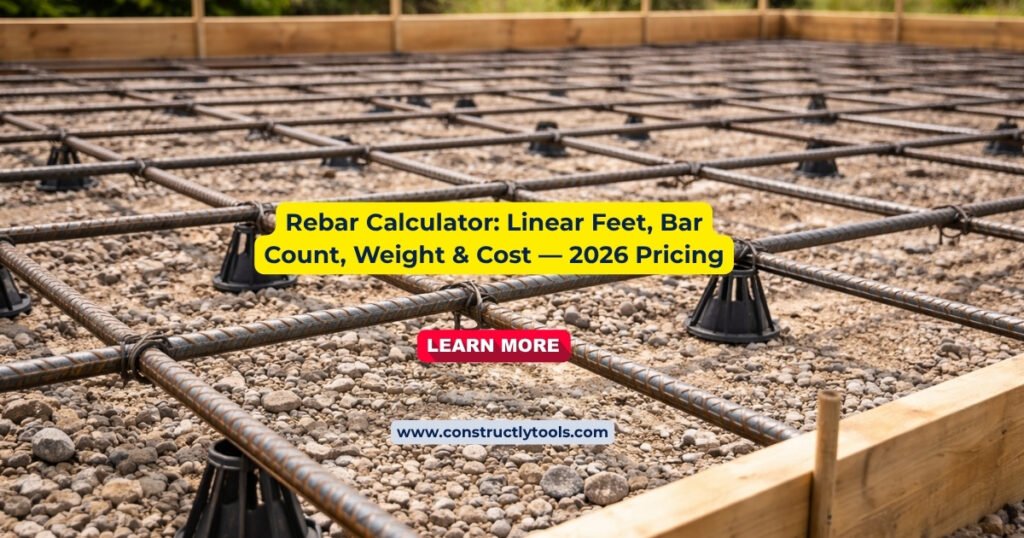
This calculator estimates rebar for a standard two-way grid — bars running in both the length and width directions, creating a grid pattern. This is the correct layout for slabs, driveways, garage floors, and most residential concrete applications per ACI 318.
Slab Dimensions
Enter the inside dimensions of your form boards — the actual pour area. For L-shaped or irregular slabs, calculate each rectangular section separately and add the bar counts. If your slab has cutouts (for posts, columns, or fixtures), deduct those areas and reduce the bar count proportionally.
Rebar Spacing — The Biggest Decision
Spacing determines both reinforcement strength and material quantity. Halving the spacing (e.g., 18" to 9" OC) roughly doubles the rebar. The right spacing is determined by slab design load, thickness, and local code requirements per ACI 318 and IRC — not personal preference. Using too wide a spacing on a driveway or garage slab is a common and costly mistake.
Lap Splice Overlap
When rebar bars connect end-to-end, they must overlap by a minimum length to transfer load across the joint. ACI 318 requires a minimum lap length of 24 bar diameters for Grade 60 rebar. For #4 rebar (½ inch), that’s 12 inches minimum. The 8% overlap factor accounts for this. Use 12% for heavily loaded structural elements or where your engineer specifies a longer lap.
Rebar and concrete are ordered together — use our concrete calculator to estimate cubic yards alongside this rebar estimate. Both materials must be ordered before the pour date — concrete has a set delivery time and rebar must be placed and tied before the truck arrives.
3 Real-World Rebar Examples
Example 1 — Residential Driveway (20×40 ft, #4 at 12" OC)
Standard 2-car driveway, 6-inch thick concrete, #4 rebar at 12" on center two-way grid, 8% lap overlap.
41 rows × 20 ft wide = 820 linear ft
Rows in width direction (20 ft ÷ 1 ft spacing + 1):21 rows × 40 ft long = 840 linear ft
Subtotal + 8% lap:(820 + 840) × 1.08 = 1,793 linear ft
20 ft bars (+ 10% waste):CEILING(1,793 ÷ 20) = 90 bars → order 99 bars
| Item | Qty | Unit Cost | Total |
|---|---|---|---|
| #4 rebar (20 ft bars) | 99 bars | $7–$12/bar | $693–$1,188 |
| Rebar chairs (1 per 4 sq ft, ~200 pcs) | 200 | $0.15–$0.30 each | $30–$60 |
| Tie wire (2 rolls) | 2 | $12–$20/roll | $24–$40 |
| Tie wire twister tool | 1 | $18–$35 | $18–$35 |
| Rebar cutter/bender rental (1 day) | 1 day | $40–$70 | $40–$70 |
| Total rebar materials + tools | $805–$1,393 | ||
Real-world note: A 20×40 driveway is a significant rebar project — 99 bars at 20 ft each and roughly 4,200 tie intersections in the grid. Rent a tie wire twister gun for $25–$40/day rather than hand-tying — it reduces tying time by 70%. Position rebar chairs every 4 feet in both directions to maintain the 1.5" cover from the bottom of the slab per ACI 318 Table 20.6.1.3 for weather-exposed slabs with #4 and smaller rebar.
Example 2 — Garage Floor Slab (24×24 ft, #4 at 12" OC)
Standard two-car garage slab — 576 sq ft, 6-inch thick, #4 rebar at 12" OC, vapor barrier underneath.
(25 rows × 24 ft) × 2 directions = 1,200 linear ft base
With 8% lap splice:1,200 × 1.08 = 1,296 linear ft
Bars + 10% waste:CEILING(1,296 ÷ 20) = 65 bars → order 72 bars
| Item | Qty | Unit Cost | Total |
|---|---|---|---|
| #4 rebar (20 ft bars) | 72 bars | $7–$12/bar | $504–$864 |
| Rebar chairs (1 per 4 sq ft) | 144 | $0.15–$0.30 | $22–$43 |
| Tie wire (1.5 rolls) | 2 rolls | $12–$20 | $24–$40 |
| Vapor barrier (6 mil poly, 576 sq ft) | 1 roll | $55–$90 | $55–$90 |
| Total reinforcement materials | $605–$1,037 | ||
Real-world note: Place the vapor barrier before the rebar grid — poly sheeting goes directly on the compacted gravel base, rebar chairs on top of the poly, then the rebar grid. Never place rebar chairs directly on soil without a vapor barrier in a garage. Position control joints at 10–12 ft intervals — a 24×24 garage needs 2 cuts in each direction.
Example 3 — Deck Footing Reinforcement (8 footings, #4 rebar)
Eight 12-inch diameter × 42-inch deep tube footings for a 16×20 ft elevated deck. Each footing gets 2 vertical #4 bars plus 1 horizontal tie bar.
2 × 8 × 4 ft = 64 linear ft
Horizontal tie bars (1 per footing × 8 × ~3.14 ft circumference):8 × 3.14 ft = ~25 linear ft
Total + 10% waste:(64 + 25) × 1.10 = ~98 linear ft → 5 bars (20 ft)
| Item | Qty | Unit Cost | Total |
|---|---|---|---|
| #4 rebar (20 ft bars) | 5 bars | $7–$12/bar | $35–$60 |
| Rebar bending (hook ends for ties) | 8 ties | Manual bend | $0 |
| Wire ties | 16 ties | $0.05 each | $1 |
| Total footing rebar cost | $36–$61 | ||
Real-world note: For vertical bars in tube footings, bend a hook at the bottom of each bar (90° bend, 6-inch tail) before insertion — this prevents the bar from pulling straight out under uplift loads per IRC Section R403. Check with your local building department whether footings require an inspection before concrete is poured — many jurisdictions require this for permitted deck projects.
Rebar Size & Weight Chart
Rebar bar numbers correspond to diameter in eighths of an inch — #4 rebar is 4/8 = ½ inch diameter. All weights are for Grade 60 deformed rebar per ASTM A615/A615M.
| Bar # | Diameter | lbs / linear ft | lbs / 20 ft bar | Cross-Section (sq in) | Common Use |
|---|---|---|---|---|---|
| #3 | 3/8 in | 0.376 | 7.5 lbs | 0.11 | Sidewalks, small slabs, temperature steel |
| #4 | 1/2 in | 0.668 | 13.4 lbs | 0.20 | Driveways, patios, slabs — most common |
| #5 | 5/8 in | 1.043 | 20.9 lbs | 0.31 | Foundations, retaining walls, footings |
| #6 | 3/4 in | 1.502 | 30.0 lbs | 0.44 | Heavy foundations, columns, large walls |
| #7 | 7/8 in | 2.044 | 40.9 lbs | 0.60 | Commercial, bridge decks, structural |
| #8 | 1 in | 2.670 | 53.4 lbs | 0.79 | Heavy structural, commercial only |
All weights per ASTM A615/A615M Grade 60 deformed rebar. Standard US bar lengths: 20 ft, 40 ft, 60 ft.
Rebar Spacing Guide by Application
Correct spacing is determined by design load, slab thickness, and local code — not general preference. The table below reflects standard practice per ACI 318 and IRC for residential construction. Always verify with your local building department before starting any permitted project.
| Application | Spacing | Bar Size | Slab Thickness | Notes |
|---|---|---|---|---|
| Sidewalk / path | 18–24 in OC | #3 | 4 in | Light foot traffic only |
| Residential patio | 18 in OC | #3 or #4 | 4 in | Upgrade to #4 for heavy furniture/hot tub |
| Residential driveway | 12–18 in OC | #4 | 4–6 in | 6" for trucks or RVs; 12" OC preferred |
| Garage floor | 12 in OC | #4 | 4–6 in | 6" recommended for vehicle loads |
| House foundation | 12 in OC | #4 or #5 | 8–12 in | Follow engineered drawings |
| Retaining wall | 12 in OC | #4 or #5 | 8–12 in | Vertical and horizontal bars both required |
| Pool deck | 12 in OC | #4 | 4–6 in | Chemical exposure — use epoxy-coated |
| Equipment pad | 12 in OC | #4 or #5 | 6–8 in | Generator, HVAC, compressor pads |
| Commercial slab | 6–12 in OC | #5 or #6 | 6+ in | Engineered design required |
Going from 18" OC to 12" OC on a 20×40 ft driveway increases rebar quantity by roughly 50% — from ~66 bars to ~99 bars. Using the correct spacing per ACI 318 isn’t just a code requirement — it’s also a major cost driver. Always verify with the inspector or engineer before placing.
Rebar Cost by Size (2026)
Rebar pricing fluctuates significantly with global steel market conditions — sometimes moving 15–20% over a single quarter. Ranges below reflect 2026 US average retail pricing per RSMeans and major home improvement retailer data. For large projects, call steel service centers for bulk pricing 2–3 weeks before your pour date.
| Size | Diameter | $/linear ft | $/20 ft bar | $/ton (bulk) | Epoxy-coated premium |
|---|---|---|---|---|---|
| #3 | 3/8 in | $0.25–$0.45 | $5–$9 | $700–$1,000 | +25–40% |
| #4 | 1/2 in | $0.35–$0.60 | $7–$12 | $650–$950 | +25–40% |
| #5 | 5/8 in | $0.50–$0.85 | $10–$17 | $600–$900 | +25–40% |
| #6 | 3/4 in | $0.70–$1.15 | $14–$23 | $580–$880 | +25–40% |
Standard Grade 60 deformed rebar per ASTM A615. Epoxy-coated per ASTM A775. Stainless steel rebar per ASTM A955 costs 8–10× more — used for bridge decks and marine environments only.
When to Use Epoxy-Coated Rebar
Epoxy-coated (green) rebar per ASTM A775 is required for concrete exposed to chlorides — road salt in freeze-thaw climates, coastal/marine exposure, and pool decks. Standard black rebar will rust in these environments within 10–15 years, causing surface cracking and spalling. The 25–40% cost premium is mandatory in salt exposure environments, not optional.
For projects requiring 1+ ton of rebar (~150+ bars of #4), contact steel service centers directly. Distributor pricing runs 15–25% lower than retail. Provide: bar size, total linear feet, and required delivery date. Most distributors deliver to job sites with a flatbed truck — confirm site access before ordering.
Concrete Cover Requirements
Concrete cover is the distance from the rebar surface to the nearest concrete face. Too little cover allows moisture to reach the rebar, causing rust and concrete spalling. Cover requirements are specified by ACI 318 Table 20.6.1.3.
| Condition | Min. Cover (ACI 318) | How to Achieve |
|---|---|---|
| Slab — not exposed to weather | ¾ inch | Use ¾" plastic bar chairs |
| Slab — exposed to weather (#5 and smaller) | 1½ inches | Use 1½" chairs; always for driveways/patios |
| Slab — exposed to weather (#6 and larger) | 2 inches | Use 2" chairs |
| Foundation wall — exposed to soil | 3 inches | Spacer blocks or wire hangers from forms |
| Footing cast against soil (no form) | 3 inches | Use dobies (precast concrete blocks) |
| Column / pier | 1½ inches | Precast spacer rings in tube forms |
The most common DIY rebar mistake: letting rebar rest directly on the ground or vapor barrier before pouring. This gives zero cover on the bottom — rebar must be in the middle-to-upper third of the slab to be in the tension zone. Always use plastic chairs. They cost $15–$30 for a bag of 50 and are the cheapest structural upgrade on any slab project.
Rebar vs Wire Mesh — Which to Use
| Factor | Deformed Rebar (#4) | Welded Wire Mesh (6×6 W1.4) |
|---|---|---|
| Cost per sq ft | $0.60–$1.00/sq ft | $0.10–$0.30/sq ft |
| Strength | High — resists cracking under load | Low — controls shrinkage cracking only |
| Installation | Labor-intensive — place, tie, chair | Fast — roll out, overlap, secure |
| Code status (driveways) | Required by most jurisdictions | Not acceptable for vehicle loads |
| Code status (patios) | Acceptable | Acceptable (light foot traffic) |
| Structural slabs | Required | Not permitted |
| Sidewalks/paths | Acceptable | Acceptable — common choice |
Wire mesh (welded wire fabric per ASTM A1064) controls shrinkage cracking but cannot resist real structural loads. The most common misuse is substituting wire mesh for rebar on driveways and garage floors — a driveway will crack within 5–10 years of normal vehicle use. For anything that carries a car, use rebar.
If a car, truck, or heavy equipment will ever drive on the slab — use rebar. If it’s only foot traffic — wire mesh or rebar both work. If it’s a structural element (foundation, retaining wall, column pad) — use rebar per engineered specs. When in doubt, use rebar. The cost difference on a typical residential slab is $200–$400, trivial compared to the cost of a cracked and failed slab.
Hidden Costs Most Estimates Miss
1. Rebar Chairs and Spacers
Plastic rebar chairs to maintain concrete cover (per ACI 318 Table 20.6.1.3) are rarely included in rebar material estimates. Cost: $15–$30 per bag of 50. For a 20×40 ft driveway, you need roughly 200 chairs spaced every 4 feet — about 4 bags ($60–$120). Skipping chairs is the single most common structural error in DIY concrete work.
2. Tie Wire and Tools
Tying 4,000+ intersections by hand is extremely time-consuming. Add: tie wire ($12–$20/roll, 1–2 rolls per 400 sq ft), a wire twister gun rental ($25–$40/day), and a rebar bender/cutter rental ($40–$70/day). These tools are optional but save 3–4 hours on a large project.
3. Delivery for Large Orders
Picking up 99 twenty-foot rebar bars requires a truck with at least an 8-foot bed plus overhang, or a flatbed trailer. Delivery from a steel supplier costs $75–$200 depending on distance and order size. Factor this in for any project requiring 50+ bars.
4. Epoxy Coating Upgrade
In freeze-thaw climates where road salt is used, or coastal areas within 1 mile of saltwater, upgrade to epoxy-coated rebar per ASTM A775 at 25–40% more per bar. A 99-bar driveway project goes from $693–$1,188 to $866–$1,663 for rebar alone. This is a non-optional upgrade in salt exposure environments — failure to use epoxy-coated rebar leads to rust-driven concrete failure in 10–15 years.
Common Rebar Mistakes
Placing Rebar on the Ground Without Chairs
The most widespread DIY error. Rebar sitting on the ground ends up at the very bottom of the pour — in the compression zone where it does nothing structurally, with zero concrete cover on the bottom face. After the pour there’s no way to correct this. Use chairs. Every bar, every time.
Using Wire Mesh Instead of Rebar for Driveways
Wire mesh per ASTM A1064 is not a substitute for rebar under vehicle loads. A 6×6-W1.4 wire mesh provides 0.028 sq inches of steel per foot. #4 rebar at 12" OC provides 0.20 sq in/ft — over 7× more cross-sectional steel. Wire mesh on a driveway will crack under normal vehicle loading within years.
Insufficient Lap Length at Splices
ACI 318 requires a minimum lap length of 24 bar diameters for Class A lap splices in Grade 60 rebar. For #4 rebar that’s 12 inches minimum. Many DIYers overlap only 6" because "it seems like enough." Mark your bars before placing — measure 12" from every bar end and mark the lap zone with a paint marker.
Not Tying Grid Intersections
Untied rebar grids shift during the pour as concrete is vibrated and screeded. Even a small shift moves bars from their design position and reduces effective cover. Tie every intersection with one loop of wire — it takes 30 seconds per tie but ensures the grid stays exactly where it was placed throughout the pour.
Ordering Without Checking Current Pricing
Steel prices fluctuate 15–20% over a few months. Always get a current quote from your supplier the week you’re ordering — don’t use calculator estimates as purchase orders without confirming live pricing. For large projects (50+ bars), call 2–3 suppliers and compare.
How We Calculate
Rows in length direction = CEILING(Length × 12 ÷ Spacing in inches) + 1
Total Linear Feet = (Length-rows × Width + Width-rows × Length) × Lap Factor
Bars = CEILING(Total LF ÷ 20) · Order = CEILING(Bars × 1.10)
The +1 in the row count places rebar at both edges of the slab. The lap factor (1.08 for standard 8% overlap) accounts for bar-to-bar connections at lap splices, consistent with ACI 318 minimum lap length requirements of 24 bar diameters for Class A lap splices. Weight is calculated using the official ASTM A615/A615M weights per bar number. Material cost uses 2026 US average retail pricing ranges per RSMeans unit cost data and major home improvement retailer pricing across 8 US markets.
Frequently Asked Questions
Plan your full concrete project with these free tools.
Concrete Tools
Related Material Calculators
- ACI 318 — Building Code Requirements for Structural Concrete — Primary reference for spacing requirements by application, minimum concrete cover by exposure condition (Table 20.6.1.3), and minimum lap splice lengths (24 bar diameters for Class A splices in Grade 60 rebar). Referenced for spacing guide, cover requirements table, lap splice minimum, and all ACI 318 citations throughout. American Concrete Institute, current edition.
- ASTM A615/A615M — Standard Specification for Deformed and Plain Steel Bars for Concrete Reinforcement — Official bar number designations, actual diameters, weight per linear foot, and cross-sectional areas used in the calculator weight calculations and the rebar size chart. Referenced for all weight constants (#3: 0.376 lbs/ft, #4: 0.668 lbs/ft, #5: 1.043 lbs/ft, #6: 1.502 lbs/ft). ASTM International, current edition.
- ASTM A775/A775M — Standard Specification for Epoxy-Coated Steel Reinforcing Bars — Performance specifications for epoxy-coated rebar, applicability in chloride-exposure environments (road salt, marine), and coating thickness requirements. Referenced for epoxy-coated rebar guidance in the cost section and hidden costs section. ASTM International, current edition.
- ASTM A1064/A1064M — Standard Specification for Carbon-Steel Wire and Welded Wire Reinforcement — Wire mesh specifications (6×6-W1.4 steel content), cross-sectional area, and design load limitations. Referenced for the rebar vs wire mesh comparison table. ASTM International, current edition.
- RSMeans Building Construction Cost Data 2026 — Unit labor and material cost data for rebar installation by bar size, slab type, and US region. Referenced for retail pricing ranges per bar size and regional cost adjustment factors in the cost table. RSMeans / Gordian, 2026.
Rebar pricing reflects 2026 US national average retail pricing. Steel prices are highly volatile — always confirm current pricing with your local supplier or steel distributor before finalizing any project budget. ConstructlyTools does not have a paid relationship with any rebar manufacturer, steel supplier, or contractor mentioned on this page.

Prakash
Prakash is the founder and editor of ConstructlyTools. He researches, develops, and maintains construction calculators, material estimators, cost guides, and DIY planning resources designed to help homeowners, contractors, and builders make informed project decisions.
Every calculator and guide is researched using trusted industry references, published building standards, manufacturer specifications, and reliable construction pricing sources. Each page is reviewed for formula accuracy, pricing methodology, readability, and practical usefulness before publication and is updated regularly as standards or market prices change.
Every calculator and article published on ConstructlyTools is independently reviewed for formula accuracy, pricing methodology, readability, and practical usefulness before publication. Content is updated whenever construction pricing, industry standards, or building code references significantly change.
This page was researched, written, and reviewed in accordance with our Editorial Policy.