
Concrete Footing Calculator
Planning a foundation project? Our Concrete Footing Calculator helps you quickly estimate how much concrete you need for footings based on length, width, and depth.
Whether you’re building a deck, fence, shed, or house foundation, this tool gives you accurate volume calculations in seconds — helping you avoid shortages, reduce waste, and stay on budget.
Includes 10% waste overage · 80 lb bag = 0.60 cu ft · 60 lb bag = 0.45 cu ft · 40 lb bag = 0.30 cu ft · 27 cu ft = 1 cu yd · Over 1 cu yd? Ready-mix is cheaper
Always order the full rounded-up quantity. Footings must extend below local frost line. Verify dimensions with a structural engineer for load-bearing applications.
Understanding the Calculator Inputs
This calculator handles three types of concrete footings used in residential construction: round tube footings (for deck posts, fence posts, and pergola columns), square pad footings (for shed corners and isolated column bases), and continuous wall footings (for house foundations, retaining walls, and additions). Select the tab that matches your project type.
Round / Tube Footings
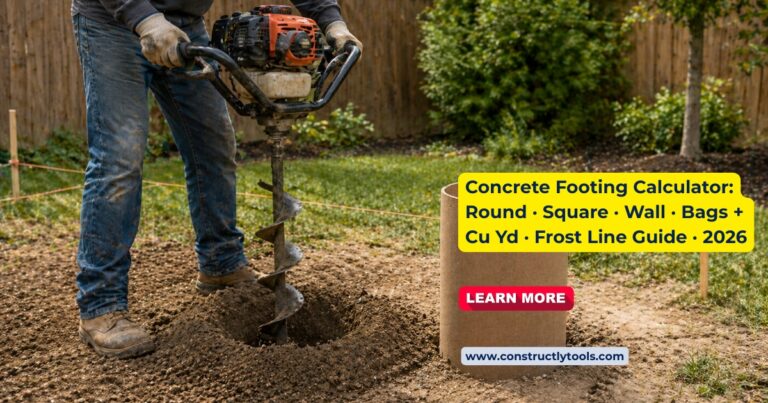
Round tube footings are the most common DIY footing type — poured into a cylindrical tube form (Sonotube is the most well-known brand) inside a drilled or dug hole. They’re used for deck posts, fence posts, pergola posts, gazebo posts, and freestanding structural columns. For most residential deck applications, a 12" diameter tube at 42" depth is the standard starting point — but always check your local code and deck span tables for the load your specific post carries.
Square / Pad Footings
Square pad footings (also called spread footings or isolated footings) are flat concrete pads poured at the base of a column or post. They’re used under shed corner posts, steel column bases in basements, and as isolated point-load footings in engineered structures. The pad dimensions are typically 2–3× the width of the post or column above, and the depth is sized to spread the load over sufficient soil bearing area.
Continuous Wall Footings
Wall footings are continuous concrete pads poured in a trench along the full length of a wall — used under house foundations, block retaining walls, and concrete stem walls. Standard rule: footing width = 2× the wall thickness, footing depth = the wall thickness. For an 8-inch concrete block wall, the footing is typically 16" wide × 8" deep. Wall footings must extend below the frost line in freeze-thaw climates.
Footing Depth
Footing depth is measured from finished ground surface to the bottom of the footing. In freeze-thaw climates, footings must extend below the local frost line to prevent frost heave — the upward movement of soil as groundwater freezes and expands. In frost-free climates, footings only need to reach stable bearing soil — typically 12–18" minimum. See the frost line guide below.
Bag Size
80 lb bags are most economical per cubic foot but heavy to mix solo. 60 lb bags are easier to handle. 40 lb bags suit small isolated footings. For 8+ footings totaling more than 1 cubic yard, ready-mix concrete is cheaper per cubic foot and eliminates bag mixing labor.
Bagged concrete is economical for small jobs — up to about 1 cubic yard. Above that, ready-mix delivered by truck is cheaper per cubic foot and eliminates mixing labor. Ready-mix minimum orders start at 1 cubic yard ($150–$250) with delivery fees of $50–$150. If your calculator shows more than 45 bags of 80 lb concrete (≈ 27 cu ft = 1 cu yd), call a local ready-mix supplier for a comparison quote.
3 Real-World Footing Examples
Example 1 — Deck Footings (6 round footings, 12" × 42")
A standard attached deck with 6 post footings. 12" diameter tube form, 42" deep (below frost line for Zone 5), using 80 lb bags.
π × (6")² × 42" ÷ 1,728 = 3.1416 × 36 × 42 ÷ 1,728 = 2.75 cu ft per footing
Total volume (6 footings):2.75 × 6 = 16.5 cu ft total (0.61 cubic yards)
Bags needed (80 lb = 0.60 cu ft each) + 10% waste:16.5 ÷ 0.60 = 27.5 → round up = 28 bags × 1.10 = 31 bags of 80 lb concrete
Cost estimate:31 bags × $7–$10 per bag = $217–$310 in concrete
| Item | Qty | Unit Cost | Total |
|---|---|---|---|
| Quikrete 80 lb bags | 31 bags | $7–$10 | $217–$310 |
| 12" Sonotube forms (4 ft sections) | 6 tubes | $10–$16 | $60–$96 |
| Post base hardware (adjustable) | 6 bases | $12–$20 | $72–$120 |
| ½" rebar (2 per footing, 3 ft) | 12 sticks | $4–$7 | $48–$84 |
| Total footing materials | $397–$610 | ||
Real-world note: For 6 footings at 42" depth, rent a one-person gas auger ($60–$90/day) — it drills a 12" hole in minutes versus 30 minutes by hand clamshell digger. Set all tubes, mix and pour one at a time, place the post base anchor while the concrete is still wet (within 20–30 minutes of pouring). Let footings cure 48–72 hours before loading with post weight.
Example 2 — Shed Corner Footings (4 square pads, 16"×16"×8")
Four isolated square pad footings for an 8×10 ft shed, one at each corner. Poured on grade in stable soil (frost-free climate).
16" × 16" × 8" ÷ 1,728 = 2,048 ÷ 1,728 = 1.19 cu ft per pad
Total volume (4 pads) + 10% waste:1.19 × 4 = 4.74 cu ft × 1.10 = 5.2 cu ft total
Bags (80 lb = 0.60 cu ft):5.2 ÷ 0.60 = 8.7 → 9 bags of 80 lb concrete
Real-world note: 9 bags for 4 corner pads is easily manageable as a solo DIY project. Build simple square forms from scrap 2×6 lumber, level them carefully — the shed floor level depends entirely on these pads being coplanar — and embed a J-bolt or post base anchor while the concrete is wet. In freeze-thaw climates, these shallow pads will heave — increase depth to below frost line or use helical piers for a frost-free foundation.
Example 3 — Continuous Wall Footing (40 ft × 16" wide × 10" deep)
A continuous footing for a 40-foot concrete block garden wall — 16" wide, 10" deep, poured in a trench.
40 ft × (16"÷12) × (10"÷12) = 40 × 1.333 × 0.833 = 44.4 cu ft = 1.64 cubic yards
Bags (80 lb) + 10% waste:44.4 ÷ 0.60 = 74 bags × 1.10 = 82 bags
Ready-mix comparison:1.64 cu yd × $150–$200/yd = $246–$328 ready-mix vs 82 bags × $8 = $656 in bags. Ready-mix is cheaper and much faster.
Real-world note: At 1.64 cubic yards, ready-mix is clearly the right choice — the bag option costs 2× as much and requires mixing and pouring 82 bags by hand. Call a ready-mix supplier, order 1.8 yards (built-in waste), poured in 30 minutes. For wall footings, place two runs of ½" rebar lengthwise before the pour and tie vertical rebar starters that will extend up into the block wall above. Use our rebar calculator to determine rebar quantity.
Footing Size Quick Reference
Standard footing sizes for common residential applications. Always verify against your local building code and actual loads — heavier loads or poor soil require larger footings.
Round Tube Footings — By Application
| Application | Tube Diameter | Typical Depth | 80 lb Bags Each | Notes |
|---|---|---|---|---|
| Fence post (4×4) | 8–10" | Below frost + 6" | 1–2 bags | Fast-set dry-pour method works well |
| Deck post (4×4, low deck) | 10–12" | Below frost + 6" | 2–3 bags | Check deck span tables for exact size |
| Deck post (6×6, elevated) | 12–14" | Below frost + 6" | 3–4 bags | Larger footings for taller/heavier decks |
| Pergola / gazebo post | 12" | Below frost + 6" | 2–3 bags | Confirm post base hardware fits tube OD |
| Freestanding shed post | 10–12" | Below frost OR 24" | 2–3 bags | In frost-free zones, 24" minimum |
| Carport / large structure | 16–24" | Below frost + 12" | 6–14 bags | May require engineer stamp |
Square Pad Footings — By Application
| Application | Pad Size | Depth | 80 lb Bags Each |
|---|---|---|---|
| Small shed corner (4×4 post) | 12"×12"×8" | Below frost or 12" | 1 bag |
| Standard shed corner (6×6 post) | 16"×16"×8" | Below frost or 18" | 2 bags |
| Garage column base | 24"×24"×12" | Below frost + 6" | 4–5 bags |
| Engineered point load | Varies — use engineer | Engineered | Varies |
Wall Footings — Standard Sizing Rule
| Wall Type | Footing Width | Footing Depth | Cu Ft per LF |
|---|---|---|---|
| 4" concrete block wall | 8–12" | 8" | 0.44–0.67 |
| 8" concrete block wall | 16" | 8–10" | 0.89–1.11 |
| Poured concrete wall (8") | 16" | 10" | 1.11 |
| House foundation (8" wall) | 20–24" | 12" | 1.67–2.00 |
Frost Line & Footing Depth Guide
In freeze-thaw climates, concrete footings must extend below the frost line — the depth at which soil freezes in winter. Footings above the frost line are pushed upward by frost heave as water freezes and expands. Even small movement can crack a concrete wall, shift a deck post, or misalign a fence.
| Region | Example States/Cities | Frost Depth | Minimum Footing Depth |
|---|---|---|---|
| Frost-free / Subtropical | Southern FL, HI | 0" | 12–18" (bearing soil) |
| Very shallow frost | Gulf Coast, Southern CA | 0–6" | 18–24" |
| Shallow frost | NC, VA, TN, Pacific NW | 6–18" | 24" |
| Moderate frost | Mid-Atlantic, Midwest, CO | 18–36" | 36–42" |
| Deep frost | New England, Great Lakes, Upper Midwest | 36–48" | 42–54" |
| Very deep frost | Northern MN, ND, MT, Upper MI | 48–60" | 54–66" |
| Extreme frost | Northern Canada, Alaska | 60–100"+ | Below freeze depth |
The table above shows typical ranges — your jurisdiction’s required footing depth may differ based on local soil conditions, elevation, and code amendments. Your local building department will give you the required depth in one phone call. For permitted projects, the inspector verifies footing depth before concrete is poured — the hole must be inspected open, before any concrete goes in.
Concrete Bag Size Comparison
| Bag Size | Volume (cu ft) | Avg Cost | Cost / Cu Ft | Best For |
|---|---|---|---|---|
| 40 lb bag | 0.30 cu ft | $5–$7 | $17–$23/cu ft | Small isolated footings, solo work, tight spaces |
| 60 lb bag | 0.45 cu ft | $6–$9 | $13–$20/cu ft | Good balance — easier to handle than 80 lb |
| 80 lb bag | 0.60 cu ft | $7–$10 | $12–$17/cu ft | Best value — standard for deck & fence footings |
| Ready-mix (1 cy) | 27 cu ft | $150–$250 + delivery | $7–$14/cu ft | Best value above ~1 cubic yard total volume |
Fast-Set vs Standard Concrete for Footings
Fast-set concrete (Quikrete Fast-Setting, Sakrete Fast-Setting) is the popular choice for fence and deck post footings because it can be poured dry directly into the hole and watered in place — no mixing required. It sets firm in 20–40 minutes, allowing you to move to the next hole quickly, and reaches full strength in 4 hours. Standard concrete requires mixing and takes 24–48 hours to set sufficiently to load. For tube footings where you’re placing a post base anchor in wet concrete, fast-set is almost always preferred. It’s sold in 50 lb bags at the same price as standard 60 lb bags and covers the same volume.
Rebar in Concrete Footings
Concrete is strong in compression but weak in tension — rebar adds tensile strength and prevents cracking under load. Whether rebar is required depends on the footing type, load, and local code.
| Footing Type | Rebar Required? | Typical Spec | Notes |
|---|---|---|---|
| Fence post (tube) | Usually no | Optional: 1 vertical ½" bar | Adds crack resistance in deep holes |
| Deck post (tube) | Code-dependent | 2 vertical ½" bars, 3 ft long | Check local deck code — often required |
| Square pad footing | Code-dependent | #4 bars in grid pattern | Engineered pads always require rebar |
| Continuous wall footing | Almost always | 2 runs of ½" horizontal + vertical starters | Required by IRC for most wall footings |
| House foundation footing | Always | Engineered rebar schedule | Requires engineer and permit inspection |
Use our rebar calculator to determine rebar quantity and weight for your footing project. For deck footings specifically, the IRC 2026 requires rebar in tube footings over 30" deep in most jurisdictions.
For round tube footings: place 2 vertical ½" (#4) rebar sticks centered in the tube before pouring, with 2–3 inches of concrete cover on all sides. Wire them together with a horizontal tie bar at mid-depth. For wall footings: run two horizontal ½" bars the full length, positioned 3 inches from the bottom. Tie vertical starter bars to the horizontal runs every 24–48 inches, extending up into the wall above. All rebar must have a minimum 3" concrete cover — use plastic rebar chairs to hold bars off the soil before pouring.
Common Concrete Footing Mistakes
Pouring Above the Frost Line
The most consequential mistake in DIY footing work. A footing poured above the frost line will heave upward in winter — potentially by 1–4 inches — then settle back unevenly in spring. Over several freeze-thaw cycles, this cracks foundation walls, misaligns deck posts, and leans fence posts. Always dig below the local frost depth plus 6 inches of bearing soil.
Not Allowing Adequate Cure Time
Standard concrete reaches about 70% of design strength in 7 days and full strength at 28 days. Fast-set concrete is firm enough to load lightly in 4 hours but should not carry full structural loads for 24–48 hours. For deck footings, wait a minimum of 24 hours before setting posts, 72 hours before beginning framing.
Undersizing the Footing Diameter for the Load
A 10" tube footing carries significantly less load than a 12" tube — not because of concrete volume, but because the bearing area at the bottom determines how much weight the footing distributes into the soil. A 10" footing has 78 sq in of bearing area; a 12" footing has 113 sq in — 45% more. In soft clay, fill soil, or organic soil, you may need larger diameter footings than the standard 12".
Skipping the Tube Form for Round Footings
Some DIYers pour directly into the hole without a tube form. This fails in sandy, gravelly, or clay soils where hole sides collapse or concrete spreads at the bottom. The tube form (Sonotube or equivalent) keeps the concrete cylindrical, prevents soil contamination, and gives a clean finished footing at grade. At $8–$15 per section, it eliminates a significant failure mode.
Using Too Little or Too Much Water
Concrete mix design is precise — the water-to-cement ratio determines final strength. Too much water produces weak, porous concrete that cracks early. Too little produces stiff concrete that doesn’t consolidate properly around rebar. Follow the bag instructions exactly — typically 3 quarts of water per 80 lb bag. Use a mixing paddle in a drill for bags larger than 40 lb — hand mixing with a hoe doesn’t achieve thorough blending.
How We Calculate
Round footing: Volume (cu ft) = π × (Diameter ÷ 2 ÷ 12)² × (Depth ÷ 12) · converts diameter and depth from inches to feet, applies the cylinder volume formula (π × r² × h), multiplied by the number of footings for total volume.
Square pad: Volume (cu ft) = (Length × Width × Depth) ÷ 1,728 · all three dimensions in inches; dividing by 1,728 (12³) converts cubic inches to cubic feet.
Wall footing: Volume (cu ft) = Length (ft) × (Width ÷ 12) × (Depth ÷ 12) · length in feet; width and depth in inches converted to feet.
Bag count: Bags = CEILING(Total Volume × 1.10 ÷ Volume per Bag) — 10% waste applied, ceiling function used (always round up since partial bags can’t be purchased). Bag volumes: 40 lb = 0.30 cu ft, 60 lb = 0.45 cu ft, 80 lb = 0.60 cu ft per Quikrete and Sakrete manufacturer specifications.
The calculator’s bag count already includes 10% waste and rounds up. Don’t round down to save money — running out mid-pour forces a cold joint (fresh concrete poured onto partially set concrete), which creates a structural weak plane in the footing. Buy the full quantity and return any unopened bags to the store.
Frequently Asked Questions
Plan your full concrete and foundation project with these free tools.
Material Calculators
Measurement Tools
- ACI 318 — Building Code Requirements for Structural Concrete — Primary US standard for concrete design including footing geometry requirements, minimum cover for reinforcement (3 inches for footings on soil), and structural design requirements for isolated and continuous footings. Referenced for footing sizing formulas and rebar cover requirements. American Concrete Institute, current edition.
- IRC (International Residential Code) — Sections R401–R408: Foundations — Prescriptive foundation requirements for residential construction including minimum footing widths by wall load, depth below frost line requirements, and rebar specifications for wall footings. Referenced for wall footing sizing table and rebar requirement guidance. ICC, current edition.
- IRC Appendix E — Manufactured Housing — Frost depth map and foundation depth requirements by USDA Plant Hardiness Zone used as the basis for the frost line table. Referenced for frost depth ranges by region. ICC, current edition.
- Quikrete — Concrete Mix Product Data Sheets — Bag yield volumes: 40 lb = 0.30 cu ft, 60 lb = 0.45 cu ft, 80 lb = 0.60 cu ft. Fast-set concrete curing time specifications (firm in 20–40 min, full strength 4 hours). Referenced for bag volume data in the bag count formula. Quikrete, current product specifications.
- Sakrete — Fast-Setting Concrete Product Data Sheet — Bag yield volumes cross-validated against Quikrete specifications. 50 lb fast-set bag coverage. Referenced for bag size comparison table. Sakrete, current product specifications.
- HomeAdvisor True Cost Guide 2026 — Footing installation cost data by region and project type. Ready-mix concrete pricing ranges by cubic yard. Referenced for cost estimates in worked examples. HomeAdvisor / Angi, 2026.
Frost depth data reflects USDA and local building department typical ranges — always confirm required footing depth with your local building department before construction. ConstructlyTools does not have a paid relationship with Quikrete, Sakrete, or any concrete product brand mentioned on this page.

Prakash
Prakash is the founder and editor of ConstructlyTools. He researches, develops, and maintains construction calculators, material estimators, cost guides, and DIY planning resources designed to help homeowners, contractors, and builders make informed project decisions.
Every calculator and guide is researched using trusted industry references, published building standards, manufacturer specifications, and reliable construction pricing sources. Each page is reviewed for formula accuracy, pricing methodology, readability, and practical usefulness before publication and is updated regularly as standards or market prices change.
Every calculator and article published on ConstructlyTools is independently reviewed for formula accuracy, pricing methodology, readability, and practical usefulness before publication. Content is updated whenever construction pricing, industry standards, or building code references significantly change.
This page was researched, written, and reviewed in accordance with our Editorial Policy.