
Septic System Cost Calculator
Use this free septic system cost calculator to instantly estimate the total cost of installing a septic system. Enter details like tank size, soil type, system type (conventional or alternative), and location to get an accurate cost estimate, including material and labor breakdown, cost factors, and overall project budget.
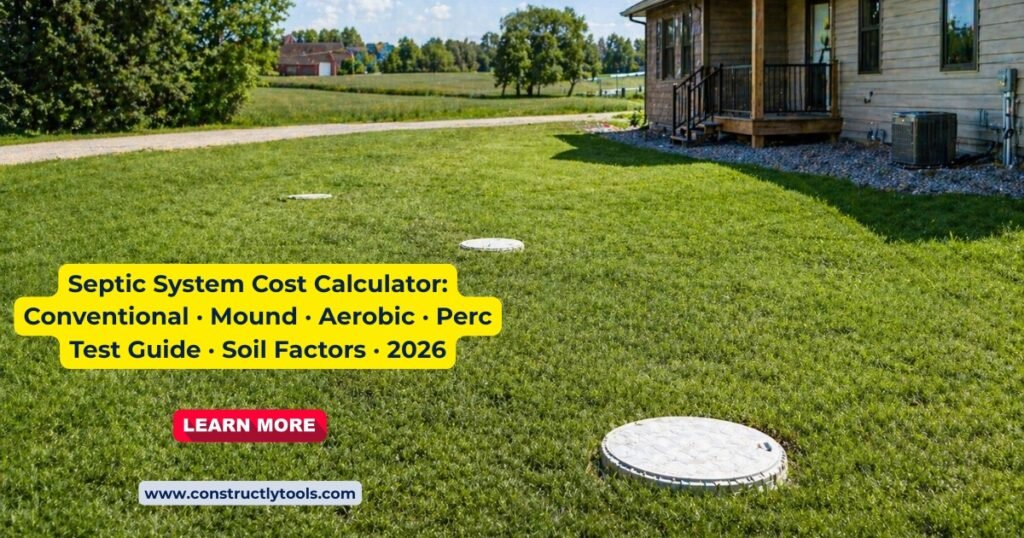
Permit required in all US counties · Soil conditions are the #1 cost variable · Mound systems cost 2–3× more than conventional · Perc test ($300–$1,500) must be done before any permit · Always get 3 quotes from licensed septic contractors
Estimates based on 2026 US national average pricing from HomeAdvisor, EPA guidance, and NAWT industry data. Septic costs vary significantly by county regulations, soil conditions, and site access. Always consult a licensed septic engineer before budgeting.
Understanding the Calculator Inputs
This septic system cost calculator estimates total installation cost based on system type, home size, tank material, soil and site conditions, drain field size, pump requirements, and location. It breaks costs into materials, labor, and permits and shows a live category breakdown visual.
Septic system costs in 2026 range from $3,500 for a basic conventional system in ideal soil to $25,000+ for a mound or aerobic system on a difficult site. The single biggest cost variable is soil condition — poor-draining clay soils require mound systems or drip distribution that cost 2–3× more than a conventional gravity-fed system in sandy soil.
System Type
The system type is almost always determined by your perc test results and lot size — not by preference. If your soil passes a standard perc test, a conventional gravity system is always the right choice. You only move to chamber, drip, mound, or ATU systems when the soil or site requires it. Never voluntarily choose a more complex system — complexity always means higher installation and maintenance cost.
Home Size in Bedrooms
Septic system sizing is based on bedrooms, not occupants. Bedrooms determine the design daily flow (gallons per day), which determines tank size and drain field area. A 2-bedroom home uses a 750 GPD design flow, a 3-bedroom uses 1,000 GPD, and a 4-bedroom uses 1,250 GPD. Adding a bedroom to a home with an undersized septic system requires upgrading the system — a hidden cost many home buyers don't discover until after purchase.
The Perc Test — Do This First
The percolation test measures how fast water drains through your soil. It is required by virtually every county health department before a septic permit is issued. Perc rate determines drain field size, which determines system type, which determines total project cost. A perc test costs $300–$1,500 and takes 1–2 days. Never budget for a septic system, buy rural land, or begin new construction without completing the perc test first. A failed perc test can make a lot legally unbuildable in some jurisdictions.
Unlike most construction projects, septic system cost is driven almost entirely by site-specific factors that cannot be known without a perc test. Two identical homes on adjacent lots can have drastically different septic costs if soil conditions differ. Always budget for the perc test first — it's $300–$1,500 and determines everything else about system type, drain field size, and total installed cost.
3 Real-World Septic System Cost Examples
Example 1 — Conventional 3-Bedroom System (Sandy Loam Soil, Midwest)
New construction, 3-bedroom home, conventional gravity-fed system, concrete tank, sandy loam soil with good perc, standard drain field, no pump required. Rural Ohio market (0.85× multiplier). Best-case scenario — everything goes according to plan.
| Item | Detail | Cost | Notes |
|---|---|---|---|
| Perc test + soil evaluation | County-required | $350–$700 | Always done before any other step |
| System design drawings | Licensed engineer | $300–$600 | Required for permit application |
| County health permit | Installation permit | $300–$600 | Must be issued before excavation begins |
| Concrete septic tank (1,000 gal) | Standard 3-bedroom tank | $700–$1,200 | Delivered and set by crane |
| Drain field excavation + gravel | 400 sq ft trench system | $2,000–$4,000 | Perforated pipe in gravel-filled trenches |
| Labor (tank set + field install) | 2-person crew, 2 days | $2,500–$4,500 | Includes pipe, distribution box, connections |
| Distribution box + access risers | Concrete D-box + 2 risers | $200–$500 | Risers allow future pumping without digging |
| Site restoration (grading + seed) | Post-excavation | $300–$600 | Often excluded from contractor quotes |
| Total (Ohio, 0.85×) | $5,480–$11,220 · mid-point ~$8,350 | ||
Real-world note: This is the best-case conventional septic scenario. Good sandy loam soil in a rural Midwest market keeps every cost at the lower end of the range. The most important step — which many new rural land buyers skip — is doing the perc test before purchasing the lot. In Ohio (and most states), perc tests must be done by a licensed soil evaluator approved by the county health department; the homeowner cannot perform their own test. Budget 3–6 weeks from perc test application to permit issuance in most Midwest counties.
Example 2 — Conventional 4-Bedroom System (Average Soil, Average Market)
4-bedroom home replacement of a failed conventional system. Concrete tank, mixed loam soil (perc rate 40–50 min/inch), larger drain field required, gravity flow, average US market (1.0×). System replacement after the old system failed — excavation of old system adds cost.
| Item | Detail | Cost | Notes |
|---|---|---|---|
| Perc test + site evaluation | New test required at permit | $500–$1,200 | Prior perc tests often expire after 2–5 yrs |
| Engineering design | Replacement system design | $500–$1,500 | County may require stamped drawings |
| Permit | Replacement permit | $400–$800 | Replacement systems always require permit |
| Old system abandonment | Pump + fill old tank | $400–$900 | Required by most health codes — not optional |
| Concrete tank (1,250 gal, 4-bed) | Larger tank for 4-bedroom | $900–$1,800 | Tank size scales with bedroom count |
| Drain field (600 sq ft) | Larger field for loam soil | $4,000–$8,000 | Slower perc = larger field = higher cost |
| Excavation + labor | Includes old system removal | $4,000–$8,000 | Removal of old field adds significant labor |
| Distribution box + risers + pipe | Full new distribution system | $400–$900 | Never reuse old distribution boxes |
| Site restoration | Grading + topsoil + seed | $600–$1,500 | Larger disruption than new construction |
| Total (average market, 1.0×) | $11,700–$24,600 · mid-point ~$18,150 | ||
Real-world note: Failed system replacement is significantly more expensive than new installation — the old tank must be pumped and abandoned (filled with concrete or crushed), the old drain field must be excavated and removed or isolated, and the entire replacement must be permitted as a new system. In many states, if the replacement field must go in a new location (because the original failed and contaminated the old location), you need setback clearances from property lines, wells, and buildings all over again. This is the most common septic scenario for homebuyers of rural properties that are 20–35 years old.
Example 3 — Mound System (Clay Soil, High-Cost Northeast Market)
3-bedroom home, mound system required due to high clay content (perc rate 90 min/inch), pressure-dosed effluent pump, large mound footprint. Massachusetts market (1.5× multiplier). This is the expensive scenario that surprises many rural land buyers.
| Item | Detail | Cost | Notes |
|---|---|---|---|
| Perc test + soil evaluation | Licensed soil evaluator | $800–$1,500 | MA requires licensed evaluator on-site |
| Engineered system design | PE-stamped mound design | $1,500–$3,500 | Complex design required for mound systems |
| State + local permits | Title 5 compliance (MA) | $600–$1,500 | MA Title 5 has strict mound requirements |
| Concrete tank (1,000 gal) | Standard 3-bedroom | $1,000–$2,000 | Higher cost in MA market |
| Pump chamber + effluent pump | Pressure-dose to mound | $2,000–$4,500 | Required — gravity cannot reach elevated mound |
| Imported sand (mound fill) | 15–25 truckloads | $3,000–$7,500 | Clean sand must meet spec — not native soil |
| Mound construction + piping | Pressurized drip distribution | $5,000–$12,000 | Largest single cost item |
| Excavation + labor | Full site prep + mound build | $5,000–$10,000 | Heavy equipment; multiple-day project |
| Electrical (pump panel + wiring) | Licensed electrician | $800–$2,000 | Required for pump — always hire licensed |
| Site restoration | Seed mound + surrounding area | $800–$2,000 | Mound must be vegetated to prevent erosion |
| Total (MA, 1.5×) | $28,050–$63,750 · mid-point ~$45,000 | ||
Real-world note: Massachusetts is one of the most regulated and most expensive septic markets in the US, governed by Title 5 of the State Environmental Code. A mound system in MA on clay soil with a pump can easily run $35,000–$55,000 all-in. This is why rural land in New England is often listed at surprisingly low prices — the cost of the septic system alone can exceed the land purchase price. If you're buying rural land in the Northeast, always require the seller to provide a current (within 2 years) Title 5 inspection report and perc test results as a condition of sale. Discovering you need a $45,000 mound system after closing is not uncommon.
Septic System Cost Breakdown by Category
Where the money goes in a typical conventional 3-bedroom septic system with concrete tank, average soil conditions, and standard drain field in 2026.
| Category | % of Total | Typical Cost Range | Notes |
|---|---|---|---|
| Septic Tank | 15–25% | $700–$3,000 | Concrete most common; fiberglass lighter to install |
| Drain Field / Leach Field | 25–40% | $2,000–$10,000 | Largest variable — size determined by perc test |
| Excavation & Labor | 30–45% | $2,500–$8,000 | Higher for difficult terrain, deep bedrock, or replacement |
| Perc Test & System Design | 5–10% | $300–$2,500 | Required before any permit is issued |
| Permits & Inspections | 4–8% | $400–$2,000 | County health department permit required in all jurisdictions |
| Pump (if required) | 0–12% | $0–$3,000 | Needed when gravity flow not possible; mound systems always need pump |
| Distribution Box / Risers | 2–5% | $150–$800 | Access risers allow future pumping without excavation |
| Site Restoration | 3–6% | $300–$2,000 | Grading, topsoil, seeding after excavation — often excluded from quotes |
Septic System Type Guide (2026)
| System Type | Cost Range | Best For | Lifespan | Annual Maintenance |
|---|---|---|---|---|
| Conventional Gravity | $3,500–$10,000 | Sandy/loamy soil, flat terrain | 25–40 yrs | Low — pump every 3–5 yrs |
| Chamber / Infiltrator | $5,000–$12,000 | Average to poor soil, no gravel available | 25–30 yrs | Low — same as conventional |
| Drip Distribution | $8,000–$18,000 | Sloped lots, limited space, shallow soil | 20–25 yrs | Medium — filter cleaning, pump service |
| Mound System | $10,000–$25,000 | High water table, clay soil, poor drainage | 20–30 yrs | Medium — pump required, annual inspection |
| Aerobic Treatment (ATU) | $10,000–$20,000 | Small lots, setback restrictions, sensitive areas | 15–25 yrs | High — annual contract required by permit |
| Cesspool Replacement | $6,000–$20,000 | Replacing failed or illegal cesspool | 25–40 yrs | Low once replaced with proper system |
If your perc test results allow it, a conventional gravity-fed septic system is by far the best value — lowest installed cost ($3,500–$10,000), lowest maintenance cost, longest lifespan (25–40 years), and simplest operation with no mechanical components to fail. Only choose alternative systems when soil conditions or lot constraints make conventional impossible. Never upgrade to a more complex system than required — higher complexity means higher long-term maintenance cost and more service calls.
Soil & Site Factors That Affect Cost
Soil conditions affect septic cost more than any other single factor. The perc test result (in minutes per inch) directly determines the drain field size and system type required — and therefore the total project cost.
| Soil / Site Condition | Perc Rate | System Required | Cost Impact |
|---|---|---|---|
| Sandy / gravelly soil | < 5 min/inch | Conventional (small drain field) | Lowest cost |
| Sandy loam | 5–30 min/inch | Conventional (standard drain field) | Standard cost |
| Loam / mixed soil | 30–60 min/inch | Conventional (larger drain field) | +10–20% |
| Clay-heavy soil | 60–120 min/inch | Mound or chamber system | +50–150% |
| Very slow draining clay | > 120 min/inch | Mound or ATU required | +100–200% |
| High water table | N/A | Mound system minimum | +80–150% |
| Rocky / shallow bedrock | N/A | Blasting or alternative system | +50–300% |
| Steep slope (>15%) | N/A | Pump + pressurized distribution | +20–60% |
Never purchase rural land without completing a perc test first as a condition of sale. A failed perc test means no conventional septic is possible — and in some jurisdictions, if no alternative system can be approved for the lot, it is legally unbuildable. A perc test costs $300–$1,500 and should be a standard contingency in any rural land purchase agreement. Discovering unbuildable soil conditions after closing is a catastrophic financial situation with no simple remedy.
Hidden Costs Most Septic Quotes Miss
1. Old System Abandonment
When replacing a failed septic system, the old tank cannot simply be left in place. Most county health codes require the old tank to be pumped, the access lids removed or secured, and the tank filled with concrete or crushed gravel to prevent collapse. This abandonment process costs $400–$900 and is almost never included in replacement system quotes. Ask specifically: "Does your quote include abandonment of the existing tank?"
2. Electrical Work for Pump Systems
Any system requiring an effluent pump — mound systems, drip systems, ATUs — needs a dedicated 120V circuit run from the house panel to the pump chamber, plus a control panel with alarm float. This electrical work must be done by a licensed electrician and costs $800–$2,000. It is almost never included in the septic contractor's base bid because it requires a separate electrical permit and trade. Budget for it separately.
3. Perc Test Expiration
Perc test results have an expiration date — typically 2–5 years depending on state regulations. If you're replacing a system on a property where the last perc test was done more than the allowed period ago, a new test is required before a permit will be issued. This means spending $300–$1,500 for a test you thought you already had — and waiting weeks for results before the permit process can begin.
4. Site Restoration
Septic system installation involves excavating substantial areas of your yard — tank hole, drain field trenches, and equipment access paths. Restoring the yard after installation (topsoil, grading, seeding or sodding) costs $300–$2,000 and is excluded from virtually every septic contractor quote. The larger the system and the more complex the site, the more restoration cost. Mound system installation can disturb 2,000–5,000 sq ft of yard.
5. Setback Encroachments
Septic systems must maintain minimum setbacks from wells, property lines, buildings, waterways, and easements — typically 10–100 feet depending on the component and jurisdiction. If your property has limited space and these setbacks constrain the available drain field area, you may be forced into a more expensive alternative system type (ATU, drip) even if your soil perc test is perfectly acceptable. A licensed engineer should evaluate setbacks before you commit to a system type.
Common Septic System Mistakes
Buying Rural Land Without a Perc Test Contingency
The most financially catastrophic septic mistake. Rural land is frequently listed without current perc test results — sellers either don't have them, they're expired, or they failed previously. Always make land purchase contracts contingent on a satisfactory perc test completed before closing. If a seller refuses this contingency, that is itself a major red flag. A lot that won't perc cannot have a home built on it in most jurisdictions — meaning you would own land with no buildable use.
Not Installing Tank Access Risers
Septic tanks buried without access risers require excavation every time the tank needs to be pumped or inspected — adding $200–$400 to every pump-out and making regular inspection impractical. Access risers (plastic or concrete extensions bringing the lids to ground level) cost $150–$400 at installation time and eliminate this expense permanently. Every new septic system installation and every replacement should include risers. If a contractor doesn't include them, ask why.
Skipping Regular Pump-Outs
The single most common cause of drain field failure is an unpumped tank. When solids accumulate beyond the tank's capacity, they overflow into the drain field and clog the soil — causing field failure that costs $10,000–$25,000 to replace. Pumping every 3–5 years costs $300–$600 and is the most cost-effective maintenance investment possible. Set a calendar reminder. Keep records. This one task has more impact on septic system lifespan than any other. If you already have a system and just need routine pumping or a repair rather than a new installation, see our Septic Tank Pumping & Repair Cost Calculator for pricing on that specifically.
Flushing Prohibited Items
Septic systems are biological systems that rely on specific bacteria to break down waste. Flushing the wrong items kills this bacterial ecosystem and accelerates drain field clogging: never flush wet wipes (even "flushable" ones), feminine hygiene products, paper towels, cooking grease, bleach in large quantities, antibacterial soaps in excess, or any medication. These items either don't break down (causing mechanical blockage) or kill the beneficial bacteria that make the system work.
Septic Maintenance & Lifespan
A septic system is one of the few home components that fails catastrophically and expensively with no warning if neglected. Proper maintenance extends system life by decades and prevents $10,000–$25,000 drain field replacement costs.
| Task | Frequency | Cost | Why It Matters |
|---|---|---|---|
| Pump the tank | Every 3–5 years | $300–$600 | Prevents solids from entering and clogging drain field |
| Inspection | Every 3 years | $100–$300 | Catches baffles, cracks, and field issues early |
| Filter cleaning (if present) | Every 1–2 years | $100–$200 | Effluent filter prevents premature field clogging |
| ATU servicing | Annually | $200–$500 | Required by permit for all aerobic systems |
| Drain field repair (partial) | As needed | $1,500–$5,000 | Localized repair possible if caught early |
| Full system replacement | Every 25–40 years | $7,000–$25,000+ | End of service life or complete field failure |
Pumping your septic tank every 3–5 years ($300–$600 per pump-out) is the single most important maintenance task for a septic system. When a tank is not pumped, solids overflow into the drain field and clog the soil — causing field failure that costs $10,000–$25,000 to replace. A properly maintained system lasts 25–40 years. A neglected system can fail in 10–15 years. The math is simple: spend $400 every 4 years or spend $20,000 once. Set a reminder and keep records of every pump-out. Use our Septic Tank Pumping & Repair Cost Calculator to budget your next scheduled pump-out or diagnose a possible drain field problem.
How We Estimate Costs
Base system costs by type: conventional $3,500–$10,000, chamber $5,000–$13,000, drip $8,000–$18,000, mound $10,000–$25,000, aerobic ATU $10,000–$20,000, cesspool replacement $6,000–$20,000. These represent the full installed system before tank, perc test, and drain field add-ons.
Bedroom multipliers: 2-bedroom 0.85×, 3-bedroom 1.0×, 4-bedroom 1.15×, 5+ bedroom 1.30×. Based on EPA design flow guidelines of 150 GPD per bedroom for residential systems.
Soil multipliers: Ideal 0.85×, average 1.0×, difficult 1.45×, failed replacement 1.30×. Reflects the cost impact of larger drain fields and alternative system requirements driven by perc test results.
Location multipliers: Rural/Midwest 0.85×, average US 1.0×, Northeast/West Coast 1.25×, high-cost states (NY, MA, CA) 1.50×. Based on HomeAdvisor regional pricing data and NAWT contractor survey data.
Data sources: HomeAdvisor True Cost Guide 2026, EPA OnSite Wastewater Treatment Systems Manual, NAWT (National Association of Wastewater Technicians) industry cost surveys. Reviewed April 2026.
Frequently Asked Questions
All free calculators on ConstructlyTools — plan any project from start to finish.
- HomeAdvisor True Cost Guide 2026 — Septic system installation cost data by system type, home size, and US region. Primary source for contractor-installed pricing ranges used in this calculator. HomeAdvisor / Angi, 2026.
- US Environmental Protection Agency (EPA) — Onsite Wastewater Treatment Systems Manual — Technical reference for septic system design including design flow rates by bedroom count (150 GPD/bedroom), soil evaluation methodology, minimum setback requirements, and system type selection criteria. Referenced for bedroom multiplier calculations and soil perc rate to system type mapping. EPA Office of Water, EPA/625/R-00/008, 2002 (current edition).
- National Association of Wastewater Technicians (NAWT) — Industry Cost Surveys — Contractor pricing benchmarks for septic system installation, pump-out costs, and inspection fees. Used for cross-validation of regional pricing ranges and maintenance cost estimates. NAWT, 2025.
- Massachusetts Title 5 — State Environmental Code (310 CMR 15.000) — Regulatory framework for septic system design, installation, inspection, and repair in Massachusetts. Referenced for the MA-specific mound system requirements and Title 5 inspection requirements described in Example 3. Massachusetts Department of Environmental Protection, current edition.
- National Onsite Wastewater Recycling Association (NOWRA) — Septic System Facts — Industry data on septic system failure rates, maintenance intervals, and the relationship between pump-out frequency and drain field lifespan. Referenced for the pump-out frequency guidance and field failure statistics. NOWRA, 2024.
- University of Minnesota Extension — Septic System Owner's Guide — Publicly available guidance on septic system care, prohibited flush items, warning signs of system failure, and maintenance scheduling. Referenced for the "what not to flush" FAQ answer and maintenance section. University of Minnesota Extension, 2024.
- RSMeans Building Construction Cost Data 2026 — Unit labor and material cost data for septic tank installation, drain field construction, and site restoration. Used for cross-validation of contractor pricing ranges. RSMeans / Gordian, 2026.
Cost estimates reflect 2026 US national average pricing. Septic regulations and permitting requirements vary by county and state — always verify requirements with your local health department before beginning any septic project. ConstructlyTools does not have a paid relationship with any contractor, product brand, or service provider mentioned on this page.

Prakash
Prakash is the founder and editor of ConstructlyTools. He researches, develops, and maintains construction calculators, material estimators, cost guides, and DIY planning resources designed to help homeowners, contractors, and builders make informed project decisions.
Every calculator and guide is researched using trusted industry references, published building standards, manufacturer specifications, and reliable construction pricing sources. Each page is reviewed for formula accuracy, pricing methodology, readability, and practical usefulness before publication and is updated regularly as standards or market prices change.
Every calculator and article published on ConstructlyTools is independently reviewed for formula accuracy, pricing methodology, readability, and practical usefulness before publication. Content is updated whenever construction pricing, industry standards, or building code references significantly change.
This page was researched, written, and reviewed in accordance with our Editorial Policy.