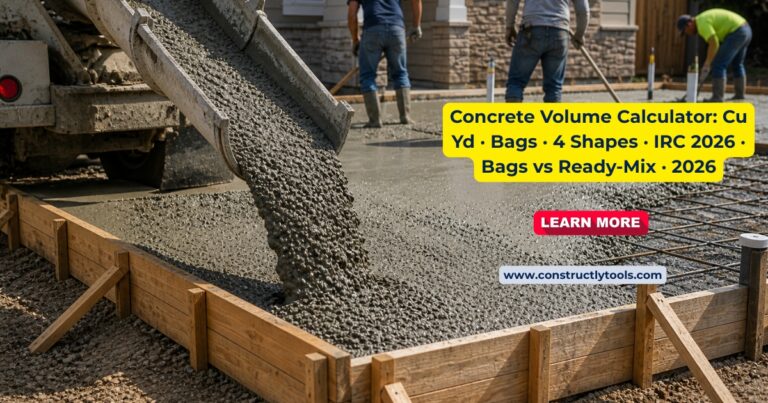
Use this free concrete volume calculator to quickly estimate the amount of concrete needed for your project. Enter dimensions like length, width, and depth to get accurate results in cubic yards or cubic feet, making it ideal for slabs, footings, foundations, and construction planning.
Reviewed by
Prakash·Published: March 29, 2026·Updated: May 3, 2026·Sources: IRC 2026 · HomeAdvisor · NRMCA
Volume (cu ft) = Length × Width × Thickness (ft) · Cu Yd = Cu Ft ÷ 27 · 60-lb bags ≈ Cu Yd × 45 · 80-lb bags ≈ Cu Yd × 34 · Per NRMCA: 1 cu yd concrete ≈ 3,900 lbs
Concrete Needed
—
Enter dimensions above
Cubic Feet
—
60-lb Bags
—
80-lb Bags
—
Pounds of Concrete
—
1 cu yd = 27 cu ft · 60-lb bag ≈ 0.45 cu ft · 80-lb bag ≈ 0.60 cu ft · Ready-mix more economical above ~1 cu yd · Always add 10% overage per NRMCA best practice · Never stop a pour mid-slab
How Does the Concrete Volume Calculator Work?
This calculator converts your project dimensions into cubic yards — the unit used for ready-mix ordering — and tells you how many 60-lb or 80-lb bags you need for smaller pours. It handles four common shapes: rectangular slabs and footings, round columns (using tube form diameter), walls, and stairs.
Unlike our full concrete material calculator which covers rebar, forming, and finishing, this tool focuses on a single question: how much concrete do I need? It outputs cubic yards for ready-mix delivery and bag counts for hand-mixed small jobs, with a built-in overage factor to prevent running short mid-pour.
💡 The #1 Concrete Ordering Mistake
Ordering exactly the calculated volume and running short mid-pour is the most common and costly concrete mistake. Once a pour begins, you cannot stop — the concrete already placed will begin to cure. If the truck runs dry, you’re stuck with a cold joint (a weak plane between old and new concrete) that may require demolition and replacement. Per NRMCA best practice, always order 10% more than your calculated volume. The extra cost of leftover concrete is nothing compared to a failed pour.
Bags vs Ready-Mix Concrete — Which to Use?
Volume
Best Option
Why
Cost Range (2026)
Under 0.5 cu yd
Bagged concrete
No minimum delivery; mix at your pace
$5–$8/60-lb bag
0.5–1 cu yd
Either
Bagged is flexible; ready-mix faster
Bags ~$200–$400; Mix ~$150–$250 + delivery
1–3 cu yd
Ready-mix
Short-load fee applies but worth it
$200–$600 + short-load fee
Over 3 cu yd
Ready-mix
Cost-effective, consistent, faster pour
$130–$170/cu yd (NRMCA 2026)
✓ Ready-Mix Minimum Loads & Short-Load Fees
Most ready-mix companies have a minimum load of 1–3 cubic yards per NRMCA industry data. If you order less than the minimum, you pay a short-load surcharge of $50–$150. For loads under 1 cubic yard, bagged concrete is almost always more economical once the short-load fee is factored in. For larger pours, ready-mix produces a more consistent mix and allows a faster, uninterrupted pour — critical for structural applications and hot-weather pours where concrete sets quickly.
Concrete Mix & Strength Guide
Mix / PSI
Common Bag Type
Best For
Min Thickness
2,500 PSI
Standard mix
Sidewalks, patios, non-structural slabs
4″
3,000 PSI
Quikrete 80-lb
Driveways, garage floors, footings
4″
4,000 PSI
High-strength mix
Structural slabs, heavy vehicle areas, columns
4″
5,000 PSI
Fiber-reinforced / commercial
Industrial floors, bridge decks, precast
4″
Fast-setting
Quikrete Fast-Setting
Post holes, fence posts — no mixing required
N/A
Self-leveling
Underlayment mix
Floor leveling overlays — poured thin
¼″–2″
⚠ Residential Minimums by Application (IRC 2026)
IRC 2026 requires 3,500 PSI for garage floors exposed to deicing salts and 2,500 PSI minimum for interior slabs. Driveways subject to freeze-thaw cycles should use 4,000 PSI with air entrainment. Always use at least #4 rebar on 18″ centers or welded wire mesh for any slab larger than 100 sq ft — concrete is strong in compression but weak in tension, and reinforcement prevents cracking from ground movement and thermal expansion per ACI 318 guidelines.
Example Calculations
Example 1 — Backyard Patio Slab (12×16 ft, 4 in)
Volume:
12 × 16 × (4÷12) = 12 × 16 × 0.333 = 64 cu ft
Cubic yards + 10% overage:
64 ÷ 27 = 2.37 cu yd × 1.10 = 2.6 cu yd → order 3 cu yd ready-mix
At $150/cu yd (NRMCA 2026 national average): ~$450 materials. 3 cu yd is within most ready-mix minimum loads.
Example 2 — Fence Post Footings (bags)
8 posts, 10″ diameter tube, 36 inches deep:
Volume per post = π × (5÷12)² × 3 = 3.14159 × 0.1736 × 3 = 1.636 cu ft
8 posts × 1.636 = 13.09 cu ft → 0.485 cu yd → use bags
At $150/cu yd: ~$1,800 materials. A 6″ garage floor should use 4,000 PSI per IRC 2026 — IRC requires 3,500 PSI minimum for any floor exposed to deicing salts.
Frequently Asked Questions
How many bags of concrete do I need for a 10×10 slab?+
A 10×10 ft slab at 4 inches thick requires 1.23 cubic yards (10 × 10 × 0.333 = 33.3 cu ft ÷ 27 = 1.23 cu yd). Add 10% overage = 1.35 cu yd. In 80-lb bags: 1.35 × 34 = 46 bags. In 60-lb bags: 1.35 × 45 = 61 bags. For a pour this size, ready-mix is worth considering — 46 bags of 80-lb concrete is significant physical labor, and ready-mix produces a more consistent mix than hand-mixed bags.
How many cubic yards are in a ready-mix truck?+
A standard ready-mix truck holds 8–10 cubic yards per NRMCA industry data (some newer trucks hold up to 11 yards). Most residential pours are 3–8 cubic yards, fitting in a single truck. For larger projects requiring more than one truck, coordinate deliveries so trucks arrive 15–20 minutes apart — you need time to place and consolidate the first load before the second arrives, but not so long that the first load begins to set.
How many 80-lb bags of concrete make a cubic yard?+
It takes approximately 45 bags of 80-lb concrete to make one cubic yard. Each 80-lb bag yields about 0.60 cubic feet of mixed concrete. Since 1 cubic yard = 27 cubic feet: 27 ÷ 0.60 = 45 bags. For 60-lb bags (0.45 cu ft each): 27 ÷ 0.45 = 60 bags per cubic yard. The calculator above computes both automatically.
How thick should a concrete slab be?+
Standard residential slab thickness per IRC 2026: 4 inches for patios, sidewalks, and non-load-bearing interior slabs; 5–6 inches for driveways and garage floors; 6–8 inches for heavy vehicle areas or structural slabs. Footings are typically 12 inches deep and twice as wide as the wall they support. Increasing thickness from 4″ to 6″ uses 50% more concrete but significantly increases load capacity.
How long does concrete take to cure?+
Concrete reaches approximately 70% of its design strength at 7 days and about 99% at 28 days (the ACI 318 standard curing period). For practical purposes: light foot traffic after 24–48 hours, full pedestrian use after 7 days, vehicle traffic after 28 days. Proper curing (keeping the surface moist for 7 days) is as important as the mix design — concrete that dries too fast can lose up to 50% of its potential strength. Cover fresh slabs with plastic sheeting or curing compound, especially in hot or windy conditions.
What is the difference between concrete and cement?+
Cement is an ingredient in concrete — specifically the binding agent (Portland cement) that reacts with water to harden. Concrete is the finished material: cement + sand + gravel (aggregate) + water. Bagged “concrete mix” already contains all three — you just add water. “Cement mix” or “mortar” contains only cement and sand without coarse aggregate, and is used for setting stone, brick, or as repair mortar — not for structural slabs or footings.
Related Construction Tools
All free calculators on ConstructlyTools — plan any project from start to finish.
Prakash is the founder and editor of ConstructlyTools. He researches, develops, and maintains construction calculators, material estimators, cost guides, and DIY planning resources designed to help homeowners, contractors, and builders make informed project decisions.
Every calculator and guide is researched using trusted industry references, published building standards, manufacturer specifications, and reliable construction pricing sources. Each page is reviewed for formula accuracy, pricing methodology, readability, and practical usefulness before publication and is updated regularly as standards or market prices change.
Formula Accuracy Verified
2026 Pricing Reviewed
Industry Sources Referenced
Updated Regularly
Last reviewed: May 3, 2026
Professional Highlights
Founder of ConstructlyTools
Develops Construction Calculators
Researches Cost Estimation Data
Reviews Building Code References
Updates Pricing Annually
Focused on DIY Homeowners & Professionals
Editorial Review Process
Every calculator and article published on ConstructlyTools is independently reviewed for formula accuracy, pricing methodology, readability, and practical usefulness before publication. Content is updated whenever construction pricing, industry standards, or building code references significantly change.