
Slope Grade Calculator
Use this free slope grade calculator to quickly determine slope percentage, angle, and ratio for your project. Enter values like rise and run to get accurate results, making it ideal for construction, landscaping, drainage planning, and road design.
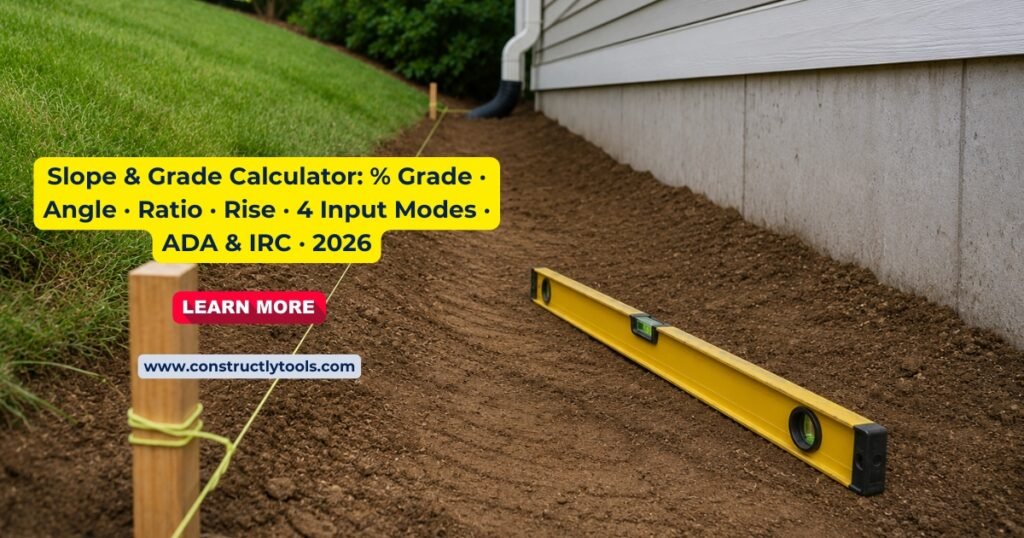
Grade % = rise ÷ run × 100 · A 2% grade rises 2 inches per 100 inches of horizontal run · Minimum drainage grade is typically 1–2% · ADA ramp max is 8.33%
How Does the Slope & Grade Calculator Work?
Slope and grade describe the same thing — how much a surface rises or falls over a horizontal distance — but expressed in different ways. This calculator converts between four common formats: percent grade, angle in degrees, rise/run ratio, and 1:X ratio notation. Enter any one format and get all others instantly.
Slope calculations are essential for drainage grading around foundations, driveway design, ramp construction, retaining wall planning, and site grading. Getting slope wrong causes water to pond against foundations, driveways to ice over dangerously, and ramps to fail accessibility requirements.
Percent grade is used in civil engineering, landscaping, road design, and site grading — because it directly tells you how many inches of rise per 100 inches of run, making drainage calculations intuitive. Degrees are used in roofing (pitch), surveying, and structural engineering. Ratio (1:X) is used in accessibility (ramps), drainage pipe design, and British civil engineering. Most construction applications use percent grade — it's the most practical unit for grading work.
Slope Reference Guide
Use this table to understand what common slope values mean in practice and where each is typically used.
| % Grade | Ratio | Angle | Description | Common Use |
|---|---|---|---|---|
| 0.5% | 1:200 | 0.29° | Very gentle — nearly flat | Minimum storm sewer slope, concrete floors |
| 1% | 1:100 | 0.57° | Gentle drainage slope | Minimum paved surface drainage, gutters |
| 2% | 1:50 | 1.15° | Standard drainage grade | Lawn grading away from foundations, patios |
| 5% | 1:20 | 2.86° | Moderate slope | Wheelchair ramp max (ADA), gentle driveway |
| 8.33% | 1:12 | 4.76° | ADA ramp maximum | Accessible ramp max — 1" rise per 12" run |
| 10% | 1:10 | 5.71° | Moderate-steep | Steep driveway, lawn transition |
| 15% | 1:6.7 | 8.53° | Steep | Upper limit for mowed lawns, most driveways |
| 20% | 1:5 | 11.3° | Very steep | Retaining wall territory — erosion risk |
| 33% | 1:3 | 18.4° | Extreme | Maximum cut slope for many soils without retaining |
| 100% | 1:1 | 45° | 45° — equal rise & run | Very steep — requires retaining wall or special engineering |
Drainage & Grading Standards
Proper grading is the most cost-effective water management strategy for any property. The goal is to direct surface water away from structures and toward appropriate drainage outlets — without creating erosion or ponding elsewhere on the lot.
| Application | Min Grade | Max Grade | Notes |
|---|---|---|---|
| Lawn away from foundation | 2% (2"/10 ft) | 10% | IRC requires 6" drop in first 10 ft from foundation |
| Concrete / paved patio | 1–2% | 5% | Slope away from house; 1/8" per ft minimum |
| Gravel driveway | 1% | 15% | Above 12% causes gravel washout in heavy rain |
| Asphalt / concrete driveway | 1% | 20% | Above 15% can be slippery in ice — ADA limit is 8.33% |
| ADA accessible ramp | — | 8.33% (1:12) | Max 30" rise before landing; cross-slope max 2% |
| Drainage swale / ditch | 0.5–1% | 5% | Below 0.5% causes standing water; above 5% causes erosion |
| Storm sewer / drain pipe | 0.5% | — | Minimum to prevent sediment deposit in pipe |
| Lawn for mowing | — | 15–20% | Above 20% most mowers can't operate safely |
The IRC building code requires the ground to slope away from a home's foundation at a minimum of 6 inches within the first 10 feet of horizontal distance — that's a 5% grade for the first 10 feet. This is the single most important grading requirement for preventing basement water infiltration. Use our landscaping cost calculator to estimate the cost of regrading your yard to meet this requirement.
Example Calculations
Example 1 — Lawn Grading Away from Foundation
Grade % = (6 ÷ 120) × 100 = 5% grade
Angle = arctan(6 ÷ 120) = arctan(0.05) = 2.86°
Ratio = 1 : (120 ÷ 6) = 1:20
Example 2 — Driveway Grade Check
Grade % = (4 ÷ 40) × 100 = 10% grade
Angle = arctan(4 ÷ 40) = 5.71°
Assessment: 10% is within the typical max of 15% for residential driveways but may be uncomfortable in ice/snow. Consider 8% maximum in cold climates.
Example 3 — ADA Ramp Check
ADA max grade = 8.33% = 1:12 ratio
Run = Rise × 12 = 18 × 12 = 216 inches (18 ft) minimum run
At 18" rise, a landing is required every 30" of rise — so one landing needed at 30" if rise exceeds that.
Example 4 — Converting Percent Grade to Inches per Foot
2% = 2/100 = 0.02 ft per ft = 0.02 × 12 = 0.24 inches per linear foot
Or: ¼ inch per foot — a common rule of thumb for patio and paved surface drainage.
Frequently Asked Questions
How We Calculate
Percent Grade from Rise & Run
Grade % = (Rise ÷ Run) × 100
Rise and run must be in the same unit (both feet, both inches, or both meters). Dividing rise by run gives the slope as a decimal; multiplying by 100 converts to percent. A 3-foot rise over 100 feet of run = 3 ÷ 100 × 100 = 3%. The same result: 3 inches over 100 inches of run = 3%.
Angle Conversion
Angle = arctan(Grade % ÷ 100) — in degrees
The calculator uses JavaScript’s Math.atan(pct/100) and converts radians to degrees (× 180/π). Reverse: entering an angle gives Grade % = tan(angle) × 100. Note that percent grade and angle are not linearly proportional — a 45% grade is 24.2°, not 45°; a 100% grade (1:1 ratio) = exactly 45°.
Ratio Conversion
Ratio (1:X) = 1 : (100 ÷ Grade %)
A 5% grade means the surface rises 1 unit for every 20 units of horizontal run: 100 ÷ 5 = 20, so the ratio is 1:20. ADA ramp maximum (8.33%) = 1 : (100 ÷ 8.33) = 1:12. When entering a ratio (1:X), the grade is computed as (1/X) × 100.
Rise over Distance
Rise over Distance = Distance × (Grade % ÷ 100)
This output tells you how much vertical elevation change occurs over the entered surface distance at the calculated grade. Useful for checking whether drainage meets code (e.g., 6 inches of drop over 10 feet) or estimating cut/fill volume for grading operations.
Slope Length
Slope Length = √(Run² + Rise²)
The actual distance along the sloped surface is the hypotenuse of the right triangle formed by the horizontal run and the vertical rise. For a 100-foot run at 5% grade (5-foot rise), slope length = √(10000 + 25) = 100.12 ft. At gentle grades the difference is small; at steeper grades it becomes significant for accurate material estimates.
- IRC 2026 (International Residential Code) — Section R401.3 Drainage — Requires the ground adjacent to a foundation to be graded to slope away at a minimum of 6 inches within the first 10 feet of horizontal distance (= 5% grade minimum for first 10 ft). This is the most widely cited residential grading requirement in the US and is the basis for the foundation grading row in the drainage standards table, the “6-Inch Rule” callout, and Example 1. International Code Council, 2026 edition.
- ADA Standards for Accessible Design — Section 4.8.2 Slope and Rise — Maximum slope for accessible ramps: 1:12 (8.33% grade). Maximum cross-slope: 1:50 (2%). Maximum rise per ramp segment before a landing is required: 30 inches. These requirements are referenced in the slope reference table (8.33% ADA ramp maximum row), drainage standards table (ADA ramp row), Example 3 (ramp run calculation), and the FAQ on 1:12 slope. US Department of Justice, ADA Standards for Accessible Design, current edition.
- AASHTO — A Policy on Geometric Design of Highways and Streets (Green Book) — Maximum and minimum grade standards for roadways and driveways referenced in the driveway grade guidance (15–20% municipal maximums, practical 10–12% cold-climate recommendation). AASHTO also provides the basis for drainage swale minimum grades (0.5–1%) and storm sewer minimum slope (0.5%) referenced in the drainage standards table. American Association of State Highway and Transportation Officials, current edition.
- ASLA / Landscape Architecture Standards — Site Grading & Drainage — Standard minimum grades for paved surfaces (1–2% for concrete and asphalt), lawn mowing limits (15–20% maximum), and the 2% = ¼ inch per foot rule of thumb for surface drainage referenced throughout the calculator and FAQ. These are standard landscape architecture and civil engineering site grading practices. American Society of Landscape Architects, standard practice guidance.
Grade requirements shown are from model codes and national standards — always verify with your local building department, which may adopt more stringent requirements. Driveway maximum grades vary significantly by municipality. ConstructlyTools does not have a paid relationship with any grading contractor or landscaping company mentioned on this page.
All free calculators on ConstructlyTools — plan any project from start to finish.

Prakash
Prakash is the founder and editor of ConstructlyTools. He researches, develops, and maintains construction calculators, material estimators, cost guides, and DIY planning resources designed to help homeowners, contractors, and builders make informed project decisions.
Every calculator and guide is researched using trusted industry references, published building standards, manufacturer specifications, and reliable construction pricing sources. Each page is reviewed for formula accuracy, pricing methodology, readability, and practical usefulness before publication and is updated regularly as standards or market prices change.
Every calculator and article published on ConstructlyTools is independently reviewed for formula accuracy, pricing methodology, readability, and practical usefulness before publication. Content is updated whenever construction pricing, industry standards, or building code references significantly change.
This page was researched, written, and reviewed in accordance with our Editorial Policy.