
Diameter to Circumference Calculator
Use this free diameter to circumference calculator to quickly find the circumference of a circle. Enter the diameter to get accurate results using the standard π formula, making it useful for geometry, construction, pipes, wheels, and engineering calculations.
π = 3.14159265 · Circumference = π × diameter · All outputs shown in the same unit as input · Use quantity for multiple pipes, posts, or columns
How Does the Diameter to Circumference Calculator Work?
Circumference is the distance around the outside of a circle — calculated as π × diameter (approximately 3.14159 × diameter). This calculator converts between diameter, radius, circumference, and area in any direction: enter what you have and get everything else instantly.
In construction, circumference is used for wrapping pipe insulation, calculating how much material wraps around a column, sizing pipe collars and flanges, cutting circular forms, and estimating fencing or edging for circular garden beds. The quantity multiplier makes it easy to total material for multiple pipes or posts in one step.
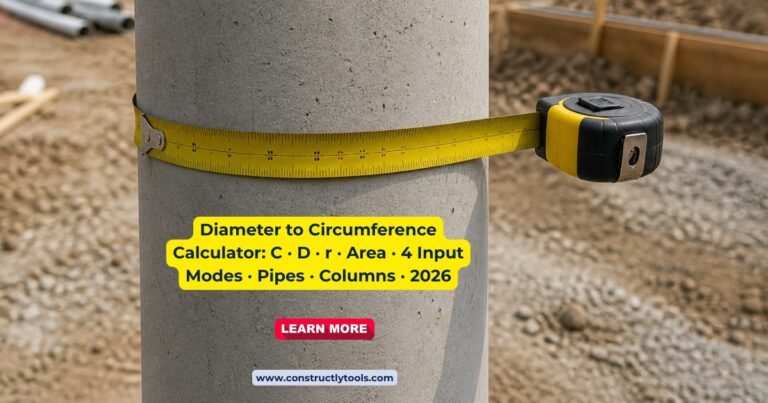
Sometimes you know the circumference (you wrapped a tape measure around a pipe or column) and need the diameter. Use the "Circumference" input mode and the calculator solves backwards: Diameter = Circumference ÷ π. This is the easiest way to measure the diameter of a large tree, an existing pipe, a round column, or any cylinder where measuring across the center isn't possible. Wrap a flexible tape around the object, note the reading, enter it here, and get the diameter instantly.
Common Pipe & Column Reference
Standard pipe and tube sizes use nominal dimensions — the actual outside diameter is often different from the nominal size. Use this table for quick reference, or enter the actual measured diameter above for a precise result.
| Description | Nominal Size | Actual OD | Circumference | Area |
|---|---|---|---|---|
| PVC pipe | ½" | 0.840" | 2.64" | 0.55 sq in |
| PVC pipe | 1" | 1.315" | 4.13" | 1.36 sq in |
| PVC pipe | 2" | 2.375" | 7.46" | 4.43 sq in |
| PVC pipe | 4" | 4.500" | 14.14" | 15.90 sq in |
| Steel pipe | 6" | 6.625" | 20.81" | 34.47 sq in |
| Concrete tube form | 10" | 10.0" | 31.42" | 78.54 sq in |
| Concrete tube form | 12" | 12.0" | 37.70" | 113.1 sq in |
| Round column | 16" | 16.0" | 50.27" | 201.1 sq in |
| Round column | 24" | 24.0" | 75.40" | 452.4 sq in |
| Large tree trunk | ~18" dia | ~18.0" | ~56.5" | ~254 sq in |
Construction Uses for Circumference
| Application | What You Need | How Circumference Helps |
|---|---|---|
| Pipe insulation | Wrap length per pipe | Circumference = width of insulation needed to wrap once around pipe |
| Column wrap / cladding | Sheet material width | Circumference tells you how wide a sheet must be to wrap a round column |
| Round garden bed edging | Linear feet of border | Circumference = total edging / border length needed |
| Tree ring mulch bed | Edge restraint length | Calculate outer and inner circle circumference to find edging for a ring |
| Curved forms / bending | Metal or wood bending radius | Circumference determines arc length when bending material around a form |
| Pipe collar / flashing | Metal collar diameter | Pipe OD circumference determines the opening needed in roof flashing |
| Round deck posts | Post wrap or sleeve size | Circumference of post × number of posts = total wrap material |
| Sprinkler coverage | Coverage arc length | Circumference of spray radius gives total arc distance at any given radius |
A standard flexible tape measure is the most accurate tool for measuring the circumference of round objects in the field — pipes, columns, posts, and trees. Wrap it snugly around the object and note the circumference reading, then enter it into this calculator's "Circumference" input mode to get the exact diameter. Never try to measure the diameter of a large pipe or column by eyeballing across — the tape-wrap method is always more accurate and takes seconds.
Example Calculations
Example 1 — Pipe Insulation for a 4" PVC Pipe
Circumference = π × 4.5 = 14.14 inches per wrap
For 20 linear feet of pipe with 1" foam insulation (adds ~2" to diameter):
Insulation OD = 4.5 + 2 = 6.5" → Circumference = π × 6.5 = 20.42" wide insulation needed
Example 2 — Circular Garden Bed Edging
Circumference = π × 8 = 25.13 linear feet of edging
Add 5% overlap/waste: 25.13 × 1.05 = 26.4 → buy 27 ft of edging
Example 3 — Working Backwards from Circumference
Diameter = 48 ÷ π = 15.28 inches
Radius = 15.28 ÷ 2 = 7.64 inches
Area = π × 7.64² = 183.5 sq inches = 1.27 sq ft
Example 4 — Total Wrap for 6 Round Deck Posts
Circumference per post = π × 6 = 18.85 inches
Wrap material per post (8 ft = 96 in tall): area = 18.85 × 96 = 1,810 sq in = 12.57 sq ft
For 6 posts: 12.57 × 6 = 75.4 sq ft total wrap material
Frequently Asked Questions
How We Calculate
From Diameter
Circumference = π × Diameter · Radius = Diameter ÷ 2 · Area = π × (Diameter ÷ 2)²
This is the most common input mode. π (pi) is the mathematical constant equal to the ratio of any circle’s circumference to its diameter — approximately 3.14159265. It is an irrational number that never terminates or repeats. The calculator uses JavaScript’s built-in Math.PI value (15+ significant digits) for maximum precision.
From Radius
Circumference = 2 × π × Radius · Diameter = Radius × 2 · Area = π × Radius²
Radius is half the diameter. Multiplying by 2π instead of π gives the same result as entering the diameter — these are algebraically identical.
From Circumference (Reverse Calculation)
Diameter = Circumference ÷ π · Radius = Circumference ÷ (2 × π)
This is the most practical mode for field measurement. Wrapping a flexible tape measure around any round object gives the circumference directly. Dividing by π produces the diameter. This is always more accurate than trying to measure diameter directly across a large pipe, column, or tree trunk.
From Area
Radius = √(Area ÷ π) · Diameter = 2 × Radius · Circumference = π × Diameter
Given the circle area (in square units), the calculator takes the square root of (area ÷ π) to recover the radius, then derives diameter and circumference. Useful when you know the cross-sectional area of a pipe or column from a datasheet and need the diameter or circumference.
Unit Conversion
All calculations are performed in the selected input unit and all outputs are returned in the same unit. No cross-unit conversion occurs — if you enter inches, all outputs (circumference, diameter, radius) are in inches, and area is in square inches. To convert between unit systems, change the unit selector and re-enter the value.
Quantity Multiplier
The “Total (× Qty)” stat multiplies the circumference by the quantity entered. This gives the total linear material needed to wrap all items once — for example, 6 pipes of circumference 14.14" each = 84.84" total wrap material. It does not account for overlap or seam allowance — add 5–10% for those in your material order.
- Euclidean Geometry — Definition of π and Circle Formulas — Circumference = π × Diameter and Area = π × r² are fundamental definitions from Euclidean geometry. π is the mathematical constant equal to the ratio of a circle’s circumference to its diameter (approximately 3.14159265358979...). These formulas are used for all calculations in this calculator. The calculator uses JavaScript’s
Math.PIconstant (IEEE 754 double precision, 15+ significant digits) for maximum accuracy. Euclidean geometry, classical mathematics. - ASME B36.10M / B36.19M — Welded and Seamless Wrought Steel Pipe Dimensions — Nominal pipe size (NPS) system and actual outside diameter (OD) values for steel pipe referenced in the pipe and column reference table. The nominal pipe size convention (e.g., “4-inch pipe” has an actual OD of 4.500″) is the ASME/ANSI standard used throughout the US piping industry. PVC pipe dimensions follow the same NPS OD schedule per ASTM D1785. ASME B36.10M, current edition; ASTM D1785, current edition.
- ASTM D1785 — PVC Plastic Pipe, Schedules 40, 80, and 120 — PVC pipe outside diameter values used in the pipe reference table (½″ nominal OD = 0.840″, 1″ = 1.315″, 2″ = 2.375″, 4″ = 4.500″). These are the industry-standard OD values for Schedule 40 PVC pipe used in US residential and commercial plumbing. ASTM International, ASTM D1785, current edition.
- Field Measurement Best Practice — Tape-Wrap Method for Round Objects — The technique of wrapping a flexible tape measure around a round object to measure circumference (then dividing by π to find diameter) is standard field surveying and arborist practice for measuring large-diameter objects including trees (DBH — diameter at breast height), pipes, and columns where direct diameter measurement is impractical. Referenced for the “working backwards” callout, Example 3, and the FAQ answer on finding diameter from circumference. Standard field measurement practice.
Pipe OD values in the reference table are for Schedule 40 PVC and standard wall steel pipe. Other schedules and materials may have different ODs — always verify OD from the pipe manufacturer’s data sheet for precision work. ConstructlyTools does not have a paid relationship with any pipe manufacturer, insulation supplier, or contractor mentioned on this page.
All free calculators on ConstructlyTools — plan any project from start to finish.

Prakash
Prakash is the founder and editor of ConstructlyTools. He researches, develops, and maintains construction calculators, material estimators, cost guides, and DIY planning resources designed to help homeowners, contractors, and builders make informed project decisions.
Every calculator and guide is researched using trusted industry references, published building standards, manufacturer specifications, and reliable construction pricing sources. Each page is reviewed for formula accuracy, pricing methodology, readability, and practical usefulness before publication and is updated regularly as standards or market prices change.
Every calculator and article published on ConstructlyTools is independently reviewed for formula accuracy, pricing methodology, readability, and practical usefulness before publication. Content is updated whenever construction pricing, industry standards, or building code references significantly change.
This page was researched, written, and reviewed in accordance with our Editorial Policy.